Search engines are evolving with AI becoming a BIG part of the mix, and together they’re changing how people find and trust brands online.
To rank you in SERPs and mention you in AI overviews, they’re looking at a wider set of signals like what credible sources say about your brand, how often you’re mentioned, and where you show up across the web (and not just your own site).
This is where Digital PR makes a difference.
It helps your brand get featured in respected news outlets, expert roundups, and niche publications, creating a network of trust signals that both search and AI systems rely on to verify your authority and decide if you get seen.
And in a world where visibility is everything, this has never been more important.
AI Overviews Reward Authority, And Digital PR Builds It
Google search is changing FAST, and we can barely keep up. Semrush recently published (05 May, 2025) a study analyzing more than 10M keywords to find out how many searches are triggering AI Overviews, and it came out to be 13% of all queries. This is a number that has jumped from 6% since the start of 2025. And it’s reshaping how people interact with search results.
Instead of showing the usual blue links, Google is now giving a single AI-curated answer, usually citing just 1 link from the top-10 ranking sites. This is putting a lot of pressure on brands to earn one of those top-10 slots to get seen.
So to get there, you have to be cited in trusted, well-reputed domains, which is where Digital PR comes in. It builds the type of authority signals that both algorithms and AI models pay attention to, like authoritative backlinks, expert mentions, and a steady presence in respected media outlets.
And it’s not all about just “backlink building”.
The best PR campaigns get your story out there across multiple credible sources and create a consistent footprint that LLMs (like Google’s AI or ChatGPT) pick up on. These models need to “see” your brand repeatedly associated with a topic, service, or expertise before they learn to trust and reference it. And strong PR does exactly that. It trains the search engines and LLMs to understand and spread the word about your brand.
Traditional PR Is Fading while Digital PR Meets Today’s Audience
The audience, and its trust, has moved online
73% of global ad budgets are now spent on digital channels, and it makes sense. Because that’s where people are actively researching, reading, and forming opinions about brands. Traditional PR, the kind that relied on newspaper spreads or TV mentions, can’t keep up with the way trust is built today. Now, conversations on the web, recommendations made in niche industry blogs, podcasts, and expert round-ups shape purchasing decisions.
Think about it.
When your brand is quoted or featured on a credible site, you’re essentially borrowing that publication’s authority. Your reader doesn’t think, “This brand says it’s great,” they think, “If this trusted outlet thinks they’re worth mentioning, there must be something to it.” This is the foundation of social proof, credibility that is validated by someone other than you, and it’s something an ad can never replicate because everyone knows an ad is paid for.
Digital PR speaks Google’s language
Google and AI models are built to detect these same trust signals – links and mentions from reputable voices – which Digital PR brings you. So, when they see you being cited by credible websites, they take it as proof that your content, product, or expertise is worth surfacing.
And now with Google’s AI Overviews now pulling heavily from authoritative top-10 results, these earned mentions not only help you with rankings, which results in more search visibility, but they ALSO help add your brand into the very pool of sources that AI will reference when answering a user’s query.
It works whether you’re local or global
For a local business, say, a wellness clinic, getting featured in a community blog or local news site would send powerful trust signals.
Google’s algorithms will see these mentions as proof that you’re real and relevant to a specific geographic audience. That’s why “near me” queries often highlight local businesses that have earned third-party mentions in credible local sources rather than just the ones with a Google Business Profile.
Similarly, for a SaaS company or a B2B brand, the playing field is different, but the principle is the same.
Earning links and mentions from industry review sites, marketing blogs, or tech publications positions you as THE expert in your field. And so when a prospect sees your company mentioned in an expert roundup on a site like G2, TechCrunch, or niche marketing publications, the credibility of those outlets transfers to you, helping convert that attention into real business opportunities.
Digital PR Provides an SEO Edge
Search rankings are still built on authority, and backlinks remain one of the strongest signals Google uses to measure it. What has changed is HOW you earn those links.
Gone are the days of you and us buying links or trading them through outdated tactics -that no longer moves the needle, Google’s algorithm has grown far too sophisticated for that. (In fact, Google heavily penalizes doing that)
But Digital PR earns links the right way – from credible media outlets, expert platforms, and niche publications that algorithms naturally trust.
Backlinks still matter, and PR delivers them at scale
The data speaks volumes.
About 21% of PR-earned backlinks come from high-DR (Domain Rating 70–79) sites, and 17% come from major news outlets – these are the kind of links that hold real SEO value and longevity. And nearly 49% of these links are dofollow, which means they pass direct SEO effect to your site, which can help boost your authority and rankings. All of this is nowhere near comparable to the traditional link-building campaigns, which often chase low-DR placements or links from irrelevant blogs.
Google and Journalists want the same thing
Google’s ranking systems prioritize high-quality content that is original, authoritative, and valuable. And journalists want the exact same thing. They’re always on the lookout for stories backed by data, expert commentary, and unique insights that stand out in a crowded news cycle.
Some examples of such content are:
- Original research or surveys (e.g., “We surveyed 1,000 small business owners to uncover the top marketing challenges of 2025”),
- Timely expert commentary that plugs into trending conversations,
- Or visual assets like charts, infographics, or mini reports that make a story easy to share.
The numbers back this up as 95% of successful digital PR campaigns include expert commentary. Also, journalists are 68% more likely to open and engage with a pitch if it contains original data or a fresh insight.
This overlap between what journalists want and what Google rewards creates a perfect visibility boosting blend for your brand – The same content that earns you media coverage ALSO gives Google a reason to rank you higher. WIN-WIN!
Rankings climb faster with PR
Ahrefs shared a very humbling fact in 2023, their analysis of 14 billion webpages revealed that nearly 96.55% of all pages get zero organic traffic, because they lack the signals of trust and authority needed to push them into the top results.
Digital PR fixes this too.
When Google sees your site being repeatedly cited across high-authority domains, it starts to treat your site as a reliable source. That rising trust translates into better rankings, more impressions, and higher click-throughs.
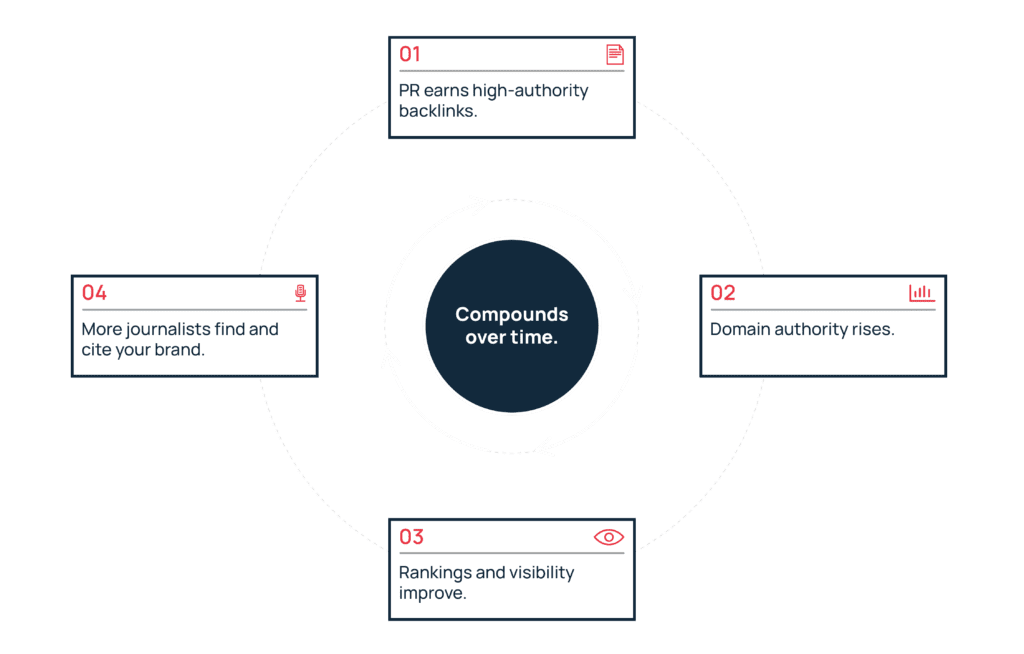
Even better, PR creates a virtuous loop because higher rankings bring more visibility, which drives more traffic and engagement. This additional attention can lead to even more backlinks, either from people naturally referencing your content or from journalists who find your site while researching stories. And over time, this cycle compounds, making your rankings more sustainable compared to the fleeting gains of traditional link-building.
AI and PR Tools have made execution faster, and easier to scale
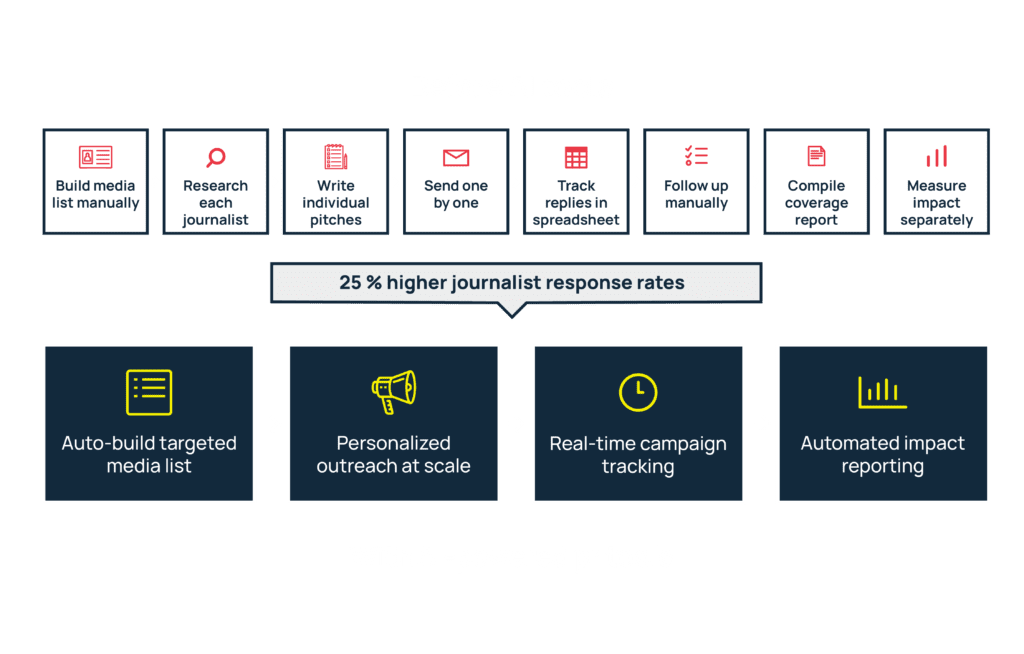
Back in the day, running a digital PR campaign used to mean spending days manually building media lists, crafting generic pitches, and hoping for replies. But now AI-powered tools have taken much of that friction out of the process and save you heaps of time ALL while making your campaign way more focused and targeted.
More effective and targeted outreach
Platforms like PressRanger can automatically build precise media lists by analyzing journalists’ recent work, preferred topics, and publishing patterns. They even personalize outreach at scale, and adjust the tone and context to match each journalist’s style. And its already outperforming the manual/generic outreach. We’ve foud some early data showing that this kind of AI-powered personalization is raising journalist response rates by up to 25%, which is significant when every pitch matters.
Better campaign management
Tools like Meltwater handle everything end-to-end: outreach, tracking, and measurement. And top of that, they even integrate with SEO platforms like Ahrefs or SEMrush. For PR teams, this makes monitoring SEO impact like backlink quality, traffic increases, and keyword movement so much more seamless, as they don’t have to deal with separate manual reports.
Feedback-based refinements
Modern PR dashboards highlight WHY some content performs better than others.
If one pitch resonates and another doesn’t, these AI-powered tools can flag the difference, which is helping teams tweak and repitch content in real time. This kind of iterative optimization can generate 3× more links per campaign compared to the old, “one-and-done” approach.
And the result is that the PR campaigns that once used to take weeks to plan and execute can now run WAY faster, reach broader audiences, and deliver measurable outcomes, all without burning out your team.
Digital PR costs less with ROI compounding over time
Links that cost less, and do more
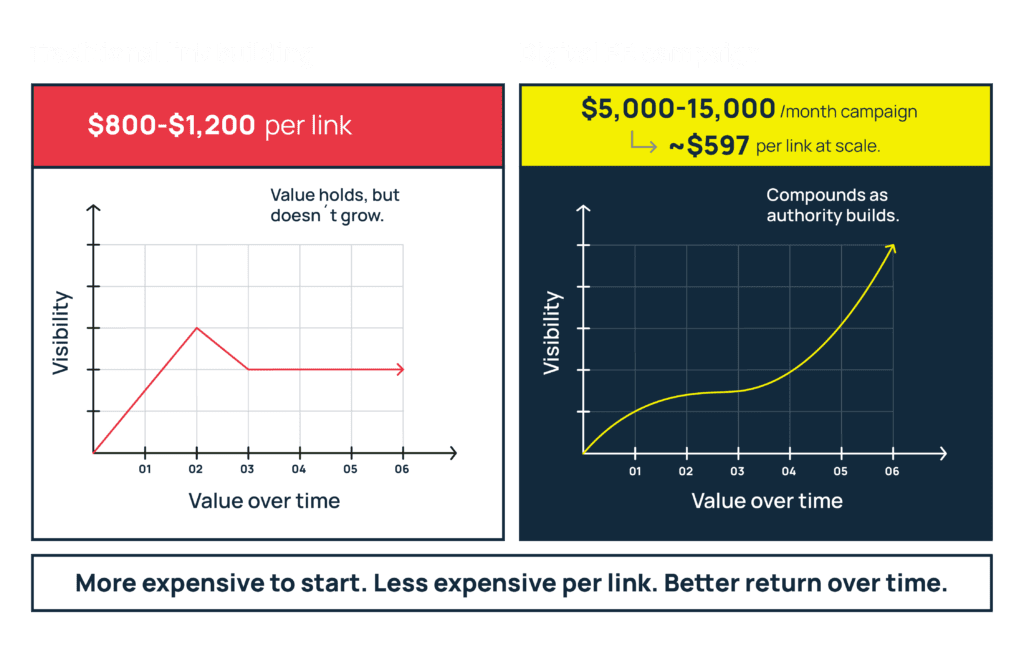
The math alone makes a strong case for digital PR. Because, when you look at it like this – buying a single backlink from a high-authority site can easily cost $500 to $1,250, depending on your niche. And even then, that link often feels isolated, one URL on one site, with limited long-term impact.
Now compare that to a well-executed PR campaign where by combining great content with smart outreach, you can land as many as 50+ high-quality backlinks for $5,000-$10,000 (again, that cost varies depending on factors like your niche/DA rating). That works out to about $100 – $200 per link on average, and these aren’t random placements.
And because these are links coming from trusted publications and industry-relevant sites, they send a much stronger confidence signals to both search engines and AI models.
You can track impact across the funnel
With PR analytics tools like PressRanger you can track the impact across every stage of your marketing funnel. You can see:
- Where your brand is being mentioned.
- How your domain authority (DA/DR) improves.
- Spikes in referral traffic from media coverage.
- Keyword ranking shifts in SERPs.
- Even lead conversions or trial signups directly tied to earned media.
This makes digital PR much easier to justify because you can show both immediate and long-term ROI.
Compound domain authority
When your brand is cited on authoritative sites, on top of pushing your higher up the SERP ranks, it builds topical trust – the kind that makes future content rank faster and cheaper. Because as your domain authority grows, your cost per acquisition (CPA) starts to drop because organic traffic (and even AI visibility) flows more naturally.
3 Common Misconceptions about Digital PR
“It’s only for big companies.”
- Not true because smaller, niche brands often get faster traction because they bring fresh perspectives and tighter targeting.
- A local DTC skincare brand or bootstrapped SaaS tool can stand out with a unique story just as well
“It’s too expensive.”
- While traditional PR retainers can still cost thousands monthly, modern Digital PR campaigns can start small.
“You can’t measure it.”
- Outdated. With the right stack, you can measure backlinks, traffic, keyword rank changes, engagement, and even revenue influenced.
Considerações finais
We’re at a turning point in search. With AI Overviews and generative engines reshaping how answers are delivered, visibility is shifting away from a simple list of organic links to curated, AI-powered recommendations. This is more than just a tweak to how we once did SEO – it’s a complete rethinking of what “authority” means online.
AI doesn’t just look at who has the most links or the most optimized content. It looks for patterns of trust – the brands being talked about, referenced, and validated across multiple credible sources. That’s exactly what Digital PR delivers – a lot of quality backlink yes, but more importantly, creating a rich, distributed presence that algorithms and AI models can learn from.
The brands investing in this now are laying the groundwork for how visibility will work in the years ahead.