You’ve built software that genuinely fixes a problem other companies struggle with. The product works, and you know it has potential to be a go-to solution… eventually.
To get there, you need to know exactly which companies to sell to. One way to get there is an Ideal Customer Profile, or ICP, which tells you which businesses are the most likely to become your customers.
Every guide on building one tells you the same thing: look at your existing customers. Since you barely have any, you wait for more. And while you’re waiting, campaign ideas never launch, feature requests are impossible to sort, and you worry about investors digging too much into the “target market” section of your pitch deck.
The good news is you don’t need customers to build an ICP. This article shows you how to build one from evidence that already exists in public, whether you have a handful of customers or more.
By the end, you will have a defensible ICP based on real market signals, ready to guide decisions now and to update as customers arrive.
If you already have customers to learn from, Part 2 picks up from there; read How to build your ICP from the customers you have.
TL;DR
How to build an ICP without customers:
- Work out the three problems your product actually solves for a business
- Describe the companies most likely to have those problems, in enough detail that you could name ten of them
- Read what those companies say about the problem on review sites and in forums
- Use search data to check that the problem is real and to see what buyers compare before they buy
- Let AI group what you found, then decide yourself what matters
- Write it down as five lines and label it Version 1
- List the companies you are not selling to, so the profile stays narrow
- Open it before every decision about outreach, content, pricing, or the roadmap
You Are Losing Money Every Week Without an ICP
Running out of money kills companies, and not knowing who you are building for can be a huge contributing factor. CB Insights looked at 431 companies that shut down and found running out of money at the top of the list, with poor product-market fit close behind at 43%.
When you sell to everyone, weak-fit customers have too many possible causes to learn from, so you have a hard time improving your product, sales process or marketing materials.
On the other hand, narrowing in on the wrong companies wastes money by trying to sell your product to people who don’t need it or aren’t ready to buy.
The ICP is what gets you to the middle spot where you have narrowed enough to identify your best customers.
Your first profile does not need to be 100% right to be usable; it needs to be defensible and specific enough that your next campaign teaches you something. Continually monitor your results and incorporate them to correct whatever it gets wrong.
Your ICP also stays at the company level, which is what separates it from a buyer persona. With no customers, anything you write about a specific person is invented, and therefore not very useful. But what a company is going through often leaves public traces.
Your ICP Starts With the Problem You Fix
Before you can pick which companies to sell to, you need to be clear about what your product actually fixes for them. Clayton Christensen called this Jobs to Be Done, and the idea is that companies pay for software to get something done that they cannot manage on their own.
What they are trying to get done drives the purchase, and you cannot always see it from the outside: Two fintechs of the same size can look identical on paper, but one just failed an audit and needs compliance reporting fixed by next quarter, while the other has a process that works fine and no reason to change it.
Most founders and early-stage companies describe what they built as a first step of finding their market, but their buyers are thinking about something else entirely:
| What you built | What they are trying to finish |
| Automated reporting dashboard | Get leadership accurate numbers without chasing six teams for updates |
| AI note-taking | Keep customer context from disappearing between the sales call and the handoff |
| Compliance monitoring | Pass the audit without pulling three people off their actual work |
| Workflow automation | Stop paying a full-time person to move data between two systems |
Whatever goes in that right-hand column usually comes down to one of these:
- Reducing risk
- Saving time
- Improving visibility
- Shortening sales cycles
- Removing manual work
If the solution your product offers does not explicitly connect to money, time, or work that has to get done, you will have a hard time figuring out which companies could be customers, because you won’t be able to see the value you would provide for them.
So tying that value to a real business problem is where your ICP starts. Open Singularity’s ICP worksheet, go to the Core Problem section, and work through three steps:
- List everything your product does. All of it, features included.
- Cut it down to your three best offerings. Keep only what your product genuinely fixes, each in one sentence.
- Check what you cut. Ask whether a company would buy your product for that reason alone. If the answer is no, it belongs on the cut list, because it might help you keep a customer, but it will never win you one.
The companies that need those three things done are your ICP. With the problems your software solves written down, you are ready for the next question: which kinds of companies feel that pain most often, and most intensely?
Stack Three Attributes to Narrow Your ICP
You know what your product fixes, so the next question is which companies feel that problem badly enough to pay you to fix it.
The answer will feel uncomfortably narrow by the time you are done; that is intentional. Lenny Rachitsky advises that early ICPs should be “super-specific and super-narrow,” almost to the point of seeming ridiculous.
The reason is that a description like “mid-sized software companies” covers so many businesses that you cannot do anything with it. You cannot write an email to it, build a list from it, or tell whether your last campaign reached the right people.
You get there by adding one detail at a time. “B2B SaaS” covers tens of thousands of companies. Add “50 to 200 employees,” and you cut most of them out. Add “handling compliance work,” and you are left with companies you could sit down and name.
These are the attributes worth using, since each one changes how hard the problem hits:
- Company size: e.g. 1,000 to 5,000 employees
- The problem they have: e.g., compliance, internal transparency
- How they work: e.g., design-driven, operationally heavy
- Tech in use: e.g., a data warehouse, GitLab
- Type of business: e.g., B2B SaaS, e-commerce
- Price point: e.g. sells software at $10k ARR
- Geography: e.g. urban centers, LatAm
- Where employees spend time: e.g. the Node.js community
Pick three or more and write them into your ICP first draft as a single sentence, something like:
“B2B SaaS companies between 50 and 200 people, selling at $10k ARR or above, running a modern data stack and dealing with compliance work.”
Then check whether that sentence describes companies that actually exist. Open LinkedIn or Crunchbase and give yourself twenty minutes to find ten businesses matching every part of it.
What happens in those twenty minutes tells you where you stand:
- You find ten quickly. The description works, and you now have your first list of real companies to research.
- You find none. One of your attributes is wrong, or you have combined details that rarely appear in the same company. Loosen the one you are least sure about and try again.
- You find hundreds. The description is still too broad to act on, so add a fourth attribute and repeat.
Finding ten companies proves your description points at something real. Now you need to understand what these companies care about, and the fastest way to do that is reading reviews of the tools companies like them already use.
Validate Your ICP With What Companies Say in Public
Now that you have your longlist, it’s time to refine and validate with real customer stories. They just might not be stories from your customers.
Start with review sites for the products in your category that your potential buyers already use. They are full of people explaining what they hoped a tool would fix, what annoyed them enough to write about it, and what finally made them switch.
Two kinds of sources, and you want both:
- G2, Capterra, TrustRadius, app store listings. The polished version, written for an audience.
- Reddit, Slack groups, LinkedIn comments, niche forums. The workaround somebody hates, the tools they are stuck with, and the moment the problem got bad enough to ask strangers for help.
Keep an eye out for overall patterns and don’t be swayed by one angry post. Look for the same pain, described in similar words, triggered by similar events, and showing up across several sources.
Picking which competitors to investigate is simpler than it sounds: Same category, roughly the same product, selling to a similar buyer. You are not sizing up the competition here; you’re just borrowing the evidence their customers left behind.
Keep a running note as you read. Four things go in it:
- Their exact words. Copy the phrasing verbatim rather than tidying it up, because this becomes the language you write with later.
- The tools they already run. Whatever they mention is used alongside the problem.
- Who deals with it. The team or department that handles the problem day to day.
- What changed right before the complaint? A new hire, a compliance deadline, a migration, a jump in volume?
That last one matters most. Knowing a company has 200 employees tells you nothing about whether they are ready to buy today, while knowing they just failed an audit tells you exactly that.
Now fill in three more lines of your ICP: the core problem in their words, what makes it urgent, and the tools they already run. Everything you write should be traceable to something someone actually said.
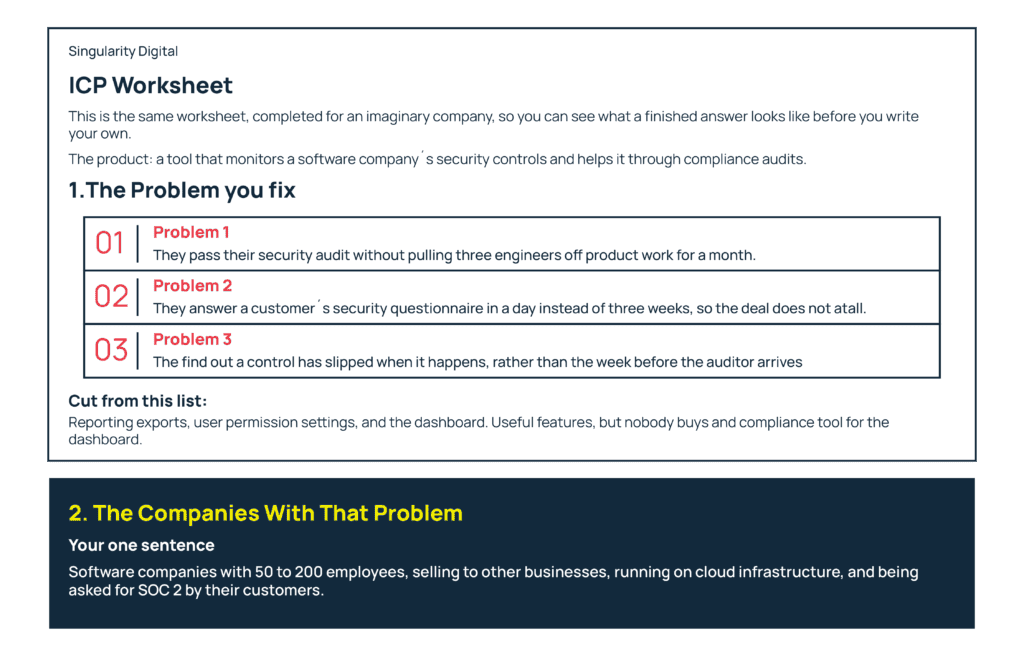
This should leave you with a clear understanding of the problems your company solves, how they affect real companies, and how real people talk about them. This sets you up for the next step: checking whether the problem shows up in search.
Check Your ICP Demand With Search Data
Search data shows you how many people are looking for something and the words they use when they look. It is a quick way to find out whether the ICP you have been building describes a real market or just a few loud voices.
Two search research exercises help settle this question. The first tells you whether people are looking for a fix at all, and the second shows you what they weigh once they start comparing options.
1) Keyword research: the demand test
Take the exact phrases you copied from reviews and forums and run them through a keyword tool. You are not planning content or chasing traffic here, only asking whether people outside your own head are looking for this.
Three things to read in the results:
- Volume: How often the problem comes up. You are not looking for huge numbers, only enough to show the problem exists beyond the posts you found.
- Wording: How the market names the problem, which is often not how you name it. If the phrases you copied from reviews return nothing but a different term does, update your ICP to match. Take note of any similar terms, searches, and suggestions the keyword tool throws up, since those are often where the useful phrasing hides.
- Modifiers: Words like software, tool, platform, best, or compare attached to the search. Those tell you someone has moved from living with the problem to shopping for a fix.
If almost nothing comes back, do not throw the idea away yet. Weak search results usually say more about your ICP than your product, since you may have picked the wrong companies or searched using your words instead of theirs.
Search volume also only shows you Google. A problem people handle by asking colleagues or posting in a Slack group can be real and expensive, yet barely register in a keyword tool.
Weak results mean something needs checking before you spend money. Better to find that out now, when the fix takes an afternoon.
2) Query fan-out: the dimension test
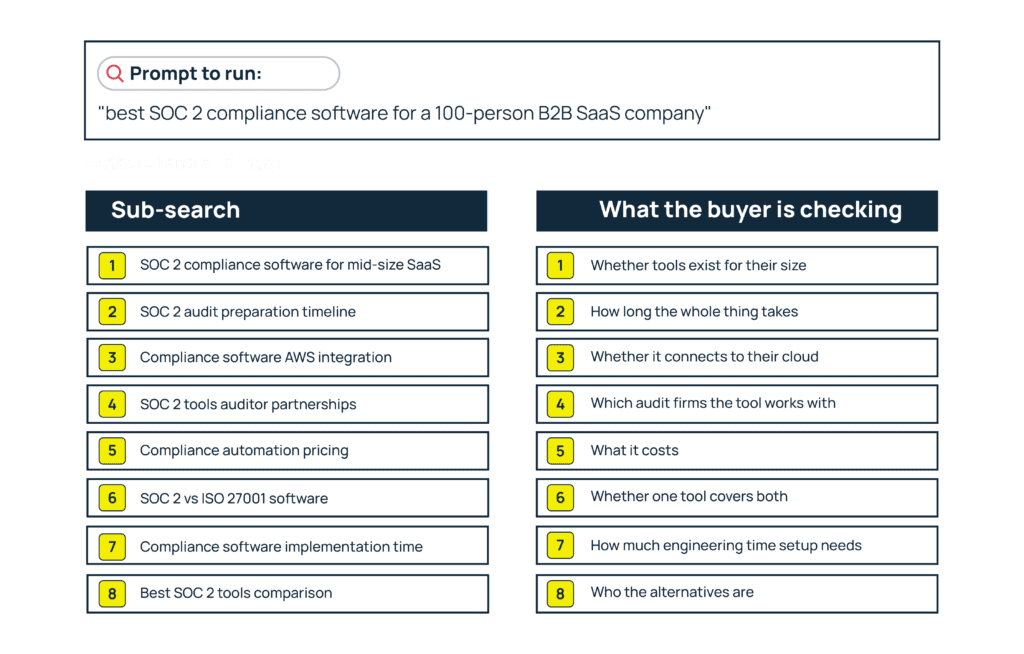
When someone asks an AI tool a question, the model quietly breaks it into several smaller searches before writing an answer. That breakdown is called query fan-out.
Take a prompt like “best CRM for early-stage SaaS with automation and Slack integration.” Behind the scenes, that one question becomes searches for:
- CRMs built for early-stage SaaS
- CRM automation features
- CRM Slack integration
- CRM pricing tiers
- CRM comparisons and alternatives
Each of those searches is part of the buyer’s decision, even though they asked only one question and never saw the searches happening.
This is not a second demand check. Most of those searches have no volume, since they are far more specific than anything a person would type; what they show you is what buyers care about once they start comparing tools.
Run your core problem through Singularity’s free fan-out tool and read what comes back. Look for themes rather than exact wording, since the queries shift each time you do a new one.
Say fan-out keeps returning questions about how long setup takes. This indicates exactly what they care about and what they need to know before they buy. It’s the exact type of detail your ICP can help you find to improve things like web copy down the line.
Cross-Check Your ICP Evidence
You now have three sets of notes: the complaints you read, the search phrases people use, and the questions fan-out surfaced. Put them side by side and look for the same problem described three times.
Where the words match across all three, you have found something the market genuinely cares about. That is what goes into your ICP.
Where they disagree, look at what is missing. If people complain in forums but nobody searches for it, the problem may be annoying rather than expensive. If fan-out surfaces pricing and integration questions that never came up in reviews, you haven’t found all the places those companies talk.
Either way, you learned it before spending money on it.
Turn Your Notes Into a First Draft With AI
You now have reviews, forum threads, the search phrases people use, and the questions that came out of query fan-outs. That is a lot of unsorted text, and AI helps because it can group hundreds of separate complaints and tell you which ones describe the same underlying problem.
For sorting:
1. Put everything in one document. Paste every complaint, review, and thread exactly as written, with the link beside it. Resist tidying the language, because the wording is the part you came for.
2. Feed AI in batches. Accuracy drops as the input grows, and smaller batches make it easier to check the output against the source.
3. Ask AI to group by problem, not by wording. “Onboarding takes forever,” “setup was painful,” and “we needed an engineer just to get started” are the same complaints in three voices. You want groups you can count.
4. Give it fields to fill for each group. Likely company type, the problem in the market’s own words, which team hits it, what set it off, tools already in use, and objections that came up. Ask for the quote that supports every field.
5. Make it flag its own guesses. Label anything it worked out rather than found in your notes. Models fill gaps convincingly, and you need to see where.
6. Delete anything thin. Any field resting on one source or on a guess comes out.
Once you have your raw output, double-check it, fill in details, and make judgment calls on what is truly important. AI cannot decide which of those groups matters to your business, or notice when it has invented a detail to fill a gap; that part stays with you.
What survives is your ICP draft; now, let’s write it down properly.
Lock In Version One of your ICP ASAP
Everything you have gathered needs to end up in one short ICP document that other people can read and understand. People across your company should be able to find and use this, not have it live only in your head or assigned to one team.
You already have most of the information you need, so this is the assembly into the start of your draft ICP:
- Type of company and size range, from the attributes you stacked
- Core problem, in the words you copied from reviews and threads
- What makes it urgent, from what changed right before people complained
- Tools they already run, from what came up alongside the problem
- Which part of the business runs into it, based on who was complaining
Five lines, one page. If an attribute does not help you decide to prioritize an account or ignore it, cut it.
This version is not supposed to be the full picture yet. But it should be enough to act on as long as every line traces back to something real: a pattern across reviews, a Reddit thread, a competitor comparison, a complaint that kept repeating, a search phrase that came up more than once.
Write “Version 1” at the top. Everyone, including founders, gets attached to assumptions once they are written down, and the label makes updating your ICP feel normal instead of like admitting a mistake.
Write Down Who You Will Not Sell To
An anti-ICP is the second half of the same document: a written list of the company types you have decided not to sell to right now. It exists so you stop spending weeks chasing accounts that were never going to close.
Start by using the same longlist you began with. Go back through the attributes you considered and mark the company types that fail for one of three reasons:
- They do not need your three core functions. If the problem you’re solving exists for them, it doesn’t cost them enough or cause enough friction for them to seek a solution.
- They cannot act when the trigger appears. No budget for tools in this category, a procurement process that takes longer than your sales cycle, or a structure that makes changing systems too disruptive to attempt.
- They already solved it another way. A workaround they trust, an internal build, or a competitor they are locked into.
Be specific enough that the list still makes sense to you in three months, or to the first person you hire. “Small companies” is not an exclusion, while “companies under 20 people, because the problem does not cost them enough to justify a tool” is.
Writing this down protects the ICP you just built, because the pressure to abandon it comes gradually.
A company outside your ICP asks for a demo. You have nothing else booked that week, so you take it. The call goes well, so you soften some of your sales materials to suit them, and eventually you are trying to reach two different markets at once, without checking whether that is the right strategy.
Your ICP Belongs in Every Decision You Make
Your ICP exists to keep you focused on the opportunities that really matter for your business, and it only works if you open it when decisions are on the table.
Right now that means you – the founder, first marketer, whatever role you have that necessitated making your company’s first ICP. Later it means the first salespeople you hire, the freelancer writing your landing page, and whoever ends up owning the roadmap. They all work from the same file.
Here are some processes where your ICP is useful:
- Outbound targeting and list building
- Go-to-market planning
- SEO and GEO direction
- Content and copywriting
- Product and roadmap decisions
- Pricing and packaging
- Investor and hiring conversations
Use it by running each decision past the ICP before you commit.
- Would this feature matter to the companies you described?
- Does this page use the words you copied from their reviews?
- Is this channel somewhere they actually spend time?
- Does the price fit the budget of a company that size?
Anything that fails those questions is not going to resonate with the group of companies you’ve decided are likely to be your best customers.
Build the Best Defensible ICP You Can, ASAP
Three things got you here, and none of them required a customer:
- The job your product does.
- Public evidence from real people talking about their companies’ problems.
- Search behavior that reveals what the market is looking for.
Using real customers would be great, but
the ICP you just built gets you moving now instead of waiting. And because you can point at where each line came from, you can defend it when someone asks why you are targeting those companies rather than the ones they had in mind.
So use what you have: start emailing companies in your new ICP, write your landing page in their words, and let the results tell you what you got wrong.
If you want help turning this ICP into search and AI visibility that reaches those companies, Agende uma chamada conosco.
And yes, this ICP is still incomplete. Once customers start arriving, their behavior will give you a ton of data to confirm or disprove what you assumed. Part 2: How to build your ICP from the customers you have covers how to read that difference and decide whether to refine or pivot your ICP as you analyze more accounts.