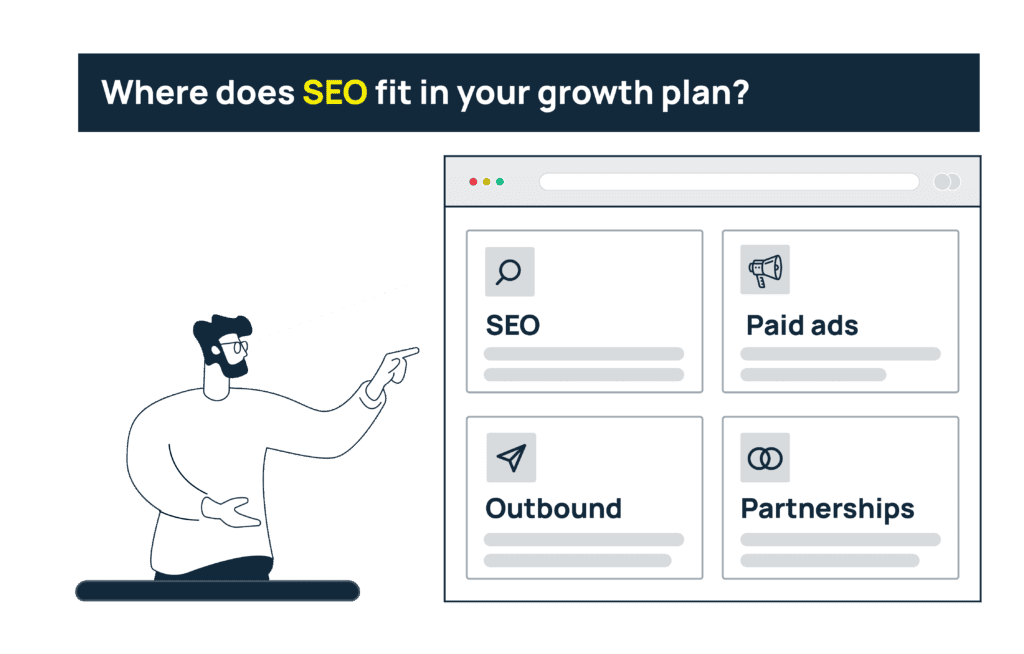
If you run a lean SaaS team, you need your limited marketing budget to work hard. Paid ads can bring traffic quickly, while outbound and partnerships can generate leads without waiting for your pages to rank.
So why invest in SEO when results may take longer? Can it still work in a crowded market? And where does it fit now that buyers also use AI search?
SEO can support growth at different points in the buying process. It helps buyers find you while they research a problem, compare solutions, and decide whether to sign up or request a demo. And unlike a paid campaign, a useful page can keep bringing in relevant traffic after you publish it.
As Patrick Herbert, CEO of Singularity Digital, explains:
“Building a strong SEO foundation, even prior to AI, was incredibly important. You want to have a reliance on something that is not paid directly. You also want something that doesn’t require repeated day-to-day work.”
This article focuses on that business case: when SEO makes sense for a SaaS company and what it can contribute to growth over time.
What Is SaaS SEO?
SaaS SEO is optimization that helps a software company show up when potential buyers search online for problems, solution categories, use cases, products, or vendors relevant to its business. It is not a separate kind of SEO; the difference is the buying process it needs to support.
B2B software buyers may need to:
- Compare vendors
- Check security and pricing
- Get internal approval before they commit
Your site needs pages that answer those questions along the way.
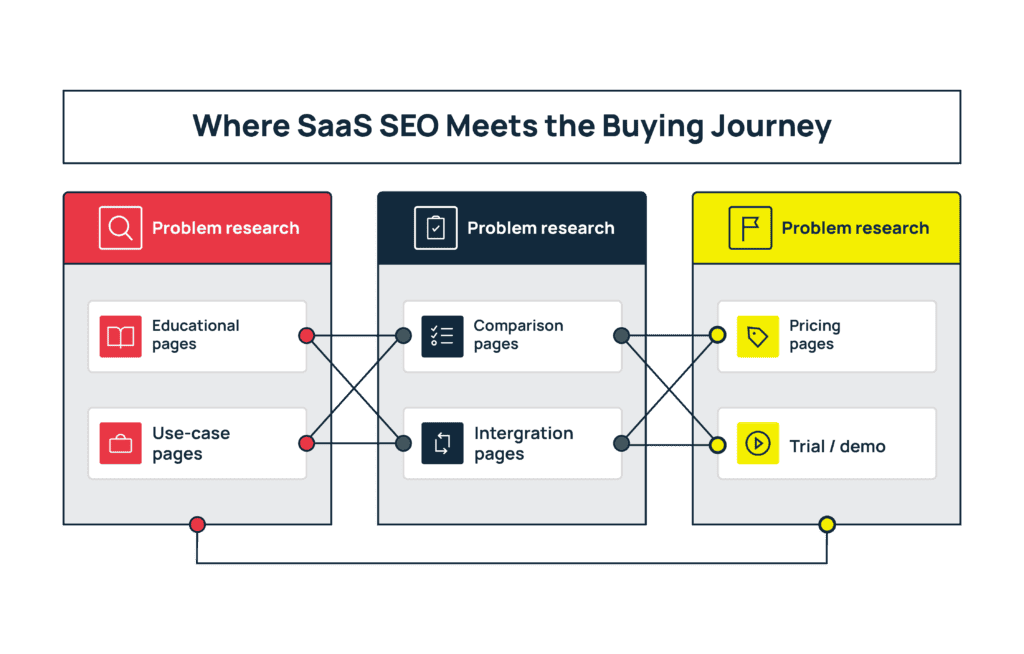
A comparison page does a different job from an educational guide; a pricing page answers a different question from a use-case page. Everything on your site, not just blog posts, can benefit from SEO whether that’s product, feature, use-case, integration, comparison, and pricing pages. Each can answer a different buying question and create a route toward conversion.
This article focuses on why and when to invest in SEO. Once you are ready to build and execute the strategy itself, see our guide to SaaS SEO strategy.
Why Is SEO Important for SaaS Companies? Buyers Search Throughout the Buying Process
Your Website Has to Help Buyers Find You and Decide To Purchase
For SaaS, your website often has to explain the product, answer questions, capture demo requests, start trials, and sometimes close the sale. Unlike a retail business, you cannot rely on foot traffic or shelf placement. SEO helps potential buyers find those pages while they investigate what is available.
This matters because for someone searching for a problem your software solves or a use case it supports, a relevant page can introduce your product and brand to them. For a self-serve or free-trial product, a relevant search result can lead directly to sign-up. For higher-consideration software, the same visibility may play an earlier role: helping the prospect decide which solutions deserve a conversation.
Buyers Keep Searching Even After They Talk to Sales
B2B buyers rarely move straight from awareness to demo. Gartner describes B2B buying as a set of tasks people revisit across digital research and sales conversations. Search content can help while buyers:
- Define the problem
- Assess approaches
- Compare vendors
- Seek reassurance
That means the first organic visit is not necessarily the conversion point. For example, a buyer who discovers an educational article may still need a security page, pricing details, and a stakeholder’s approval before committing to a demo. SEO can help answer the next question when the buyer needs it instead of expecting every page to convert on the spot.
Different Stakeholders Search for Different Answers
Your end users may check workflow fit, IT may evaluate integrations or security, and budget owners may look at cost and implementation implications.
They may search at different points and land on different pages. SEO gives each of them a way to find the answer they need, even when you are not paying to put an ad in front of them.
Education also matters when the product has several capabilities or solves problems buyers do not yet understand. Your content can explain the relevant use case, the trade-offs between approaches, and how a product might fit a workflow.
Google’s people-first content guidance reinforces this basic idea: useful search content should help the reader, not just target a keyword. SEO does not create trust by itself, but useful pages can help buyers make a better-informed decision.
Why SEO Can Pay Off More Over Time
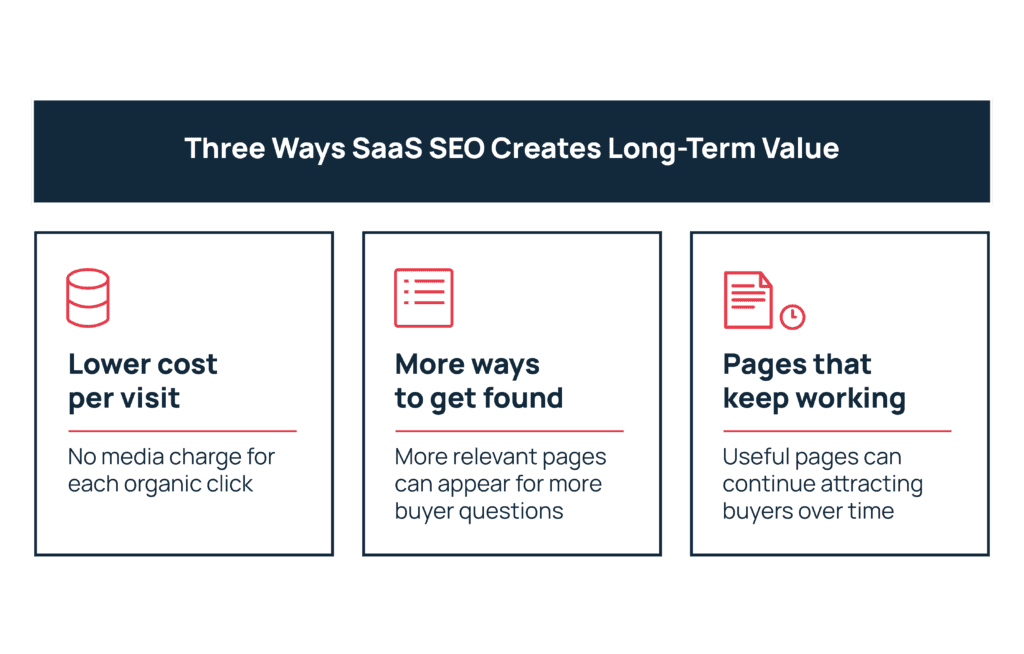
The business case for SEO comes down to three things:
- Lower acquisition costs over time
- More ways for buyers to find you
- Pages that can keep working after you publish them
None of that happens just because you write keyword content. But when you target real buyer demand and keep useful pages current, SEO can become more valuable over time.
SEO Costs Less Over Time
After your initial investment, a page can continue attracting visitors without paying for each additional click.
SEO is not free: research, production, technical improvements, links, and updates still cost money. But when the same pages keep attracting relevant visits, those costs can be spread across more traffic over time.
For SaaS, assess SEO against metrics including:
- Trial starts,
- Demo requests,
- Qualified pipeline, and
- Revenue contribution.
A SaaS customer may keep paying long after the first conversion, but that does not automatically make SEO a cheap acquisition channel. You still need to compare what you spend on SEO with the customers and revenue you can reasonably tie to it.
Want to know whether SEO is actually paying off? See our guide on How to measure SEO ROI for B2B SaaS.
SEO Gives Buyers More Ways to Find You
One useful page can rank for several related searches, bringing in buyers who are asking different versions of the same question. Build several strong product, integration, comparison, and use-case pages, and you create more ways for relevant buyers to find you without paying for every click. Paid channels can extend your reach too, but they usually depend on continued spend.
That does not mean publishing as much as possible, though. More traffic only helps if it comes from people who could realistically use your product. Ten visitors who are actively evaluating your product category may be more useful than hundreds of unrelated readers – volume cannot substitute for intent.
A Good Search Page Can Keep Working for Years
In a 2025 Ahrefs study of the top 10 results for 1.3 million US keywords, 72.9% of ranking pages were more than three years old, based on when Ahrefs first discovered each URL. The average #1-ranking page was five years old. That does not mean waiting makes content rank, it shows that older pages can still rank well.
You still need to maintain ranking pages, but that may mean updating product details, statistics, examples, or buyer language rather than rewriting the whole page. You can schedule a bigger refresh when buyer needs change, competitors publish something better, or your product changes.
3 Questions to Ask Before Investing in SaaS SEO
SEO makes sense when your buyers search for answers, and your team can support the work over time. Before you invest, ask these three questions:
1. Do your buyers need education and decision support before converting?
If buyers research the problem, compare solutions, revisit objections, or need to justify the purchase internally, SEO can help you show up while they do it.
They may search for early questions, vendor comparisons, integrations, or pricing. Search demand will not be equally strong at every stage in every SaaS category, so focus on the questions your buyers actually search.
Don’t judge a page only by whether it converts on the first visit. With Careerflow, an AI-powered career platform, we worked to help people find the product through searches that did not include its name. Over roughly ten months, we fixed technical issues, worked on content and links, and improved product pages.
Over the same period, branded organic clicks grew 109%, and branded impressions increased 192%. Across the wider engagement, monthly sign-ups from all channels also increased from approximately 9,000 to 360,000.
Herbert recommends looking at those signals together to get a full picture of how people form a relationship with your brand. For your SaaS, look at visits from searches with and without your company name, alongside sign-ups and sales.
2. Would SEO reduce your dependence on paid and founder-led acquisition?
You can grow without SEO. Paid acquisition, outbound, partnerships, and founder-led sales can all work. The risk is relying too heavily on a channel that gets expensive, time-consuming, or less effective. SEO gives buyers another way to find you without replacing the channels that already work.
A good use-case or comparison page can do more than rank. You can use it in an ad campaign, an outbound follow-up, or a sales conversation. If your founders or sales team keep answering the same feature, integration, or objection questions one-to-one, put the answer somewhere prospects can return to. For a lean team, the same content can help people who find you through search and prospects already talking to Sales.
3. Can you invest for the long term and compete on quality, not volume?
Your Lead Horizon
If you need pipeline next month, do not rely on a new SEO strategy to deliver it. How soon you see results depends on your market, competition, existing search visibility, and the work you put in. You may need paid ads, outbound, or partnerships to bring in customers while your search visibility grows and starts to generate leads.
Your Capacity For Quality
Being more competitive with content does not mean publishing more at random. Careerflow was already publishing content, but related pages were not clearly organized or linked, and there was no clear plan for which searches to target.
We organized their work around two topics: “AI resume builder” and “AI job search tools”. Pages targeting those searches reached first- and second-place positions. Together, the two search terms had roughly 50K monthly searches.
“We picked clusters that we knew that we had some authority in and doubled down on those. We did publish more, but we published more inside of a particular cluster. That’s what changed,” Herbert says.
The lesson is not “publish less” or “publish more.” Publish enough useful content around a topic to compete instead of adding volume without a clear reason.
Does SEO Still Work for SaaS in 2027?
Yes. But buyers are now finding software through AI results as well as traditional search. Google says the same core SEO practices still matter for AI Overviews and AI Mode because those features use Google’s existing search and quality systems.
That does not mean a page that ranks well in Google will automatically be cited by every AI tool.
During our Careerflow engagement, we also recorded 126 AI citations and a 415% rise in visits from AI results. Those gains happened during the same period as the SEO, content, and site work, but we cannot say improved rankings caused the AI visibility.
AI can also influence a buyer before they ever click through to your site, so clicks are no longer the only way to think about visibility.
Keep your product, use cases, and the problems you solve clear and easy to find. To understand how AI tools find and use your website content, see our guide.
Why Is SEO Important for SaaS Companies? The Final Takeaway
SEO matters for SaaS because a useful page can keep helping new buyers find and understand your product long after you publish it.
It gives you more ways to reach potential customers and can reduce how much you rely on paid distribution. It is not a quick win, and it should not be your only growth channel, but it is worth your investment.
If your buyers search and compare before they buy, SEO belongs in the growth conversation alongside paid, outbound, partnerships, and the other channels you use to acquire customers.
Want to build an SEO strategy around the buying questions that actually matter to your SaaS company? Contact our team to discuss your growth goals.