You’ve built your ICP, so you know which companies are worth your time to target. But when it comes to the people at those companies, you still open a sales call unsure who in the room makes the decision, and you still stare at a cold outreach list wondering whose inbox to target.
A buyer persona fixes that. It’s a short profile of one person involved in the purchase, built from what real buyers say and do.
Most guides tell you those “real buyers” are your customers, which is useless advice when you don’t have customers yet. So you either put it off and continue to struggle, or the persona ends up written from opinion, and everyone argues about their own version of the buyer.
There’s a third option. This guide shows you how to build your first persona from evidence that’s already public, without a single customer interview.
TL;DR
- Most B2B SaaS purchases involve several people, so build separate personas for the two to four roles that genuinely shape the decision.
- A useful buyer persona focuses on how someone buys: what makes them start looking, what outcome they want, what could stop them, what they compare, and how the decision happens.
- If you don’t have customers yet, you can research real buyers through competitor reviews, communities and forums, prospects, lost deals, and the terms they search for.
- A finished persona should be short, grounded in real buyer evidence, and specific enough to change what you write, what you ask on sales calls, and what you show in a demo.
- Don’t use AI to invent the persona. Use it after you’ve done the research to test messaging and content against the buyer evidence you collected.
- Treat your first persona as a working version and update it as you learn more from prospects and customers.
Who really decides to buy your software?
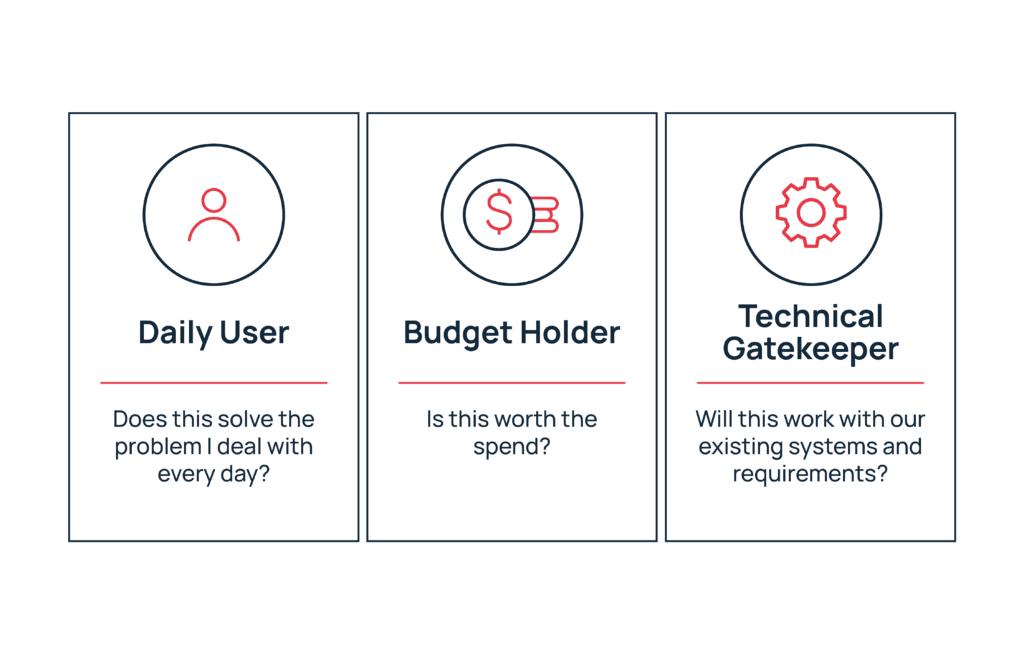
Almost nobody buys business software alone. Most SaaS purchases involve these three roles:
- The daily user, usually a team lead or manager who deals with the problem every day and will spend the most time in your tool.
- The budget holder, usually a department head, VP, or, at a smaller company, the founder, who approves the spend and wants to know what happens if the team stops using the tool in six months.
- The technical gatekeeper, usually whoever owns IT, security, or the existing software stack, who can block the purchase over integrations, data access, or setup work, even when that isn’t officially part of their job.
Buying decisions get crowded fast. Forrester’s 2024 research found that an average of 13 people are involved in a B2B purchase, and that 89% of purchases involve two or more departments. A smaller SaaS company usually has fewer people in the decision-making process, but each person who does have a say still needs their own reason to say yes.
Take Up2Speed, the example we’ll use for the rest of this guide. It’s a project management tool that stops tasks from getting lost when work moves between teams, and its ICP is B2B SaaS companies with 50 to 200 employees that run engineering, marketing, and support on three disconnected tools.
Inside a company that fits Up2Speed’s ICP, an engineering manager, a marketing ops lead, and a customer success lead all lose work in the gaps between their teams. Each of them wants something different from the same product, and each of them has a say in whether the company buys it, so Up2Speed needs a separate buyer persona for all three.
Your own ICP companies will work the same way. Once you identify the two to four people who shape the purchase decision, you’ll build one buyer persona for each of them, which keeps the work small enough to finish.
ICP vs persona
Your ICP tells you which companies are worth your time. Your persona tells you which person inside those companies to talk to, and why that person would care.
They work in sequence for a practical reason. The research you already did to build your ICP turned up the roles, the complaints, and the language you need for the personas, so you’re not starting from a blank page. You’re going one level deeper into work you’ve already done.
Age, salary, star sign… What should a B2B SaaS buyer persona actually include?
Adele Revella, founder of the Buyer Persona Institute, spent years interviewing people about purchases they’d actually made. She concluded that a buyer persona is only useful when it explains how someone makes a buying decision, and to lay out that explanation she organizes every buyer persona into five areas:
- Priority initiatives: what makes them start looking now?
- Success factors: what do they expect to be different afterward?
- Perceived barriers: what stops them from buying anything?
- Decision criteria: what do they compare?
- Buyer’s journey: how does the decision actually happen?
Alongside these five areas, copy down the exact words buyers use to describe their problem. If they say “stuff falls through the cracks between teams,” write that phrase down as it is.
A tidier version like “cross-functional workflow visibility” sounds more professional, but meeting buyers where they are is what makes them reply to an email or keep reading a page.
Those phrases are also what buyers type into Google and AI tools when they look for a fix, so your persona research can feed straight into your keyword research.
What to leave out
Hobbies, weekend habits, and stock photos. They make a persona feel like a real person, but they won’t change anything you write, ask on a call, or show in a demo, and in most templates they’re invented anyway.
Age is the exception worth keeping, because people’s words shift between generations, and the person approving the spend is usually the older one in the room.
The table below shows each core area and what to look for when starting persona research:
| Area | The question it answers | What to write down |
| Priority initiatives | What made this buyer start looking for a solution right now? | The daily problem, what it costs them, the event that made it urgent, and how soon they need it fixed |
| Success factors | What does the buyer expect to be different once the problem is solved? | The outcome they expect, and who will measure whether they got it |
| Perceived barriers | What could stop the buyer from buying any solution, even one they like? | The effort of switching tools, the risk of a new tool failing in front of their team or boss, and any vendor claims they don’t trust |
| Decision criteria | What does the buyer compare when choosing between tools? | The capabilities they check, the proof they need to see, and what rules a tool out completely |
| Buyer’s journey | How does the purchase move from first search to signed contract? | Where they research before contacting a vendor, who else has to approve, and what makes the timing right to buy |
| How they talk | What words does the buyer use to describe the problem and the tools that solve it? | Their exact phrasing for the problem, what vendors do that annoys them (like generic cold emails or vague claims), and the kinds of messages they actually reply to |
[Download the buyer persona worksheet] to collect your research across the five persona areas, then turn those findings into a finished persona.
Where to find persona data when you have no customers
Now that you know you need two to four buyers and their buying decisions identified, it’s time to find out how people in those roles describe the problem you solve and how they choose software to fix it.
If you don’t have customers to reach out to, you can still find details from real buyers. Places to look:
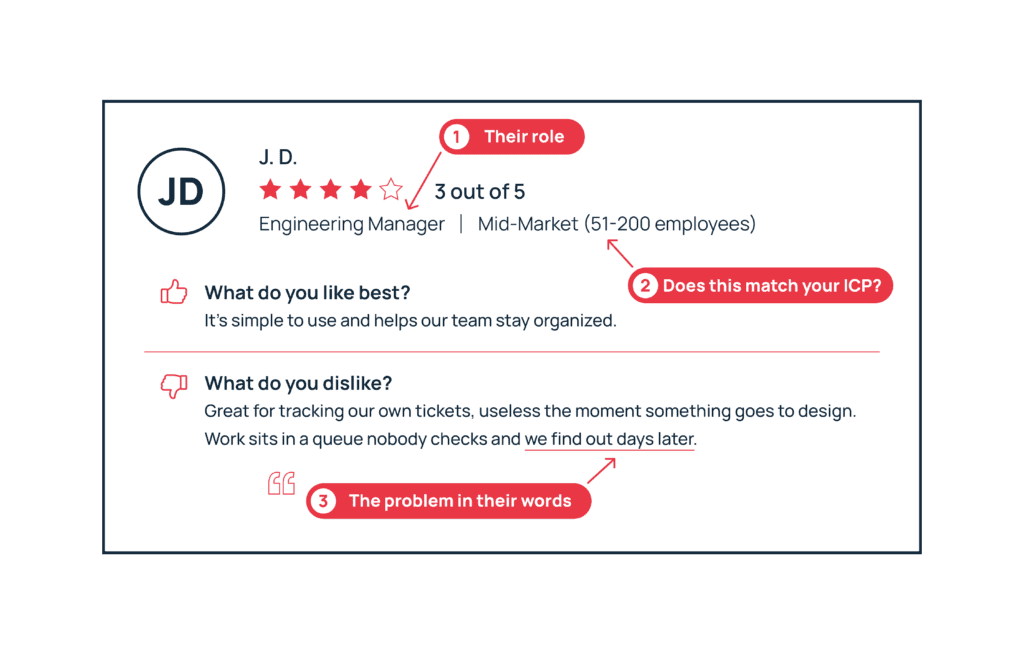
Competitor reviews: G2 and Capterra reviewers state their role and company size, then explain what made them switch and what nearly stopped them. Not every star rating is equally useful:
- Three- and four-star reviews are the most honest, because the reviewer liked the tool enough to keep it but still lists what frustrated them.
- Vendors often request five-star reviews, so look for patterns, like the same feature being praised repeatedly.
- One- and two-star reviews often come from a single bad experience or a poor fit, but when the reviewer matches your ICP, they show you what rules a tool out.
Communities and forums: Reddit and LinkedIn comment threads are public and easy to search. Closed groups for a role are often more candid, since members talk freely in private, so join a few, follow the rules, and listen without pitching.
Prospects and lost deals: Every sale that went wrong is research. Note where the conversation cooled, the objection in the prospect’s own words, who they had to check with, and which tools they compared you to.
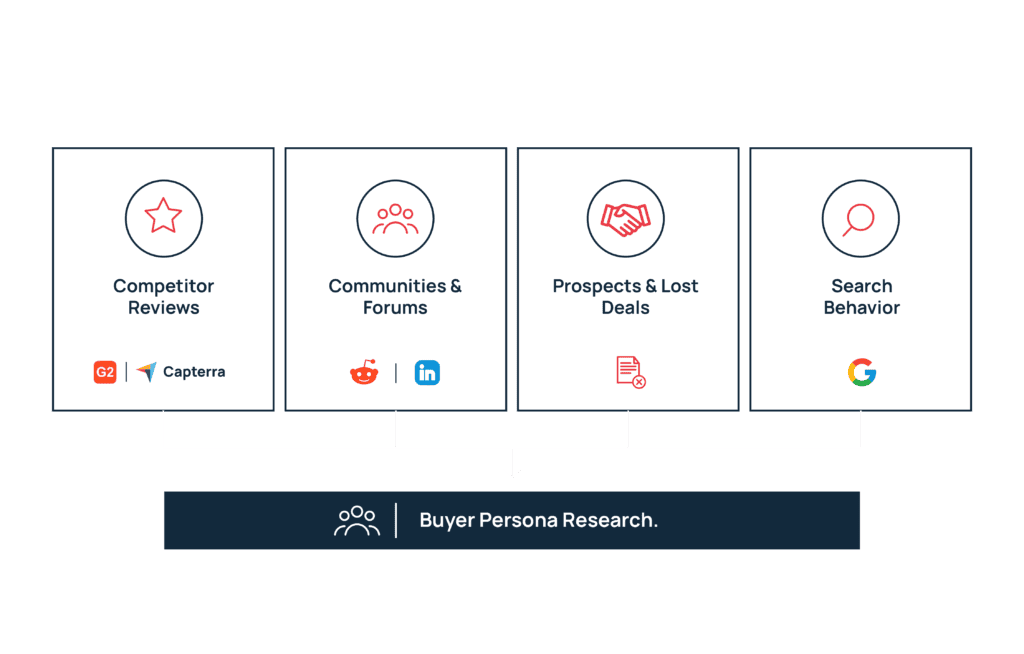
Pick two or three of these sources to start with, and pull out your persona chart with five areas laid out. It’s time to collect your data. If you want buyer research that actually changes your marketing but don’t have a few days to spend in reviews and forums, Singularity can do it for you and turn it into content that reaches those buyers. Book a free call to talk through your ICP and the people you’re trying to reach.
Collecting buyer research and turning it into a persona
You know which roles you’re profiling and where buyers in those roles are already talking. Now it’s time to collect their insights and turn it into your persona.
Collect until it repeats
If you’re using our worksheet, start adding each quote to the relevant persona area as you go. Keep going until new quotes start sounding like ones you already have, because that’s your sign you’ve collected enough. “Enough” is when you stop getting different insights from reading more reviews. Adele Revella found that after about ten interviews in the same segment, her team stopped learning anything new.
Tag as you go
Some areas fill up fast while others stay empty, and the empty ones tell you where to look next. When an area stays empty, go back to your sources and search for that area’s question directly.
For example, try “why did you switch” for priority initiatives, or “[tool] vs [tool]” for decision criteria. Barriers are usually the emptiest, since reviewers write about problems but rarely mention what made them doubt when buying, so check threads like “is it worth switching from [tool]” and your lost-deal notes, where hesitation tends to show up.
Pick one answer per area
Your quotes will point in different directions, like the price, the setup time, or a boss who said no. Each one is true for whoever wrote it, but you need to pick one answer per area for each persona.
Make sure that answer is tied to a problem your product actually solves. Two people with the same job title can care about different problems, and the one you build the persona around needs to care about something your product can address.
A persona that lists every possible reason can’t tell you what to lead with in an email or on a homepage, so you need to go with the idea that shows up most often across different sources, since that’s the one most of your buyers share.
If one or two other ideas come up nearly as often, they may belong to another persona. Keep those quotes, but set them aside for now.
Putting it all together
Start with one line on the role and the company they work at, then write one or two full sentences for each of the five areas, using the answer you picked for that area.
Finish with a few of the buyer’s exact phrases, so anyone writing an email or a page can borrow their words.
Keep the whole persona under a page. If it runs longer, you’ve probably drifted into describing the person’s life instead of how they decide to buy, and a long persona is one your team won’t read before a call.
You’ll see a full example in the Up2Speed persona later in this guide.
How to tell whether your persona is good enough
A weak persona reads like this: VP of Customer Success. Wants to reduce churn.
Every VP of Customer Success wants to reduce churn, so the line tells you nothing about why this person would or wouldn’t choose your software, and any competitor could write the same thing.
A strong persona reads like this: VP of Customer Success at a 120-person SaaS company who finds out about at-risk accounts too late, has been asked to prove renewals are safe and can’t, and is wary of another dashboard nobody opens.
The strong version adds three details specific to this buyer:
- A trigger (finding out about at-risk accounts too late)
- A pressure (proving renewals are safe)
- A worry (buying another dashboard nobody uses)
With those, you know what to open an email with and which objection to answer first. If yours is missing the worry, look for the moments buyers hesitated, in phrases like “my only concern was,” “we almost didn’t,” or “it took a while to convince my boss.”
As you start using your personas, you’ll be running the final lightweight test: if a persona doesn’t change what you write, what you ask on a call, and what you show first in a demo, it isn’t finished.
If you want help putting buyer research to work in your marketing, talk to the Singularity Digital team.
The Up2Speed buyer persona, built from start to finish
Here’s the whole persona research and drafting process, applied to one of Up2Speed’s personas.
The role: the engineering manager
Three people at Up2Speed’s ICP companies feel the handoff problem, and the engineering manager comes first.
She feels it most often, she has the most to lose when work stalls, and she’s usually the one who starts the search and brings a tool to her VP for approval; that makes her persona the one that shapes Up2Speed’s first outreach.
What the research turned up
A few hours of reading produced these quotes and insights:
- From G2 three-star reviews of a competing tool: “Great for tracking our own tickets, useless the moment something goes to design.” Several reviewers in engineering roles said this in different words, which made cross-team handoffs the recurring complaint rather than tracking itself.
- From a subreddit for engineering managers: a thread about standups, where someone complained that they only find out work is blocked when a developer mentions it three days later, in passing. Twelve replies agreed.
- From a lost sales call: a prospect went quiet after the word “migration.” When asked directly, she said the team had already moved tools twice in eighteen months and she couldn’t ask them to do it again.
- From search: people in these roles look for “tasks falling through the cracks between teams” and “handoff process engineering marketing,” rather than searching directly for project management software.
The written persona
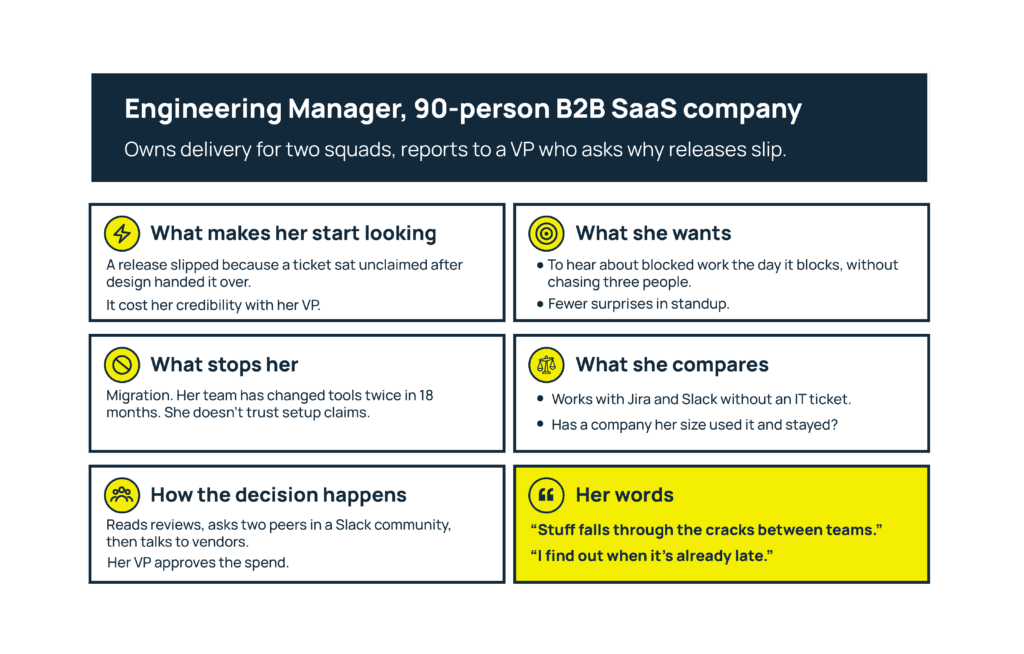
Engineering manager at a 90-person B2B SaaS company. She owns delivery for two squads and reports to a VP who asks why releases slip.
She starts looking when a release date is missed, and the reason turns out to be a ticket that sat unclaimed after design handed it over. What it costs her is credibility more than hours: she committed to a date in front of her VP and found out too late to fix it.
What she wants is to hear about blocked work on the day it blocks, without chasing three people for status. She measures it as fewer surprises in standup.
What stops her buying is the migration. Her team has changed tools twice in eighteen months, and she’s unwilling to spend her own goodwill asking them again. She also doesn’t trust setup claims, because the last tool took three weeks to be usable.
What she compares: She compares tools on whether they work with Jira and Slack without her raising a ticket with IT, and whether anyone at her company size has used it and stayed. A tool that needs its own workflow gets ruled out.
How the decision happens: She reads reviews and asks two peers in a Slack community before she talks to a vendor. Her VP approves the spend and cares about release predictability rather than features.
In her words: “stuff falls through the cracks between teams” and “I find out when it’s already late.”
The check
Now that Up2Speed is using this persona, they can run the lightweight test from the last section. Their persona passes because it has changed four specific things:
- Sales emails open differently. Not with a vague idea of what Up2Speed does, “We unlock synchronicity across project workflows”, but with the pain points your buyers deal with “You hate finding out about blocked work three days late.” The problem, in their prospect’s own words.
- The first call has a better question. “How do you currently find out a ticket has stalled after handoff?” That surfaces the problem instead of pitching at it.
- The homepage is up for revision. Marketing has flagged the homepage for a rewrite so the headline speaks to work getting lost between teams, and they plan to address migration close to the top, since that’s the objection most likely to stall the deal.
- The content team adjusted its keywords. She searches for her problem before she searches for a category of tool, so the team added long-tail questions about handoff processes between engineering and design to its keyword research.
One thing this persona still doesn’t cover: the VP who approves the spend. That’s the second persona, and it will build off this research.
Where AI fits, and where it doesn’t
All of that took a few hours out of your week. Which raises the obvious question: couldn’t AI have done it in a minute? It can, and that’s the problem.
Why invented personas fall apart
LLMs like ChatGPT and Claude learn from public data, but the B2B buying context your roles operate in is underrepresented there. They also blend everything they’ve read into one answer, so the model fills the gaps with the most average version of that job title.
If you ask an LLM to pretend to be your persona based only on its own information, it doesn’t know how a 90-person company approves a purchase or why their last tool failed, and it writes both with total confidence.
NN Group tested this by recreating three of its real user studies with synthetic users. The synthetic users gave shallow, overly positive answers, missed the context behind people’s choices, and listed every need as equally important, which NN Group says makes them unhelpful for building personas.
Synthetic answers come back tidier and more agreeable, so your invented buyer likes your product, understands your pricing, and has no migration problem. This is not a persona that will aid your decisionmaking.
Where AI actually helps
Once you have researched and written a persona by hand, you can use it to get better results from AI. Paste the persona and your research documents in, ask it to react to your homepage headline or your outreach email as that person, and see which parts fall flat.
You won’t get perfect results from AI, but you’ll get much more reliable data if your persona is well-researched. With your genuine evidence, an LLM can push back with what real buyers said.
Your first persona will be partly wrong, and that’s how it should work
You now have two to four personas tied to your ICP, built from what buyers said rather than what anyone assumed: every line traces back to a review, a thread, or a lost deal.
But it won’t be perfect. This is a starting point for you to work off of and improve as you get more customers and more customer information. That’s fine: it’s still better than the alternative of making up a persona or stalling because you don’t have good data.
So, update your personas regularly: when multiple prospects describe the problem in words it doesn’t use, when a deal dies on an objection you hadn’t listed, or when a new person turns up in the decision.
And when enough customers arrive to form a strong base, the interview guide takes your personas further, and [the AI piece] covers where those tools help.
If you want help putting buyer research to work in your marketing, talk to the Singularity Digital team.
Frequently asked questions
How is a B2B buyer persona different from a B2C one? In B2C, the buyer and the user are usually the same person, and there’s no company above them, so the persona and the ideal customer are nearly the same. In B2B, the ICP (ideal customer profile) describes the type of company worth selling to, and each persona describes one person inside that company who’s part of a group that decides together.
How often should you update a buyer persona? There’s no fixed schedule; you update when the evidence changes. Pre-customers, that means after every batch of sales conversations. Once customers exist, review every few months or whenever your pricing, ICP, or product changes.
How many buyer personas does a startup need? Two to four, one for each person who genuinely shapes the decision.
Can AI create buyer personas? AIcan produce a persona in seconds, but it will reflect what’s in its training data rather than the details of your market. Use it to test a persona you researched, not to write one.
What’s the difference between a buyer persona and a user persona? The buyer approves the spend; the user logs in daily. In SaaS, they’re often different people, and the user is usually who decides whether you keep the account.
Where can I find data to build a buyer persona? Competitor reviews, communities and forums, conversations with prospects and lost deals, and the search terms people in those roles use when they look for solutions to the problem you solve.