Say you run Up2Speed, a project management tool for remote SaaS teams.
You ask ChatGPT, “What’s the best project management tool for a remote team that keeps engineering, product, and marketing in sync?” It recommends Asana, ClickUp, Linear, and a few smaller tools, but not Up2Speed. So you type, “What is Up2Speed?” and it calls you a task manager for freelancers.
*Task manager for Freelancers? Really?*
That misalignment happens when AI searches the web for an answer and can’t find a clear, consistent picture of what you do across the places it looks. And as a result, it can’t categorize your product right, let alone recommend it to buyers.
The way to fix it is to make your SEO say what you want your product to be known for, starting with your own website, since that’s the biggest source AI tools cite when they describe a brand. Then you take the same message off-site.
But before you touch a single page, you need to be very clear on what you want your product to be known for. So that’s where we’ll start, and then show you how to say it and reinforce it consistently through SEO, so AI has what it needs to recommend you.
TL;DR:
- AI tools learn what your product does and who it’s for from what they find across the web. If those details aren’t clear, AI won’t recommend you, and buyers who use it to find tools won’t discover you at all..
- Brand consistency means describing your product the same way everywhere, from your website to your pitch deck to your sales calls.
- SEO is how you carry that consistency into your site, your content, and your mentions on other sites – the places AI pulls from when it researches your category.
- It starts with defining what you want your product to be known for, then reinforcing those ideas across your keyword research, your site, your schema, and your off-site presence.
- To see whether these changes are improving how AI describes and recommends your product, rerun a set of brand, market, and buyer prompts in ChatGPT every few weeks.
- Results take time, but consistency is how a small SaaS can own its niche against bigger competitors.
Define what you want your product to be known for
Good branding always starts with clarity. When you’re clear on what your product does and who it’s for, it shows in everything you publish, and that’s what AI picks up on.
If you already have a brand guide that spells out what your product does, who it’s for, and why people choose it, pull it out and use it as a reference as you work through updating your web presence.
And if you’re reading that thinking, “we don’t really have one of those,” that’s pretty normal for an early-stage SaaS company. The founder usually knows exactly what the product is for, but sales explains it their way, marketing explains it another way, and none of it is written down anywhere. That’s fine when you’re small, but it’s exactly the kind of mixed signal AI picks up on and then describes you wrong. So take a moment to get it out of your head and onto paper.
An easy way to start is with a few questions adapted from April Dunford, author of Obviously Awesome. She’s written extensively on positioning and breaks it down into five core components. Here are the questions:
- What do your buyers use today instead of you?
- What does your product do that those can’t?
- What does that get your buyer, in their words?
- Who cares about that the most?
From your answers, pick out your product’s three to five biggest strengths, the concrete reasons buyers are most likely to choose you over a competitor. These become your messaging pillars, and we’ll keep coming back to them throughout this guide.
Write each one out clearly, with all the details in place.
For Up2Speed, it’d look something like this,
| What buyers use today | What Up2Speed does that competitors can’t | What the buyer gets | Who cares most | Messaging pillar |
| Status meetings and chasing updates in Slack | Keeps teams in sync asynchronously | Everyone knows where work stands without a meeting | Team leads working across time zones | Stay in sync without status meetings |
| Engineering-only tools that leave product and marketing out | Flags dependencies across engineering, product and marketing | Dependencies get caught before they wreck a deadline | Product leads and marketing ops coordinating launches | Catch cross-team dependencies early |
| Heavier PM tools that everyone needs to use on top of specialized tools | Works inside Jira, GitHub, Slack and HubSpot | Each team keeps working where it already does, with nothing duplicated | Engineering managers whose teams live in Jira | Works with the tools your teams already use |
Let your messaging pillars guide your keyword research
With your pillars written down, you know exactly what you want to say across your site. So the next step is making sure the right buyers find the pages where you say it. That’s done by targeting the right keywords.
Your pillars help you figure out which keywords those are.
Each pillar solves a problem your buyers run into at work, and when they hit that problem, they search for a way around it, like how to keep a remote team in sync without daily standups. Searches like that are called jobs-to-be-done (JTBD) keywords, and since your product is the answer to them, they’re the ones worth going after.
For Up2Speed, each pillar translates to JTBD keywords like this:
- Stay in sync without status meetings → “how to keep a remote team in sync without daily standups”
- Catch cross-team dependencies early → “how to track dependencies between engineering and marketing”
- Works with the tools your teams already use → “how to see Jira progress without leaving Slack”
To find the searches buyers are actually making, plug each pillar into a keyword tool like Ahrefs or Semrush and look through the keyword ideas it suggests. Those are the ones to target, whether you’re creating new content or working them into existing pages when you refresh them.
Want to get more out of your keyword research? Check out our guide to ICP-focused SEO – it walks through the complete process of finding and validating JTBD keywords.
Refresh existing pages and create new content around your messaging pillars
You’ve got messaging pillars that define how you want AI tools to understand and categorize your product, and JTBD keywords that show what your buyers search for when they need what it does.
This step puts both to work on your site.
Update the pages you already have so they say what your pillars say, and create new ones around your JTBD keywords. That way, buyers and AI find the same message across your site, and you show up in more of the searches AI runs when your buyers ask for help.
Here are the pages to focus on, in order of importance:
1. Homepage and feature pages
These pages have different jobs, but both should describe your product in the same terms. Put proof next to each feature claim you make, whether that’s a metric, a customer quote, or a short case study.
2. Comparison pages
ChatGPT cites comparison content more consistently than any other format, at a 95% citation rate. Use your pillars as the rows in your comparison table, and be honest about where each option comes out ahead.
3. Pricing page
List the features in each tier in language that shows how they solve your buyers’ problems, like “async updates that replace status meetings.” Use the FAQs below it to answer the doubts that stop buyers from moving forward.
4. Integration pages
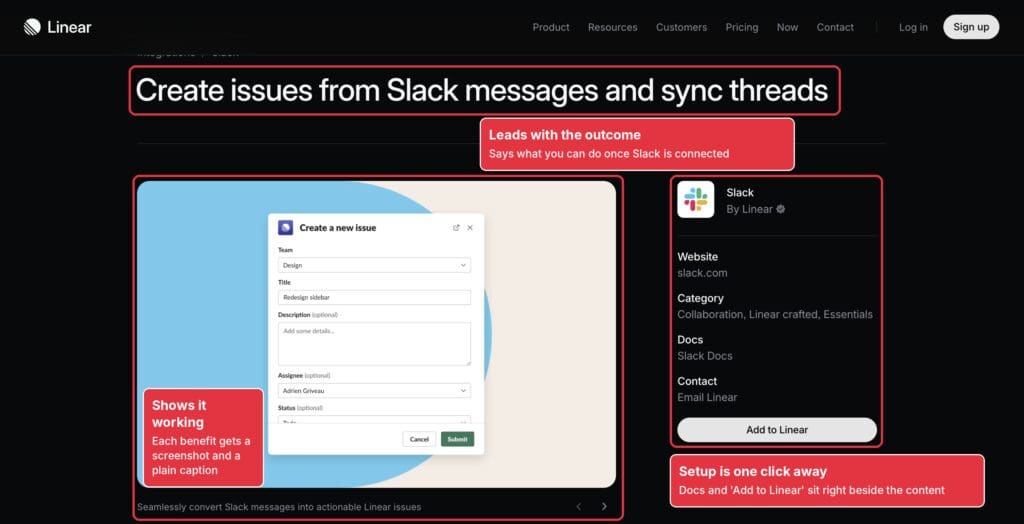
Give each integration its own page. Lead with what buyers can do once it’s connected, in the same words as the pillar it supports, show it working with a screenshot or short demo, and cover who it’s for and how to set it up. Linear’s Slack integration page is a good example of this:
5. Blog posts
Build each post around one JTBD keyword and the pillar it connects to, so its point of view, examples, and language all reinforce that pillar. Bring your product in only where it’s genuinely part of the answer.
Across every page: add meta titles, descriptions, and internal links
Whichever pages you update or create from the list above, finish by going over their meta titles, descriptions, and internal links for keyword opportunities. These details do more for search engines and AI than for buyers, which makes them easy places to work in your pillars and JTBD keywords.
For example, take internal links: a reader will be happy with “learn more” on your homepage/feature page, as long as the sentence around it explains where it goes, but search engines use the anchor text itself to understand what the linked page is about. And, descriptive anchors like “track cross-team dependencies” give them more to work with. So, where it reads naturally, use the descriptive version.
Together, these refreshes and new pages make every page on your site send the same signals about what your product is and who it’s for, all anchored in the pillars you defined for yourself. And since your website is the part of your brand you control most, getting it aligned is the biggest step toward influencing AI tools to describe you the way you’d want it to.
At Singularity, this is where we start with every client, so their own website is sending AI one clear, consistent message about who they are from day one. Book a free call, and we’ll take a look at yours.
Spell out your messaging pillars for search engines with schema markup
Search engines and AI tools read your pages to work out what your product is. Schema markup is code added to your pages that tells search engines plain facts about your business, like what you are, what your product does, and where else you exist online.
Schema won’t get you into AI answers on its own, and Google says no special markup is needed for its AI features. What it does do is remove guesswork, so the facts in your schema and the story on your pages line up into one clear picture of who you are.
For brand consistency, two types matter most:
- Organization schema goes on your homepage. It has a description field, where a short version of your brand description goes – write this from your pillars. It also has a sameAs field, where you list your profiles on other sites, like G2, LinkedIn and Crunchbase, so search engines know they all belong to the same company.
- SoftwareApplication schema goes on your product pages. Make sure the category and features you list there match the ones your pages and brand description use, so every layer of your site points to the same product.
Our guide to schema markup walks you through how to add these to your site.
Get the rest of the web echoing your messaging pillars
Your site is where you state your pillars. Off-site mentions are where other sources confirm them, and AI weighs both. In Ahrefs’ study of 75,000 brands, mentions across the web had the strongest link to AI visibility of any factor measured. You won’t control the exact words other people use about you, but you can control what you give them to work with.
Profiles and directories: Write one short brand description from your pillars and use it on G2, Capterra, LinkedIn, Crunchbase, and any directory you’re listed in.
Digital PR and guest content: Build your pitch angles around your pillars, and include your brand description and a proof point with every pitch, so coverage puts your name next to the ideas you want to be known for.
Review sites: When you ask customers for reviews, phrase your questions around your pillars, so their answers speak directly to the outcomes you want to be known for. For Up2Speed, asking “How has Up2Speed changed the way your team handles status meetings?” gets a far more useful review than “What do you think of Up2Speed?”
Communities and your team: Take part in the Reddit, LinkedIn and Slack communities where your category gets discussed, and offer genuinely useful advice. Where it fits, mention your product after you’ve helped, and be upfront that it’s yours. Your team should describe the product in the same terms on podcasts, LinkedIn and sales calls.
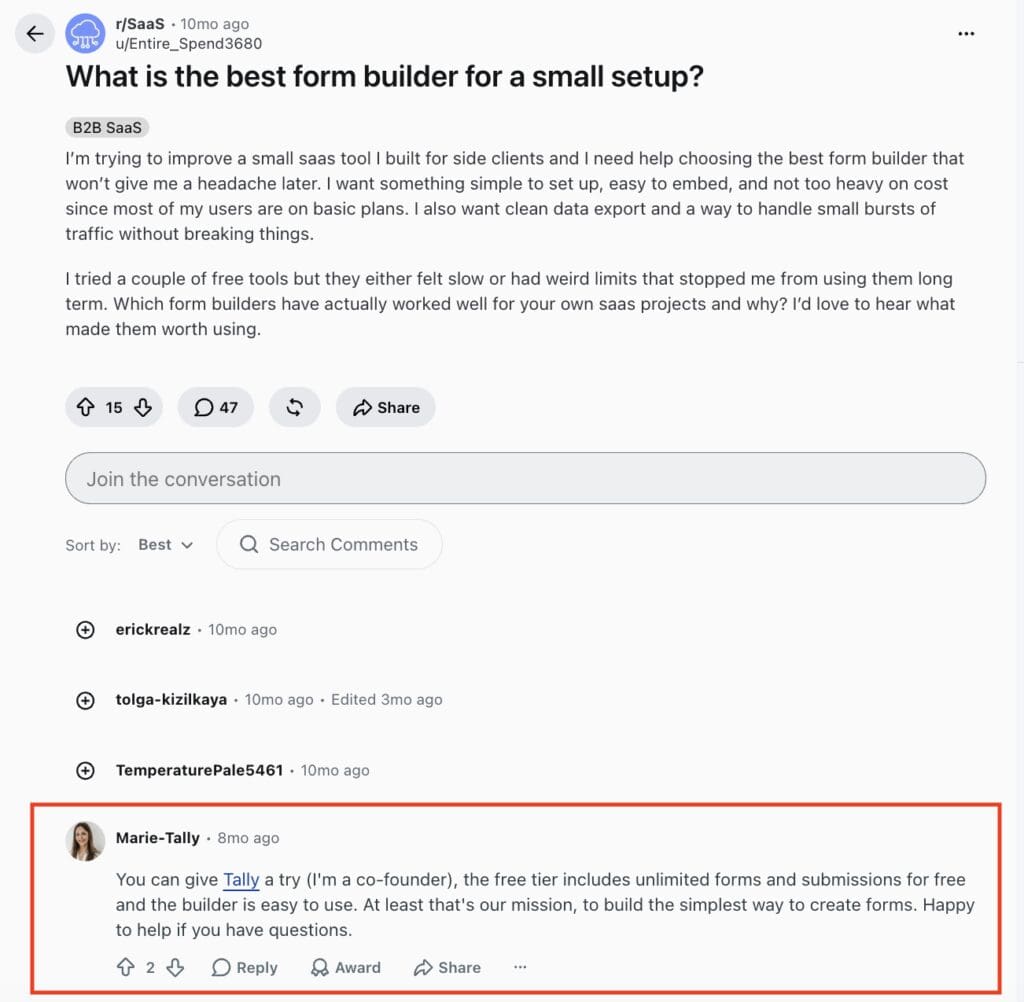
Tally, a free form builder, is a good example of this done well. Its co-founder, Marie Martens, regularly answers questions on Reddit, and when Tally comes up, she describes it the same way Tally describes itself everywhere else: unlimited forms and submissions, for free.
Track how AI describes your product over time
Remember the prompts you ran at the start that showed AI getting your product wrong? Use them again to track your progress. Before you change any pages, run a small set of prompts in the AI tools your buyers use and save the answers. Then run the same prompts every few weeks as you roll out your pillars, and compare the answers to see what’s changed.
Three kinds of prompts cover what you need to know:
- Brand prompts show whether AI describes you the way your pillars do, like “What is Up2Speed?” or “Who is Up2Speed for?”
- Market prompts show which products AI groups you with, like “What are the best project management tools for remote SaaS teams?”
- Buyer prompts show whether AI recommends you for the problems you solve, like “Our engineering, product and marketing teams keep missing each other’s dependencies. What should we use?”
Look at the sources AI cites in its answers, too. If any of them still carry the way you described yourself before you aligned everything, plan to update those next. Refresh the ones on your own site, and reach out to update the ones on other sites where you can.
The three types of prompts we’ve outlined give you a solid baseline check, and as your prompt set grows, a dedicated AI visibility tracking tool can run it for you at scale. To build a fuller prompt set that goes beyond these three types, check out our guide to choosing which prompts to track.
Final Thoughts on Brand Consistency In AI Search
The way buyers research tools is changing fast, so seeing ChatGPT call your product a task manager for freelancers can make it feel like you need to drop everything and start chasing AI.
But really, you don’t.
Most of what shapes how AI describes you comes down to SEO and GEO basics, and the steps in this guide help you get those in order.
It will take time to show up, since AI needs to see the same message again and again before it changes how it describes and recommends you. But that’s where a small SaaS has an edge. When you’re focused on one buyer and a small set of problems, it’s much easier to keep your message consistent everywhere.
We’re building our own product while running our own business, so we know how easily marketing slips when the product needs you. Keeping every page, post, and mention aligned is the part we take off your plate, so you can stay focused on building. Book a free call to discuss how we’d do it for yours.