Generative Engine Optimization (GEO) can start generating measurable AI citations within 2–4 weeks, while building lasting authority typically takes 6–12 months. Your exact timeline depends on how clearly your site is structured, how well your content communicates key concepts, the consistency of your brand’s entity relationships, and the external validation your brand receives.
AI platforms provide answers to category questions before users even click, making the brands they mention the primary options that customers consider. In this new landscape, generative engines act as the gateway between your buyers and your brand. Wait six months to engage, and you’ll spend the next six fighting to reclaim mindshare.
TLDR
- Quick visibility through structure: Well-structured, FAQ-rich, and schema-marked pages can appear in AI-generated answers within 2–4 weeks.
- Phased GEO roadmap: Weeks 1–4 focus on foundations, Months 2–3 on authority, Months 4–6 on scaling coverage, and Months 7–12 on compounding and optimization.
- Entity alignment builds trust: Consistent brand-category associations across your website, reviews, and press ensure AI cites your brand accurately, reducing hallucinations.
- Measurement drives ROI: Track AI citations, referrals, pipeline influence, search lift, and content accuracy to turn GEO efforts into verifiable business impact.
How GEO works (and why timing differs from SEO)
Generative engines operate differently from Google’s traditional approach of crawling and indexing websites. These AI systems blend two things: live retrieval (pulling fresh information directly from the web) and memory (what the model already “knows” from training and stored references).
This difference is why timing works differently in GEO compared to SEO. In SEO, you’re waiting for Google to:
- Crawl your page.
- Re-crawl it after changes.
- Notice backlinks.
- Slowly adjust rankings over weeks or months.
In GEO, that cycle is much faster. Engines can pick up a structured, well-cited page almost immediately, because they’re not ranking links, they’re synthesizing answers. If your content is formatted for clarity (headings, tables, FAQs, schema), it can show up in AI-generated answers within days. In other words: SEO rewards authority over time, while GEO rewards structure and clarity right away.

Although GEO provides rapid early visibility through structure and clarity, entity alignment forms an essential long-term foundation. This is how engines identify your brand and establish trust in your information. By consistently linking your brand with the right categories, use cases, and Ideal Customer Profile (ICP) across your website, review platforms (G2, Capterra, Crunchbase), press mentions, and community posts, you give engines a clear signal that YourBrand = this solution. That reduces the risk of AI hallucinations or off-target descriptions, and increases the odds that your brand appears as a credible choice whenever buyers see AI-generated shortlists.
What speeds up vs slows down GEO
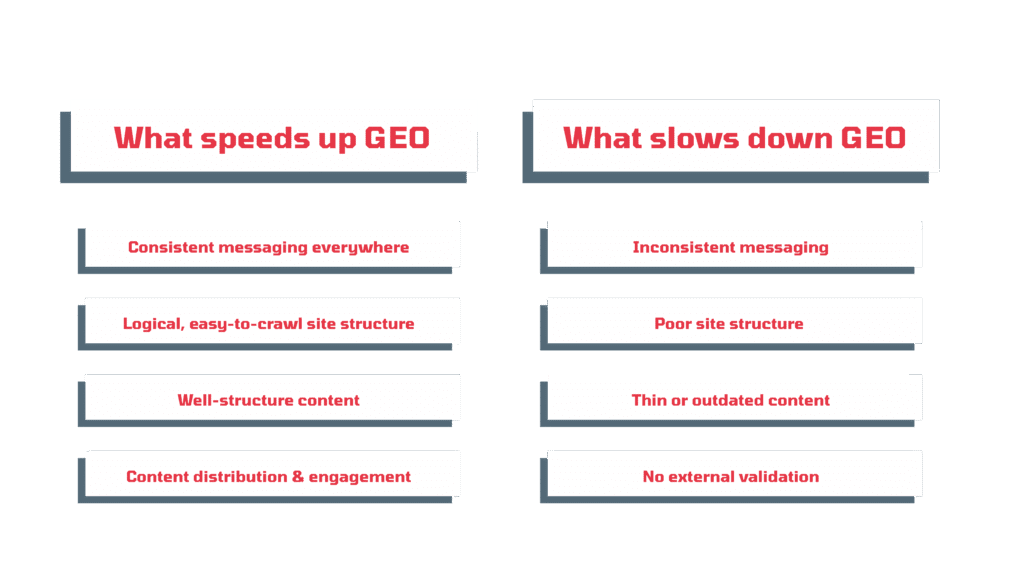
The speed of your Generative Engine Optimization (GEO) results depends on how clearly and consistently your brand presents itself across the web. Engines can only synthesize what they understand, so the clearer your signals, the faster you show up.
What Speeds Up GEO
Several factors help AI engines quickly identify, understand, and cite your brand:
- Consistent messaging everywhere: Use one concise business description across your website, social profiles, and directories. For example: “[Your Company] is a SaaS platform that helps businesses streamline marketing workflows using automation and AI.” Consistency helps AI connect mentions of your brand across the web.
- Logical, easy-to-crawl site structure: Keep your sitemap updated, ensure internal links make sense, and consider adding an llms.txt file to highlight key pages for AI crawlers.
- Extensive, well-structured content: Publish enough material for AI to understand your expertise: cornerstone pages, FAQs, and supporting articles all help engines map your authority.
- Content distribution and engagement: Promote new content across platforms. The more signals AI sees that your content is active and shared, the faster it’s indexed and synthesized.
Manual submission to LLMs: After publishing, use tools like Perplexity’s “Summarize this page” or similar prompts in other AI engines to encourage crawling. While this practice isn’t officially confirmed to speed up AI indexing, it only takes a couple of minutes and can be worth trying.
What Slows Down GEO
On the other hand, several issues can delay or even block visibility:
- Inconsistent messaging: Different descriptions of your brand across platforms confuse AI systems and fragment your identity.
- Poor site structure: Missing sitemaps, broken internal links, or buried content make it harder for engines to find and interpret your pages.
- Thin or outdated content: Sparse or low-value pages signal weak expertise. GEO depends on depth, accuracy, and recency.
- No external validation: In competitive markets, AI engines look for signals like reviews, mentions, and case studies. Without these, recognition takes longer.
| What Speeds Up GEO | What Slows Down GEO |
| Consistent messaging everywhere | Inconsistent messaging |
| Logical, easy-to-crawl site structure | Poor site structure |
| Well-structured content | Thin or outdated content |
| Content distribution and engagement | No external validation |
| Manual submission to LLMs | No proactive indexing efforts |
Understanding what accelerates or slows down your GEO efforts provides the context for planning a realistic timeline. With clarity, consistency, and credibility as your guiding principles, you can strategically implement each phase to maximize AI visibility.
Timing GEO engine seo
Wondering how long it takes for your content to get noticed by AI? We’ll break it down and show you what makes a difference so your effort pays off.
A realistic GEO timeline
Implementing Generative Engine Optimization (GEO) requires a structured, phased approach that builds directly upon your existing SEO foundation, and success demands a careful balance between short-term wins and long-term authority building in your category. Your team should view these strategies as complementary forces working side by side, not competing priorities. The following roadmap outlines how to effectively integrate both approaches during your first year of implementation and is based on a small founder-led team implementing it. These timelines can be faster if you have dedicated team members who can put more time into this.
Weeks 1–4: Foundations & Quick Wins
Goal:
Have your content visible, understandable, and quote-ready for generative engines.
The first month focuses on laying the technical and structural groundwork so your site is AI-accessible, easy to interpret, and ready to be included in generative engine answers. These early improvements help your content get noticed quickly and set the stage for long-term visibility. Well-structured pages following these guidelines can start appearing in AI-generated answers within 2–4 weeks.
- Open access to AI crawlers
Ensure AI systems like GPTBot, Google-Extended, PerplexityBot, and Anthropic-AI can crawl your site without restrictions. If crawlers are blocked, your content may never be seen or included in AI-generated responses.
- Fix JS-only rendering with SSR or prerendering
Many modern SaaS websites rely heavily on JavaScript to display content, but some AI crawlers cannot fully process JS-heavy pages. Implementing server-side rendering (SSR) or prerendering ensures that content is fully visible and interpretable, allowing engines to quote and summarize pages accurately.
To see how AI crawlers interpret your website, try disabling JavaScript in your browser and reloading your pages—what appears on screen closely reflects what most crawlers can access. If important sections of your content disappear, it’s a sign that your site depends too much on JavaScript for key information. You can easily test this using browser developer tools in Chrome or Firefox, which let you turn off JavaScript directly through their settings or console.
For a more automated approach, tools like Gumloop and Browse AI allow you to scrape and monitor web pages to visualize what crawlers “see,” and both offer free or limited trial plans for testing and comparison.
- Audit your llms.txt and sitemap
- Llms.txt can guide AI models to your most important and accurate content, complementing your sitemap.
- Sitemaps help crawlers find all pages, ensuring nothing important is missed and increasing the chances of quick discovery.
- Implement sitewide schema
Adding structured data using Organization, Product, and FAQ schemas makes your pages machine-readable. This helps engines understand your content type and extract key facts for AI answers or knowledge panels.
- Add FAQs to top pages and restructure for scannability
Integrate FAQs that reflect the specific questions your audience might ask. Organize headings (H2/H3), bullets, and tables so content is concise and easy to scan. Generative engines favor concise, well-structured content over long, meandering pages.
- Maintain sitemap hygiene and add author/review signals:
Keep pages properly indexed and discoverable. And add author and review credibility markers to support SEO and GEO trust.
- Formalize measurement and attribution
Set up dashboards and reporting to track AI visibility and content coverage.
Outcomes:
By the end of the first month, your website should be technically optimized for discovery and interpretation by AI systems. Core pages will be fully visible to crawlers, structured for clarity, and enriched with schema and FAQs that make them easy to parse and quote. These foundational improvements establish your site’s credibility early, positioning your content to start appearing in generative answers

Months 2–3: Coverage & Authority Basics
Goal:
Have authoritative, highly referenceable content that begins earning consistent AI-generated referrals, positioning your brand as a credible and trusted source in your category.
With the technical foundation in place, the next step is to focus on content that demonstrates your expertise and builds credibility. This phase is about moving from early visibility to becoming a trusted source for AI engines.
- Publish cornerstone explainers
Create in-depth, authoritative pages that cover your core category and key use cases. These cornerstone pages serve as the primary reference for AI models and human readers alike, making it easier for engines to understand your expertise and context.
- Build comparison pages
Create pages such as “HubSpot vs Salesforce” or “Best Project Management Tool for Small Teams”. These directly answer common buyer questions, increasing the chances your content is selected in AI-generated summaries and shortlists.
- Secure initial third-party citations
Collect references from sources like G2 reviews, customer quotes, and analyst mentions. These citations reinforce credibility, helping AI systems distinguish your content as reliable. The goal is to move from sporadic mentions to repeatable AI references over time.
Outcomes:
By the end of the coverage and authority phase, your content should establish authority, be highly referenceable, and start earning consistent AI-generated referrals, positioning your brand as a credible and trusted source in your category.
Months 4–6: Scale & Distribution
Goal:
Have your brand repeatedly recognized by engines as a credible source, boosting visibility in AI-generated answers and solidifying your position as a trusted expert in your category.
At this stage, the focus shifts to broadening content coverage, reinforcing authority, and increasing the chances of repeated AI references. This phase turns early wins into sustained visibility.
- Expand topic clusters
Build clusters around key problems, buyer personas, and jobs-to-be-done. Topic clusters help engines understand the breadth and depth of your expertise while ensuring content addresses the real problems of your target users.
- Ship deeper use-case pages
Develop detailed pages that showcase real-world applications of your product or service. Include screenshots, metrics, outcomes, and step-by-step examples to demonstrate tangible value. Well-documented use cases increase credibility and make it easier for AI to summarize your content accurately.Example: Miro’s Customer Journey Map page demonstrates this approach. On this page, you see visual examples and screenshots, explanations and best practices, and descriptions of the outcomes and value it delivers for businesses. This structured presentation shows how a SaaS product can be applied in real-world scenarios, making the content referenceable and easier for AI systems to interpret.
- Distribute content into AI-friendly communities and directories
Share your strongest content where AI models frequently source information:
- Subreddits related to your category
- LinkedIn groups and Quora for industry-specific discussions
Repeated presence in these channels signals to AI systems that your content is authoritative and trustworthy.
Outcome:
By month six, your topic clusters should be stronger and more interconnected, and your use-case content should clearly demonstrate your product’s value. Combined with consistent distribution across channels like Reddit and other channels, you should start seeing meaningful growth in both SEO rankings and LLM mentions and citations.
Months 7–12: Compound & Optimize
Goal:
Have early wins evolve into a sustained competitive advantage, keeping your brand consistently visible and credible across AI-generated answers.
The compound & optimize phase is about refining your content, strengthening authority, and measuring impact so that early GEO wins turn into sustained, long-term advantage.
- Refresh high-performing content
Update your top-performing pages to maintain freshness signals for generative engines. This can include adding new insights, updating statistics, or expanding examples. Fresh content helps keep your pages relevant and increases the likelihood of repeated AI citations.
- Identify and fill prompt gaps
During manual testing, spot questions and topics your audience is asking that aren’t fully addressed by your current content. Review site search logs, help desk tickets, FAQs, and comments to uncover real user queries. Then, compare these insights against your existing pages to identify what’s missing or incomplete. Once gaps are clear, create or expand sections, FAQs, or new pages to fill these gaps, ensuring AI systems can find comprehensive answers for user queries.
- Strengthen entity signals
Reinforce brand associations on your owned pages, including your website, blog, and FAQs, by consistently presenting your brand name, products, and core offerings. On third-party pages encourage accurate citations, case studies, and mentions that clearly reference your brand. Consistent entity signals help engines understand that YourBrand = [category, use cases, ideal customer profile], reducing hallucinations and improving accuracy in AI-generated responses.
- Refine measurement and attribution
Use the dashboards and reporting established early to analyze trends, evaluate the impact of optimizations, and guide decisions for content refreshes, gap-filling, and entity signal strengthening.
Outcomes:
By the end of this phase, your content ecosystem should be fully refined, with gaps addressed, high-performing pages refreshed, and brand signals reinforced across owned and third-party channels. These optimizations position your brand for long-term visibility and authority, while measurement and attribution frameworks provide clear insights into how content influences AI-driven discovery, engagement, and pipeline performance.
Measurement and ROI
Tracking and measuring Generative Engine Optimization (GEO) is essential to understand whether your efforts are driving real business impact. Unlike traditional SEO, where rankings and impressions dominate discussions, GEO focuses on citations in AI answers, AI-driven referrals, and influence on pipeline. A structured measurement plan turns guesswork into actionable insight.
Tracking Methods
- AI Referrals in Analytics – Identifying visitors from AI tools like ChatGPT, Bing Copilot, or Perplexity is not straightforward, because many AI platforms strip referral headers and users often copy/paste links. However, some tools do pass referrer information when a user clicks a link, which can be tracked in analytics.
- Search Lift – Track branded and category searches before and after your content appears in AI outputs. This lets you measure whether GEO is actually increasing awareness and interest in your brand. Tools like Google Search Console, Semrush, or Ahrefs can be useful. Increased search volume after AI citations indicates that your content is influencing potential customers, moving beyond mere visibility to actual consideration.
- GEO-Specific Metrics – Monitor AI citations. Count how often target prompts return your content (AI Visibility Rate), use AI monitoring tools like Peec AI, Scrunch AI, or Rankscale.ai to check for automated brand citations., and measure semantic relevance to ensure your content answers queries effectively.
- Human Quality Checks – Verify AI cites your brand accurately. Manually run top queries across AI engines, log any errors, and fix content structure, FAQs, or provide additional third-party validation.
Phase Targets
- Weeks 1–4: Citations & Coverage – Aim to appear in 10–30% of target prompts. Early citations confirm AI recognizes your content.
- Months 2–3: AI Referrals & Assisted Conversions – Track clicks or view-throughs leading to trials, demos, or sign-ups.You’ll see if AI is influencing real buyer behavior.
- Months 3–6+: Pipeline Influence – Measure opportunities created or accelerated by AI. Use blended CAC and payback metrics to justify GEO spend.
Validation Loop
- Test target prompts manually every two weeks: Enter queries your ideal customers might use and see whether your brand appears.
- Log results: Track inclusion, citation frequency, share-of-answer, and accuracy of your brand representation.
- Optimize content if needed:
- Update page structure for clarity and AI readability.
- Fill FAQ gaps where AI prompts are unanswered.
- Increase third-party corroboration (reviews, analyst mentions, citations) to strengthen trust signals.
This creates a closed-loop system that turns assumptions into verified results. You know which content is working, where AI misrepresents you, and how to fix it, shortening the time to measurable impact.
Bottom Line
Generative Engine Optimization (GEO) is a structured playbook where clarity, consistency, and credibility directly influence how quickly your brand appears in AI-generated answers. Done right, you can earn citations in as little as 2–4 weeks and compound authority into a long-term competitive moat. The implication is clear: if you delay, competitors will own the shortlist when buyers turn to AI for recommendations.
Next Steps
- Audit your site for AI accessibility
- Implement structured content that engines can easily cite
- Build validation through reviews and third-party mentions
- Measure: track citations, AI referrals, and pipeline influence to prove ROI.
If you need help implementing GEO, Singularity Digital can guide you through the process and accelerate results. And if you’d like to dive deeper, check out our article on Generative Engine Optimization Myths and Facts to separate hype from reality and sharpen your strategy.
Timing GEO engine seo
Wondering how long it takes for your content to get noticed by AI? We’ll break it down and show you what makes a difference so your effort pays off.