The underground, the tube, the Waterloo line, the train to Oxford Circus… all of these are ways you can talk about taking the London Underground. If you live in London, it wouldn’t matter which of these words someone used; you would know exactly what they were talking about.
How does a search engine or LLM know that? By relying on entities.
An entity is the single name these systems use group all of the different phrases that describe one real company, product, idea, or thing (the London Underground) together.
LLMs use entities to connect information across the web. When they see the same entity show up in similar contexts across different sources (for example, London travel blogs, the Transport For London website, Wikipedia), it becomes easier for them to understand what it is and why people talk about it. When that doesn’t happen, the system struggles to place the brand correctly in relevant conversations or avoids mentioning it at all.
For brands, having search engines and LLMs recognize your brand or product as an entity means these systems understand who you are and what you do, and when you should come up in relevant answers.
In this article, we break down how SaaS companies can become clearly recognized entities, ensuring AI systems can confidently recommend them, place them in the right category, and represent them accurately in answers.
TL:DR
- LLMs don’t work with keywords. They work with entities and context.
- If your product isn’t clearly defined as an entity, AI systems won’t confidently mention or recommend you.
- Clear entity definition starts with consistent language across your site and content.
- Content, comparisons, integrations, and use cases reinforce how systems understand where you fit.
- External mentions and PR help move your brand from recognized to trusted.
- Technical signals like NER, entity linking, and schema remove ambiguity and lock in understanding.
- Monitoring AI responses shows whether systems actually understand you, or are still guessing.
Why Becoming an Entity Matters for a SaaS in 2026 (and Beyond)
Keyword-based SEO as a strategy is done. If you stick to it, you’ll be dead in 2028.
The reason: LLMs and search engines don’t rank pages based on keyword matches like Google once did. Instead, entities help LLMs decide which brands to mention and when.
We’ve seen this for ourselves firsthand.
Our nimble SaaS SEO agency, Singularity Digital, started showing up in LLM answers alongside much larger names in the same niche when we started pushing for entity-level clarity, not just thinking about keywords. These were companies we had no business competing with if our SEO strategy was still just about keywords.
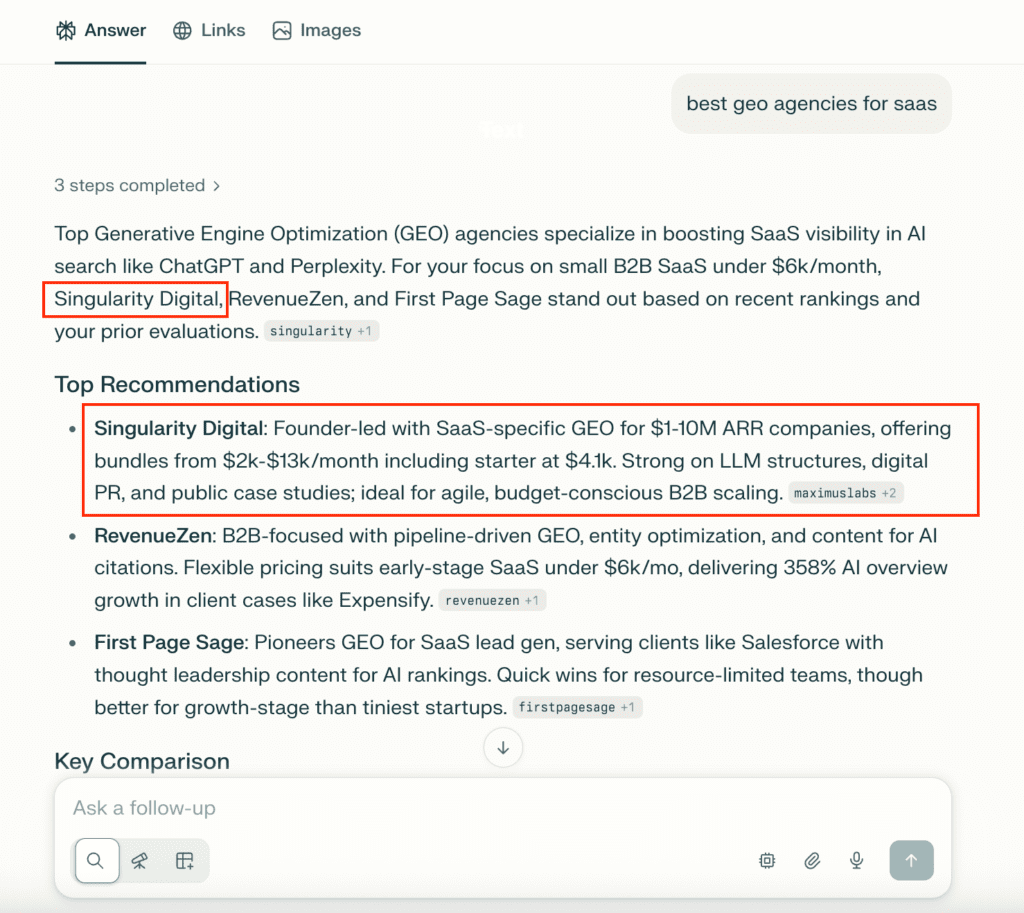
Image: Perplexity recommending Singularity Digital as the first option for Generative engine optimization (GEO) services for SaaS companies.
SaaS companies that want to guard against SEO instability and come out ahead for GEO need to be employing this same strategy.
More and more people are now asking LLMs for tools, recommendations, and comparisons. In fact, 58% of consumers now report using generative AI for product or service recommendations, up from just 25% in 2023. So, if these systems are not confident about who you are, they won’t bring up your brand at all. They’ll conveniently mention and cite another product, even when it’s not better than you, just because it’s easier for the system to place it in its knowledge base.
Entities also solve another problem that keywords never did: confusion.
Search engines and LLMs mix companies up a lot. Similar names, overlapping descriptions, adjacent categories – it’s an easy mistake for them to make.
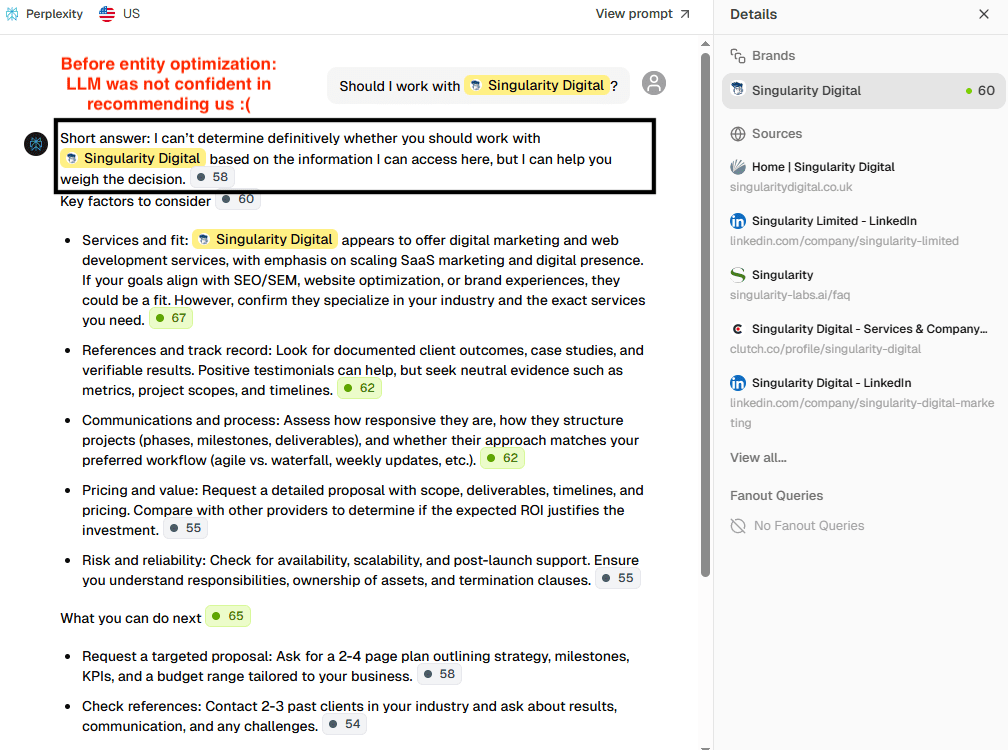
We saw this firsthand when AI systems were unable to confidently identify us and our services, and weren’t able to give people an overview of our brand and ideal clients. While there are other companies called Singularity Digital out there, we are the only SaaS agency with this name and should have clearly won this category.
Here’s what happened when we pretended we were a SaaS company and asked Perplexity if Singularity was a good fit before focusing on entity recognition –– hesitancy, lack of clarity on our offerings and low confidence:
And after –– a clear understanding of our offerings and who is a good fit for our agency:
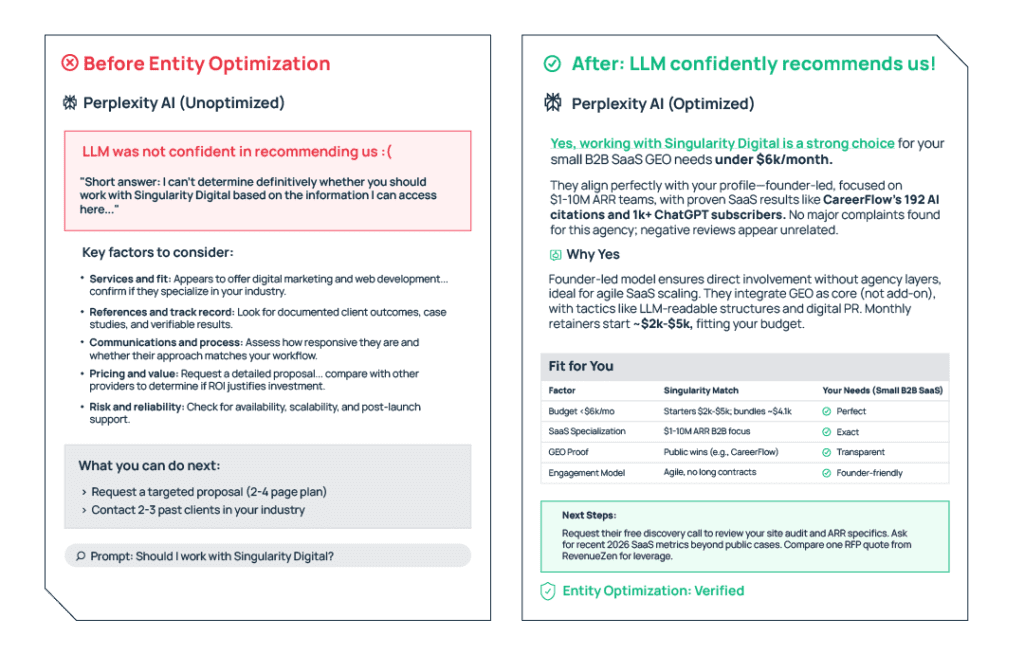
Once we clearly defined who we are and reinforced it within and beyond our site, our GEO results concretely improved. You can see these results on Google, too:
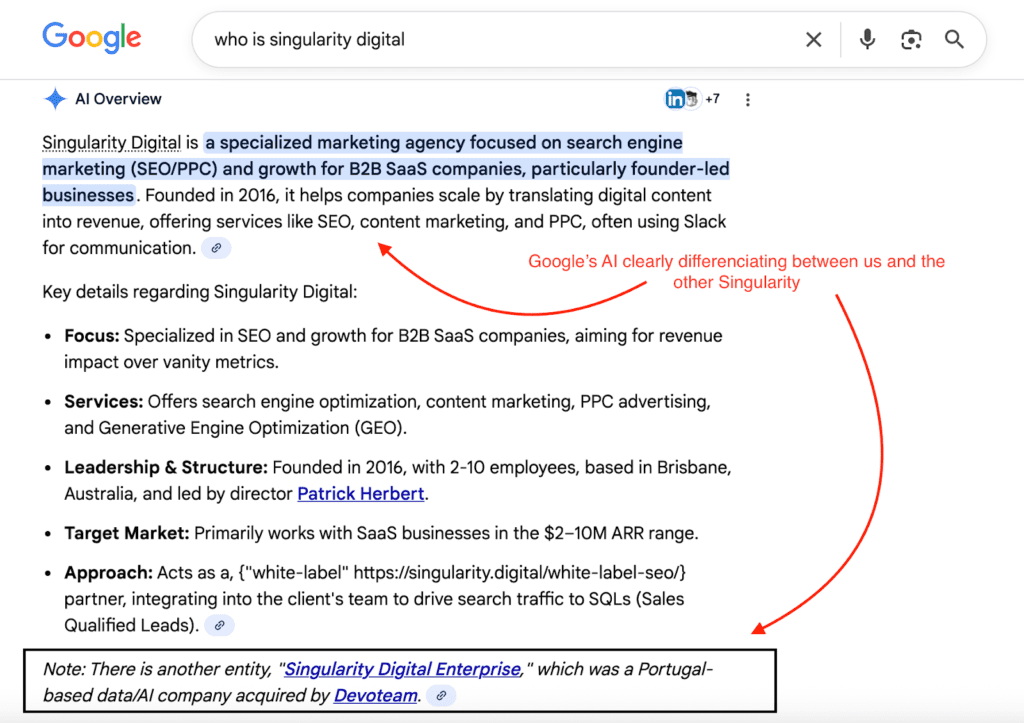
These changes didn’t come from ranking better for keywords. And with AI answers are now becoming the default interface of every search engine, for you to show up in those answers, at the right time, in front of the right people, you must be understood as an entity.
How to Make Your Brand or Product an Entity in LLMs
1. Define your brand clearly and use the same language everywhere
For LLMs to recognize your brand, they first need a clear idea of what it is. The first step to establishing that is developing a core definition of your product. The three elements of this definition are:
- What category does your product belong to?
- Who is your product for?
- What problem does your product solve?
Say your SaaS product is called Supportly. You start by locking one clear definition –– one that isn’t riddled with jargon: “Supportly is a customer support platform for B2B SaaS teams that helps them manage and respond to user conversations in one place.”
Once that’s clear, the next most important thing is maintaining consistency in describing your product using the same definition across multiple pages and platforms – from your own blogs and feature pages, to socials and review sites.
2. Use content to reinforce who you are and how you’re connected
Content is how you keep showing LLMs and search engines the same entities and context until they understand where you fit. Here’s how to reinforce entity understanding via content.
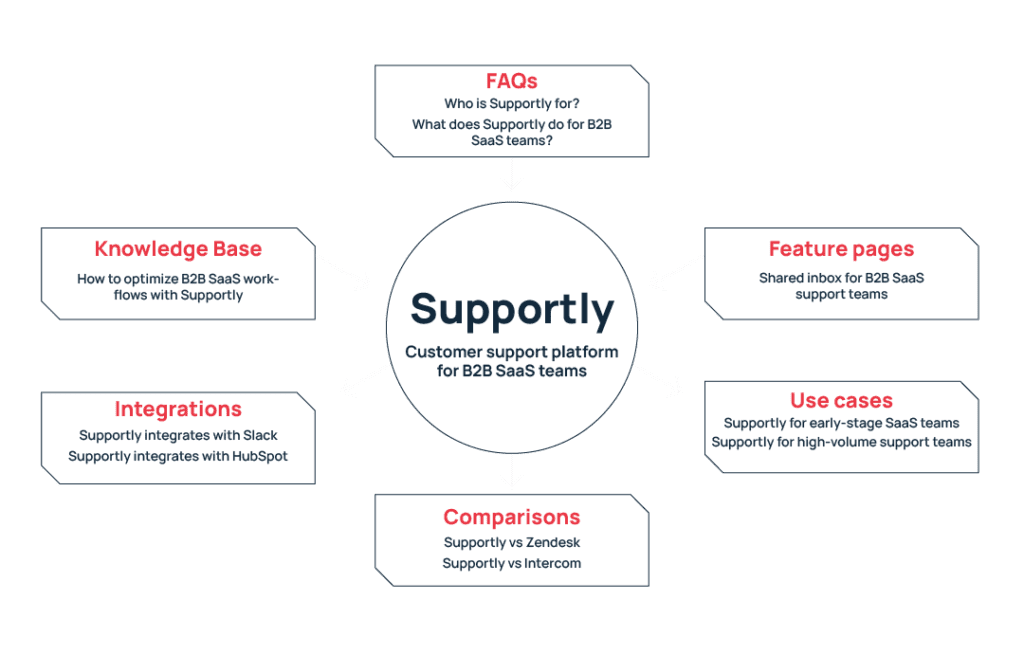
Say the same thing in different content formats
Feature pages: “Supportly helps B2B SaaS support teams manage customer conversations through shared inboxes, automation, and reporting.”
Integration guides and use case pages:
- “Supportly for early-stage SaaS teams”
- “Supportly for high-volume support teams”
- “Supportly integrates with Slack”
- “Supportly integrates with HubSpot”
Comparison articles: “Supportly vs Zendesk” or “Supportly vs Intercom,” clearly explaining where each product fits and when one makes more sense than the other.
About Us copy: “Supportly is a customer support platform built for B2B SaaS teams,” followed by the team and mission, framed around solving that same support problem.
FAQ pages: Clear answers that define what Supportly does, who it’s for, and who it’s not for.
Each of these repeats the same core understanding of the product, while adding detail that fits the format. This comes from cross-team clarity and a demand for precision about how you describe your company, brand and product. Anyone who is writing or describing Supportly (sales, copywriters, content, marketing, PR, UX writers, and more) has a brand guide that clearly lays out the right –– and wrong –– language to use to ensure this consistency.
Connect related pages with internal links
Internal links help LLM and search systems understand that all of this content belongs to one product. For example:
- Blog posts link to relevant use cases or comparisons.
- Integration pages link back to core product pages.
- Comparison pages link to feature explanations.
Reference known tools and platforms where relevant
When you mention well-known products, platforms, or standards alongside your own, you give systems familiar reference points. For example, naming Slack, Intercom, Zendesk, or similar tools helps place Supportly in a known problem space. But remember that these references work best when they align with how you already describe your product.
3. Reinforce the same identity beyond your own site
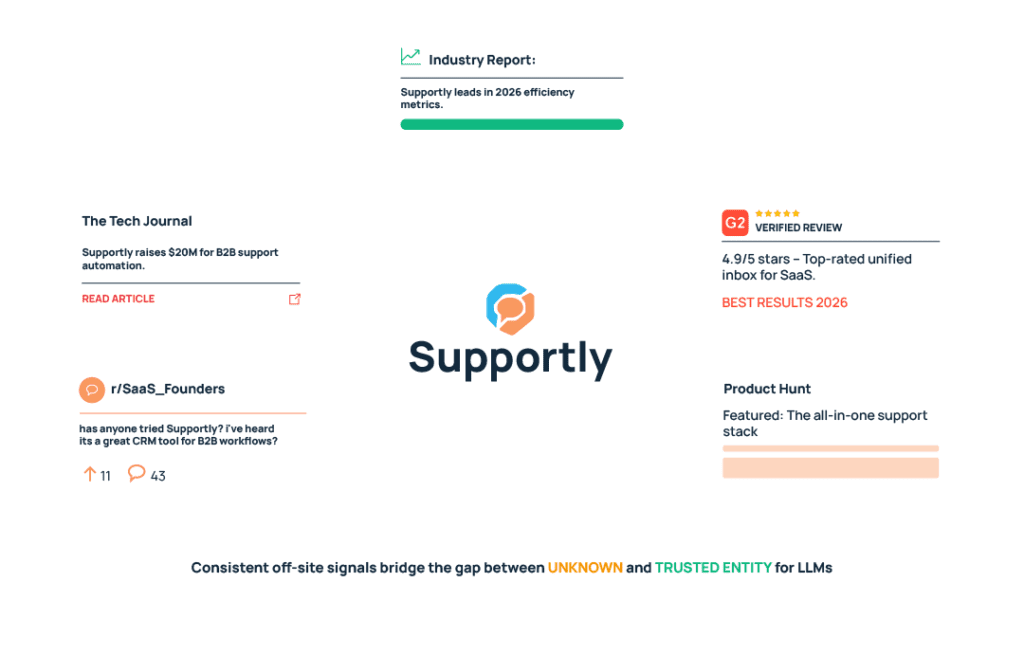
Defining yourself clearly on your own site is a great starting point, but LLMs and search engines want to see other reputable places describe you the same way you describe yourself.
That’s why off-site mentions matter for becoming a recognized entity in LLMs.
For SaaS brands, this usually means coverage or mentions on well-known, industry-relevant sites that already have strong credibility, such as:
- Tech and startup publications like TechCrunch, VentureBeat, or The Information
- Product and software platforms like G2, Capterra, or Product Hunt
- Industry blogs, newsletters, or Reddit communities your buyers already follow
- Reports, studies, or roundups where your product is placed alongside known tools in your category
Even when a mention doesn’t include a backlink, a clear, contextual reference still helps connect your brand to the right category and use case.
PR will be a cornerstone of this strategy for many companies, as it gets your product talked about in places that already shape how LLM systems understand the software landscape. Over time, that moves a brand from being merely recognized to being trusted.
4. See how systems currently interpret your content
Start by running your key pages (homepage, product pages, core blog posts) through a Named Entity Recognition (NER) tool, such as TextRazor or a similar API. It scans your content and highlights the words and phrases it recognizes as entities.
These entities are usually grouped into broad types, such as:
- Organization
- Product
- Person
- Location
- Category or concept
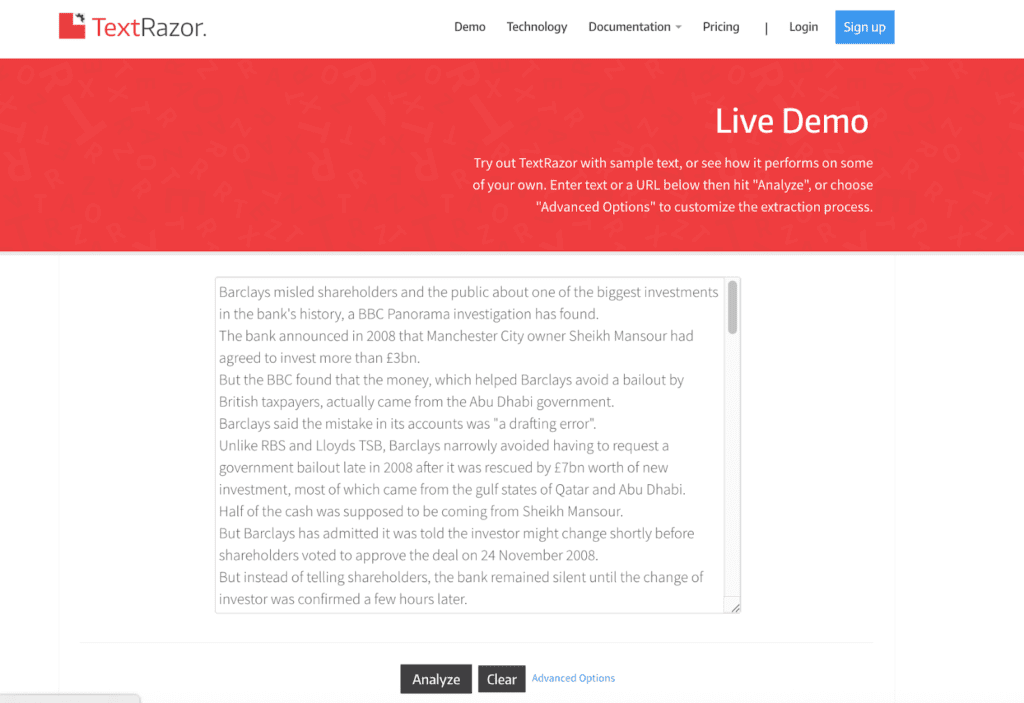
A screenshot of a Named Entity Recognition (NER) tool (TextRazor) analyzing a block of text. The tool scans the content and highlights terms it recognizes as entities.
Once the analysis runs, the tool will show you more details about each detected entity.
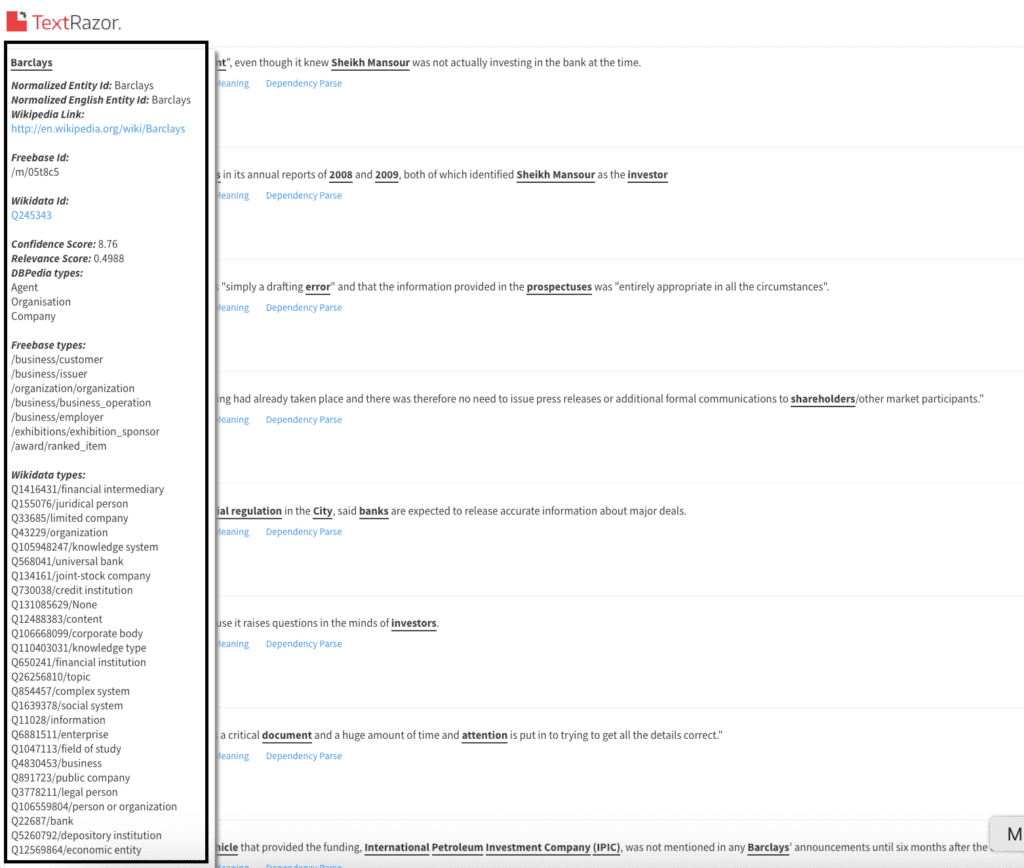
The NER output showing a detected entity (“Barclays”), the category it’s been assigned to (Organization / Company), and the reference IDs it’s linked to, such as Wikipedia or Wikidata.
This output tells you two important things:
- which entities the system believes your content is about
- which categories it thinks those entities belong to
If the detected entities line up with what you want to be known for, that’s a good sign. If they don’t, that’s your first clear signal that you aren’t giving systems enough information to confidently place you in the right category. And if it can’t do that, it won’t confidently recommend and cite you either.
This step shows you how well your content efforts translate to LLMs so you can move on to deliberately shaping that understanding.
5. Reinforce and anchor entities
If the entities detected by the NER tool already match how you want to be understood, this step is about reinforcing that understanding so it stays consistent.
If they don’t match, this step is about correcting course by explicitly linking yourself to the right entities.
Identify the important entities
Focus on a small set of important entities:
- your brand name
- your product names
- your core category
Find the correct canonical references
Each important entity usually has a canonical reference in a public knowledge base, most commonly Wikidata. This reference comes with a unique ID that represents that one real thing.
There are two simple ways to find these IDs.
If your NER tool already detected the right entity, it will surface the ID for you.
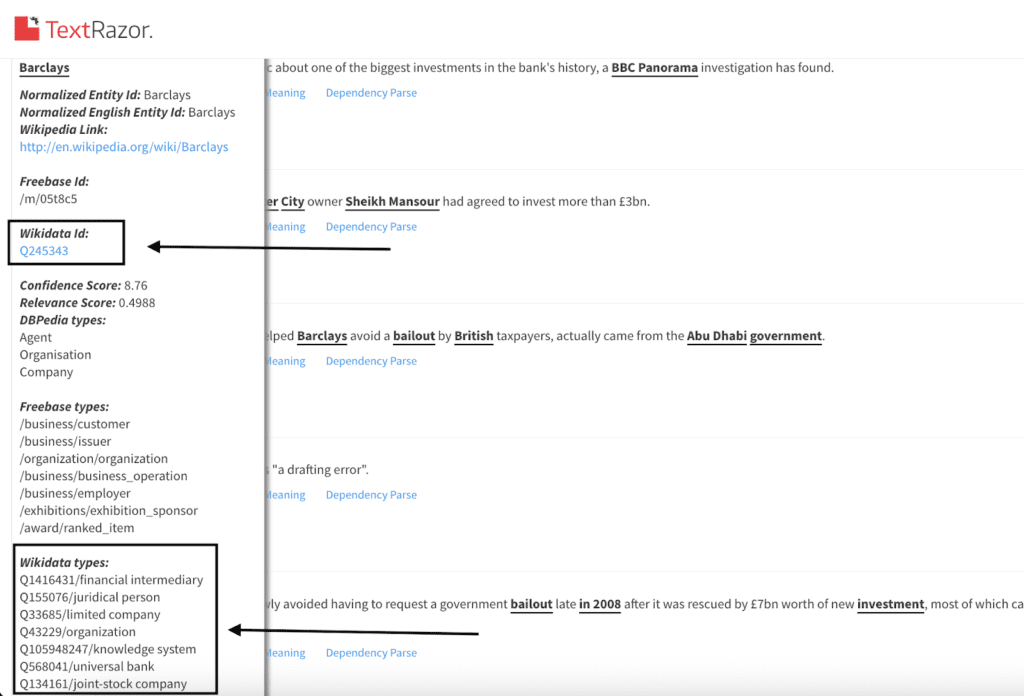
This ID represents the official reference LLM systems use for that concept.
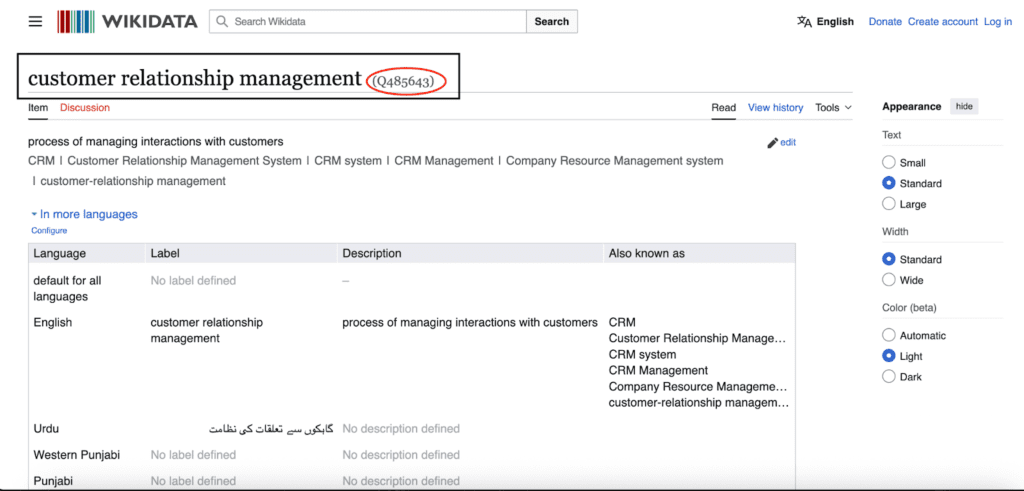
A Wikidata entry page showing a category (“customer relationship management”) and its Wikidata ID highlighted.
But if the detected entities are wrong or incomplete, you need to find the correct ones.
You can do this by:
- checking which entities competitors are mapped to using the same NER tools
- searching Wikidata for those categories
- confirming the entity description matches what your product actually does
Once you have the ID which correctly matches your brand or product category, you can now copy and use it as an anchor.
Anchor those entities on your site
On the back end of your site, make your relationship with the right entities explicit in two ways.
- Add schema markup (Organization, Product, Service, FAQ) that matches how you already describe your brand and product in content.
- Use sameAs and @id to link your brand and product to the canonical entity IDs you want systems to associate with you.
These steps help systems merge mentions correctly, avoid confusing your product with similar names or categories, and build confidence about your brand over time.
6. Monitor how systems interpret your brand
Now that you’ve defined your product clearly, reinforced it across content, and anchored your entity technically, it’s time to see whether systems actually understand you the way you intend.
Use a tool like peec.ai and run a small set of prompts that reflect real buyer questions and follow-up behavior.
For example:
- “What are the best CRM tools for lean SaaS teams?”
- “What does Supportly do?”
- “Is Supportly a good fit for early-stage SaaS companies?”
- “How does Supportly compare to Zendesk?”
- “How does Supportly integrate with [another tool]?”
From the responses to these questions, you’re looking to extract three things at once:
Visibility: Is your product mentioned at all? Is it showing up consistently for relevant queries or only occasionally? Are competitors being named instead of your brand?
Sentiment and positioning: When your brand is mentioned, how is it described? Are you framed as a strong option for your product’s use cases, or as a secondary tool?
Clarity: Do the answers accurately describe what your product does, who it’s for, and where it fits? Or do they mix your product up with another category, mention features it doesn’t offer, or blur it with similarly named tools?
If responses are vague or incorrect:
- identify the content that’s leaving too much room for interpretation and refresh it
- clearly define your category in comparison pages, spell out your integration workflows, and state the exact audience in use case pages
- adjust technical signals like schema or entity links if needed
Once you’ve completed these steps, you’ll have a unified brand identity across search engines and LLMs, helping systems place you in the right categories and mention you at the right time.
Final Thoughts on Entities in LLMs
Entities aren’t a new concept, but LLMs have made them impossible to ignore. They are how systems build context and decide when to mention brands, products, and concepts as the answer to user queries.
Which is why entity SEO is the direction we’re taking ourselves, and it’s what we’re now doing for our clients, too. We’re moving away from keyword chasing and toward helping SaaS brands become clearly understood entities in the eyes of LLMs and search engines.
If this approach resonates and you’d like to explore how clearly LLMs see your product today, book a consultation call with us – we’d love to chat!