E-E-A-T has been part of Google’s quality rater guidelines for years. But its role in content has grown lately with AI systems using E-E-A-T-based filters to evaluate a massive and ever-growing volume of content before synthesizing an answer.
For SaaS brands, understanding how this framework works is essential to creating web content that gains visibility in both traditional SERPs and AI answers.
TL;DR
- E-E-A-T (Experience, Expertise, Authoritativeness, Trust) is a framework Google uses to evaluate the credibility of content.
- E-E-A-T is not a direct ranking factor, but content that follows its guidelines is more likely to rank in traditional SERPs and be cited in AI search.
- Faking E-E-A-T doesn’t work in the long-term. AI systems compare multiple sources side-by-side and evaluate signals across the wider web, which exposes superficial credibility.
What is E-E-A-T?
E-E-A-T stands for Experience, Expertise, Authoritativeness, and Trust. It’s a framework defined in Google’s Search Quality Rater Guidelines, and it describes how the quality and credibility of content should be evaluated.
Before we dive into deeper details, let’s clear up a common misconception that E-E-A-T is a ranking factor: it’s not. There’s no E-E-A-T score sitting in an algorithm somewhere.
Then, why does it matter so much?
Because when Google indexes a webpage, E-E-A-T shapes how back-end systems evaluate, retrieve, rank, and cite content.
Also, Google’s human quality raters use these guidelines directly when evaluating sites. The insights gathered from those evaluations then help Google refine and train its search systems. The patterns found on sites with good E-E-A-T are then favored by the algorithm.
This means that every piece of content your team publishes is being measured against the quality signals E-E-A-T describes. Understanding what those signals are and how to demonstrate them is what keeps your brand visible in both traditional and AI search.
Breaking Down E-E-A-T in the Context of AI Search
When Google returns pages from a search query, every page that is in some way relevant and indexed by Google will be returned to a searcher, whether that’s in position 2 or 2,000.
But AI-driven search works differently. It pulls a single answer from across a handful of sources that it deems most useful and relevant. In other words, AI systems discard many relevant web pages in the course of giving an answer. Based on that, we believe, in AI search E-E-A-T signals help determine whether or not a source enters the conversation at all.
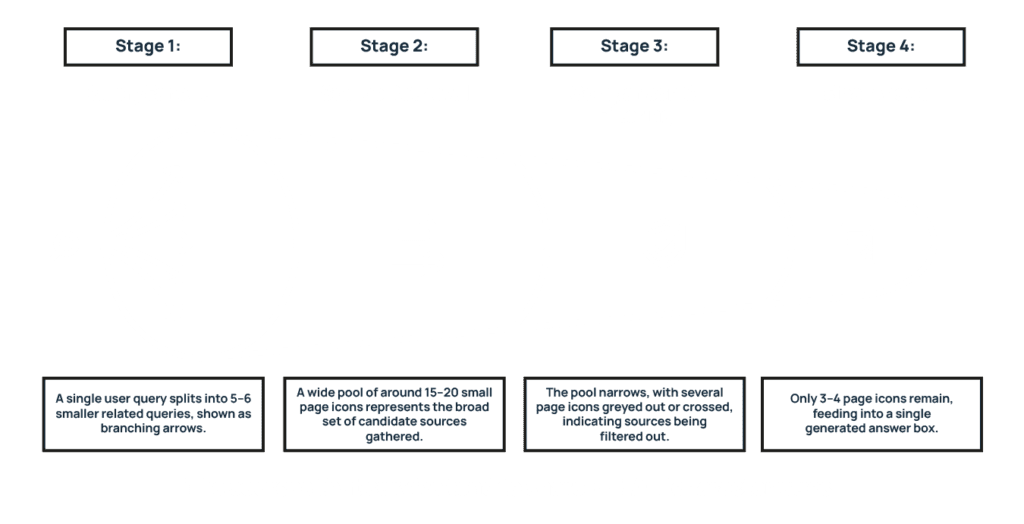
To understand why, it helps to look at how AI systems work to put together an answer:
- A user gives the AI system a question or command, known as a prompt or a query
- The user’s prompt is then expanded into related queries and subtopics (a process called query fanout)
- A wide set of potential sources is retrieved, called the candidate pool
- Those sources are compared against each other for usefulness and credibility
- Sources that the algorithm determines are more useful are kept, while the rest are eliminated
- The AI generates an answer based on a small handful of sources it deems to be the most relevant to the prompt
These last two steps are key. In traditional search, pages are largely evaluated on their own merits against a query, but in AI retrieval, they’re evaluated relative to each other. Which means even decent content can get filtered out if something more credible or more specific is present in the same candidate pool.
So how do you get your content to stay in that candidate pool? The answer is to create content that matches what AI systems prioritize. Current research shows that these systems are inherently programmed to prioritize high-authority domains, credible sources, topical depth, and specificity.
All of that is E-E-A-T. These LLMs don’t explicitly call it that, but it’s written all over the patterns in how they retrieve and evaluate content.
So to appear in LLMs and AI overviews, we think that focusing on writing E-E-A-T content is a good bet. Here’s how to do it.
1. Experience
Experience refers to whether the creator of the content has first-hand familiarity with the topic being discussed, for example, so an LLM can separate a piece by a Financial Times journalist from a post by a hobby blogger. This component shows up very clearly in how AI systems select sources.
For example, say you ask, “What is the best way to calculate the ROI of SEO?” As an LLM formulates the answer, it retrieves large numbers of pages that use similar definitions and surface-level explanations, often because they were written by referencing the same handful of sources.
Many of those pages get eliminated when the LLM’s re-ranking filters compare pages and determine what is the most relevant and trustworthy. In this step, the content grounded in real use stands out because it contains details that only come from first-hand experience.
These details might be:
- Explanations drawn from actual implementation – for example, an SEO agency walking through how they calculate ROI for a client by factoring in time-to-rank, content production costs, and assisted conversions, rather than just repeating the generic “revenue from organic ÷ cost of SEO” formula.
- Examples rooted in real product usage – like a CRM platform’s blog showing how a specific integration reduced manual data entry by a measurable amount.
- Observations about constraints, trade-offs, or mistakes encountered along the way – such as an analytics tool’s CEO sharing why she chose one data model over another and what broke before she got it right.
For SaaS companies, prioritizing case studies, product walkthroughs, and documentation, and insights from founders or company leaders will bring proof of experience. All of these give an easy opportunity to show learnings that are specific and unique, not generic definitions that appear on dozens of other sites.
2. Expertise
Expertise is about whether the source is visibly credible enough for an LLM to trust it with explaining a topic. AI systems are looking for credentialed authors with a track record of publishing on specific topics.
For SaaS companies, this means that publishing great content must be complemented with clear expertise signals for AI systems to consider it reliable. That includes having:
- The author’s name on every piece, not a generic “Team” byline
- A descriptive bio that includes their relevant qualifications, professional background, and links to their social media profiles
- Person schema markup with properties for certifications, job titles, or professional affiliations, which helps search engines and AI systems connect the author to their area of expertise programmatically
These signals help both Google and AI systems assess whether a page deserves to be treated as a reliable reference, and they compound over time as systems start associating your brand or authors with specific topics.
3. Authority
Experience and expertise are things you can demonstrate through your own content, but authority is the one component of E-E-A-T that you can’t fully control, because it depends on how others treat you.
As per Google’s guidelines, authoritativeness reflects how widely a source is recognized by others as a reliable voice on a topic, across the broader web ecosystem.
In traditional SEO, this was largely measured through backlinks. And while backlinks still matter for GEO, AI systems look at a broader set of signals, like:
- Brand mentions across third-party content
- Your content appearing alongside trusted sources in the same topic space
- Citations in reputable publications
- Consistently being mentioned across the web for your areas of expertise
Across the LLM systems we studied (ChatGPT, Perplexity, Gemini, Claude), this plays out clearly during the later evaluation stages.
For example, in Perplexity’s case, connections with high-confidence domains like GitHub or Stack Overflow for developer topics are treated as trusted starting points. Sites that can be tied back to these trusted domains seem more likely to be used in Perplexity’s final answers.
For SaaS brands, authority tends to build through:
- Publishing original research, data, or frameworks that others reference
- Contributing to industry conversations, podcasts, guest posts, and community discussions
- Building a founder or C-suite presence and point of view that becomes associated with your sector
- Using digital PR and partnerships to getting coverage and citations from high domain authority sites in your niche
This is the slowest part of E-E-A-T to build, but also the hardest for competitors to replicate. As a result, once the LLMs start to recognize your brand as an authoritative source for a topic, they begin to mention/cite you more often.
4. Trustworthiness
Trust is the combined result of building Experience, Expertise, and Authority into your content, because these are signals that show Google your site is a reliable source of information.
AI systems choose sources that are credible and reliable by narrowing down possible sources multiple times before citing them, to ensure quality.
These are some of the signals that help your content pass these tests:
- Accurate, verifiable claims backed by credible sources
- Transparent company and authorship information
- A secure, well-functioning website (HTTPS, fast load times, clean UX)
- Honest product reviews and editorial content that serve the reader first
- A strong backlink profile from respected, relevant publications
- A consistent reputation across the web – reviews, mentions, and third-party coverage that all tell the same story
Can You Fake E-E-A-T?
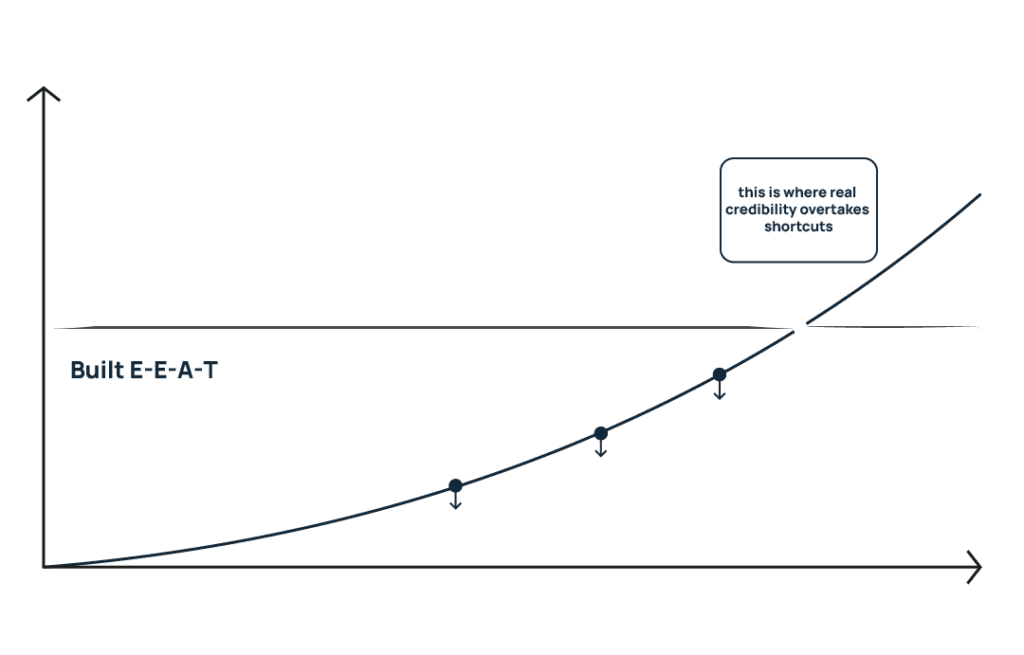
Some of it, sure. You can buy backlinks, put together a polished-looking author bio, and spin up a site that feels credible on the surface. It might even work for a while.
But it won’t bring you long-term results, because search systems don’t rely on any one signal alone.
They’re looking at on-page quality, off-site reputation, link relationships, brand mentions, historical performance, and sometimes, there are manual quality reviews too. You can’t game all of those consistently as the months roll on.
And AI systems make it even harder – we know because we’ve looked at their back-end ranking mechanisms. They apply different filters and compare multiple candidate sources against each other before deciding which ones make it into a final answer. That side-by-side comparison puts huge pressure on the validity of your content.
For SaaS companies thinking long-term, the honest answer is that genuinely building the credibility that E-E-A-T describes is the best way to build brand visibility and get the best return from your marketing content.
Final Thoughts on E-E-A-T in the AI Era
AI systems retrieve a wide pool of sources, compare them, and rely on a small subset to construct answers. The sources that consistently make it through that process tend to share the same characteristics the E-E-A-T framework describes.
For SaaS companies, this makes E-E-A-T something bigger than just an SEO concept. It’s the foundation of whether your content shows up in the places your potential customers are increasingly going to find solutions – Google’s AI Overviews, Perplexity, ChatGPT, and whatever comes next.
At Singularity, we help SaaS brands build E-E-A-T signals that hold up across both traditional and AI search. If you want to know where yours stand, book a call with us, and we’ll take a look together.