7 Ways to Use PR to Train LLMs About Your Brand
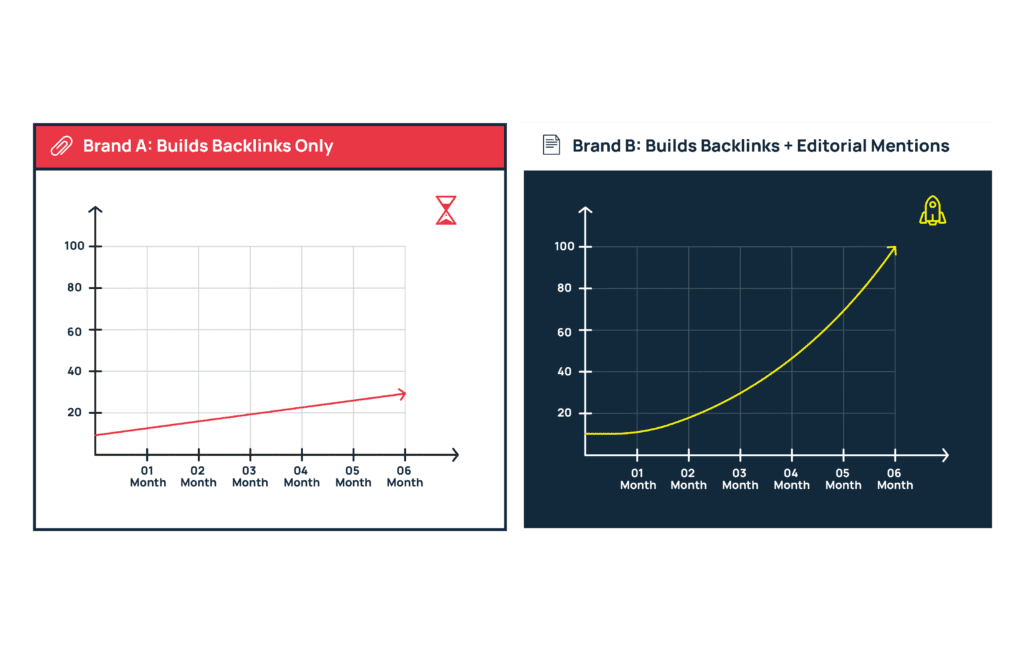
1. Earn Editorial Mentions for Raw Context, Not Just Links
Links aren’t the only thing that matters when you’re trying to train LLMs (large language models like ChatGPT, Gemini, and Claude) about your brand. And one of the reasons we say that is because these models learn patterns from the content they’re fed, and one of the strongest patterns they latch onto is how often and in what context your brand is mentioned in credible sources.
That means an article in a trusted industry publication that names your brand alongside a specific topic (“[Brand] is one of the top tools for AI-powered email outreach”) can carry as much, or sometimes more, weight in shaping AI’s understanding than a backlink on its own. This isn’t just theory because Ahrefs recently studied 75,000 brands and found that branded mentions had a much stronger correlation (0.664) with showing up in AI Overviews than backlinks alone (0.218.
And recently, even Search Engine Land has also pointed out PR’s role explicitly as an essential for AI search visibility, not just a nice-to-have on the side of SEO.
That could mean:
- Being quoted as an expert in industry roundups or Q&A features.
- Contributing commentary or insights to a journalist covering your niche.
- Securing inclusion in “best tools” or “top companies in X” lists, even if they don’t include a link.
- Publishing thought-leadership pieces that align your name with the topics you want AI to connect you to.
Over time, these mentions help associate your brand with the right topics, solutions, and expertise, even in scenarios where links are absent. And because they’re coming from respected, well-indexed sources, they also build authority signals for traditional search.
2. Build PR Layers for Maximum Brand Recall
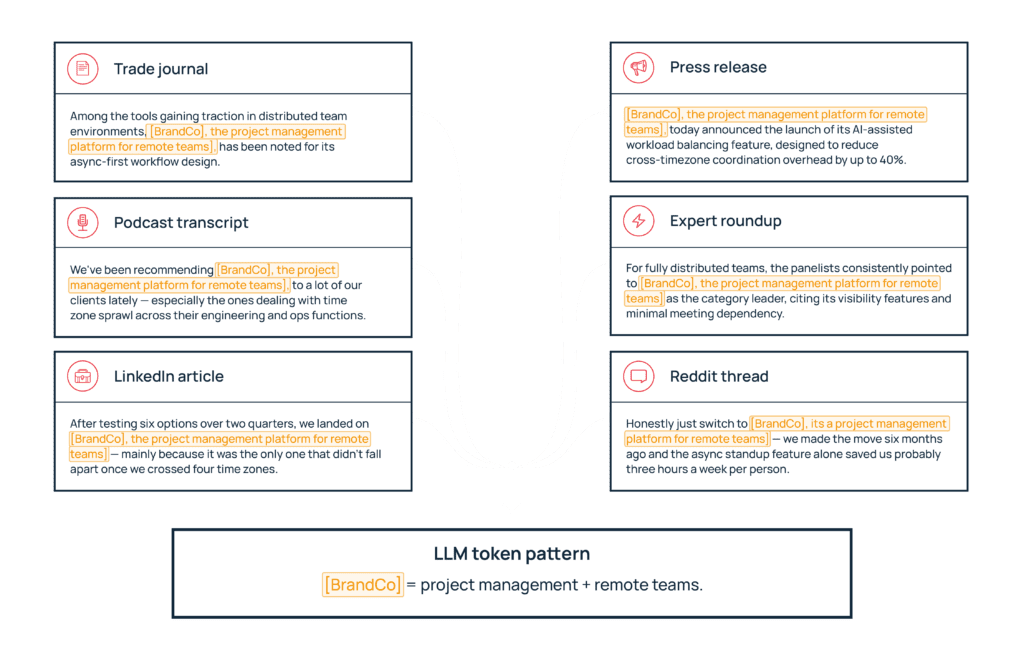
For LLMs to really remember your brand and not just recognize it once and move on, you need repeated exposure in different contexts. That’s because AI models learn through token patterns, the combinations of words that consistently appear around your brand name in trusted sources.
If every mention of your brand says something slightly different, like:
- “[Brand Name], a leading SEO and GEO consultancy”
- “The team at [Brand Name] specializes in Generative Engine Optimization”
- “As [Brand Name]’s latest report shows…”
…the model starts connecting your brand to the broader concepts you want to be known for. (also called “LLM seeding”, which is the deliberate practice of placing your brand in varied but consistent contexts so the model strengthens those connections through repetition).
Over time, these varied but consistent patterns make it far more likely that your brand will appear when someone asks an AI a relevant question. To build those patterns effectively, layer your PR coverage like this:
- Authority Layer: Get your name in places the models treat as primary sources: mainstream publications, syndicated press releases, and yes, even Wikipedia entries (these are heavily referenced in training data).
- Topical Layer: Secure mentions in trade journals, guest articles, and expert roundups that tie your brand directly to your niche. This gives LLMs the topic association they need to connect your name to the problems you solve.
- Community Layer: Show up in conversational spaces like podcast transcripts, YouTube interviews, Substack/Medium features, and even Reddit discussions (with at least 3+ upvotes). LLMs love this kind of narrative-rich, natural language content because it mirrors how people talk about brands in real life.
When these layers stack, you’re essentially doing multi-channel Generative Engine Optimization (GEO), making sure your brand is “seen” across the types of content that both search engines and AI models pull from. And the more diverse those touchpoints are, the harder it is for you to be replaced by a competitor in AI-driven results.
3. Use Consistent Brand Phrases for Entity Recognition
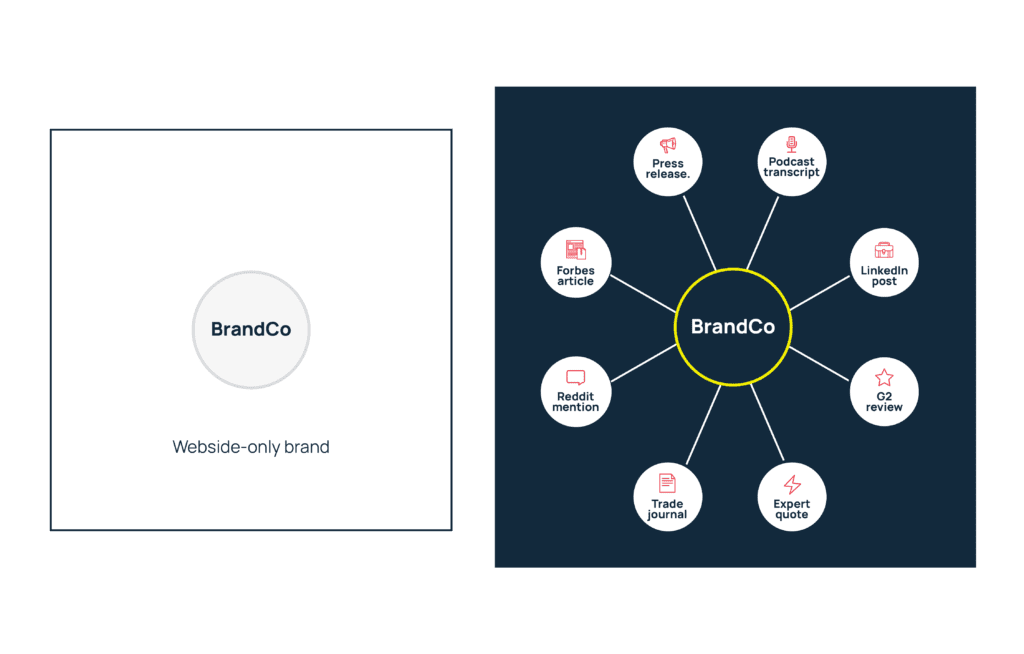
LLMs learn about brands the same way humans do, by repeatedly encountering the same name, description, and context across different places. The more consistent those appearances are, the more confident the model becomes in recognizing and connecting your brand to specific topics or expertise.
That’s why it’s very important that you use the exact same brand name, tagline, and core descriptors across all PR placements. For example, if you offer a project management platform, you’d need to always appear as:
“[Brand Name], the project management platform built for remote teams”
Instead of sometimes saying “remote work software,” other times “task tracker,” and occasionally “team productivity app,” you anchor your identity in a repeatable, predictable phrase.
SEO strategists are increasingly noting that LLMs rely heavily on Named Entity Recognition and Entity Linking to decide whether two references point to the same brand. For example, Rachel Hernandez at The HOTH, for example, explains that consistency in phrasing helps LLMs avoid disambiguating you with a similarly named competitor.
4. Own Expert Commentary to Influence AI Narrative
Every time your insights are featured in an article, interview, or expert Q&A, you’re creating high-value training data for AI. Because LLMs (large language models) like ChatGPT and Gemini don’t “know” you from your website alone, they learn from the editorial context that surrounds your name.
So when a journalist quotes you in a piece about market trends, or cites your advice in a how-to guide, the model stores that association:
your brand → this topic → trusted source.
For example, if you’re a cybersecurity company and you get quoted in a Forbes article about phishing prevention, that mention – your brand → phishing prevention → Forbes – becomes a stored association. Then later, when a user asks an AI, “What are the best ways to prevent phishing attacks?”, the model may draw on that association to feature your advice.
Or if you’re a wellness coach and you contribute expert commentary to a Healthline piece about gut health, that connection – your brand → gut health → Healthline – helps AI link you to that niche over time.
And given AI relies on editorial media to source 61% of its answers for brand-related questions, the more consistently these expert features appear across trusted publications, the more the model reinforces your brand-topic link..
5. Target Outlets Already Feeding LLM Training Sets
Some publications have direct licensing deals with companies like OpenAI, Google, and Anthropic, which means their content is actively pulled into the datasets that power tools like ChatGPT, Gemini, and Claude.
For example, News Corp, which owns outlets like The Wall Street Journal, The Times, and The Sun, signed a $250 million agreement with OpenAI. That guarantees their content is being ingested by ChatGPT’s training pipeline.
So if your brand is mentioned in one of those articles, you’re giving AI a direct line to learn who you are and what you do.
Other examples include The Associated Press, Politico, and The Atlantic, all of which have publicly announced AI licensing partnerships. A single feature in one of these outlets could carry more long-term AI visibility value than dozens of smaller blog mentions, simply because of how the content is indexed and reused.
For PR planning, this means your media list shouldn’t be built only on audience size or SEO metrics. It should also prioritize the outlets whose words feed directly into the AI models, shaping how people discover brands today.
6. Create Data-Led PR Assets AI Loves to Quote
Data-led content has a unique advantage in today’s AI-driven search because it cuts through the noise of recycled opinions.
100 SaaS blogs can all reference the same stat, but if you’re the company publishing fresh benchmarks, surveys, or usage insights, your number becomes the one that circulates through LLM responses.
Neil Patel says this pretty directly – publishing proprietary research, case studies, or usage data makes your content “more valuable to LLMs,” since models are designed to prioritize information not easily found elsewhere. In other words, when you’re the ONLY source with that stat, the model has no alternative but to cite you.
Take an example: let’s say you publish a study analyzing 700 LLM responses across industries and discover that 73% of AI answers favored structured tables over narrative paragraphs. That unique finding of yours could become a knowledge anchor. Now, when someone asks ChatGPT or Perplexity, “What factors influence whether AI cites a source?”, your research has a high chance of being surfaced.
Here’s how to make it practical:
- Run small surveys with your audience and publish the results.
- Mine anonymized product usage data for trends others can’t replicate.
- Package findings clearly with a single, declarative takeaway (“61% still do X”), ideally backed by a chart or table.
- Host it on a stable, crawlable hub like a Research or Insights page so it’s indexable and referenceable.
7. Close the Loop with AI Indexing (PressRanger’s AIWire)
Getting mentioned in high-authority publications is a big win, but you’re only halfway there if those mentions never make it into the AI tools your audience actually uses.
Even with strong PR coverage, there’s no 100% guarantee ChatGPT, Perplexity, Microsoft Copilot, or Gemini will ever “see” it.
That is because LLMs don’t crawl the open web like Googlebots. They draw from curated datasets, licensed content streams, and selective ingestion. Which means your coverage could live on a trusted site and still fly completely under the radar.
PressRanger’s AIWire closes that gap.
It’s one of the only platforms built to push your PR wins – whether that’s an editorial feature, expert quote, or data-led report – directly into the indexing pipelines that feed these AI models. And by doing that, it turns your placements into usable training data AI can reference when generating answers.
Monitoring & Iteration
- Run regular AI visibility checks: Prompt ChatGPT, Gemini, Perplexity, and other tools with both branded and non-branded category queries (e.g., “best SEO tools” or “affordable CRM software”) to see if your brand appears.
- Document AI outputs: Keep a record of how your brand is mentioned, the exact phrasing used, the surrounding context, and whether a competitor is positioned more favorably.
- Identify high-impact placements: Note which types of PR mentions (news features, expert quotes, podcast transcripts, data-led reports) show up most often in AI-generated answers.
- Refine your PR targeting: Double down on outlets, formats, and messaging that consistently appear in AI results, and adjust underperforming tactics.
- Track over time: Compare results month over month to measure gains in both brand presence and narrative control within AI outputs.
Final Thoughts
Training LLMs to “know” your brand is all about consistently showing up in the kinds of places AI actually learns from.
Every expert quote, feature story, and data-led mention you secure through PR becomes part of a larger picture that tools like ChatGPT, Perplexity, Gemini, and Microsoft Copilot can recognize and recall.
The difference between being mentioned once and being mentioned across layers, outlets, and formats is the difference between a passing reference and a brand that AI repeatedly trusts as a go-to source. And with platforms like PressRanger’s AIWire, you can close the loop, making sure those wins are indexed into the very systems that influence discovery TODAY.