TL;DR
- AI tools increasingly shape how buyers understand problems, evaluate software, and perceive brands before they ever visit a website.
- To appear in AI-generated answers, content must not only be indexed but also retrieved and cited, which depends on how that content is presented.
- LLMs break pages into chunks, embed them based on meaning, and retrieve standalone ideas. This means page-level SEO optimizing does not guarantee AI visibility.
- Clear structure, plain language, semantic HTML, and accessibility best practices directly improve how AI systems interpret, match, and reuse content.
- For SaaS founders, GEO is not a one-time optimization but an execution and ownership challenge that requires marketing and engineering, to work together consistently.
For B2B SaaS founders, the shift in how people search online goes beyond rankings or traffic. It’s directly tied to brand and discovery.
Buyers now ask AI tools to compare vendors, and summarize products before visiting a website. For some searchers, AI’s response becomes the first (and sometimes only) impression of your brand.
This means that SaaS founders who have previously focused on SEO now need to consider how AI systems interpret their content in order to improve how their brand shows up during AI-driven discovery.
This guide explains how LLMs index and retrieve website content, how Generative Engine Optimization (GEO) differs from traditional SEO, and how you can structure teams, content, and technical priorities to improve AI visibility and citations.
How LLMs Index and Retrieve Websites
To appear in AI-generated answers, two things must happen: your content must be indexed by an LLM, and it must be selected and cited when a user asks a question. Many SaaS sites manage the first but fail at the second, especially those built only with traditional SEO in mind.
Here’s the basics of how LLMs select and cite.
Crawling: Access Comes First
LLMs rely on crawlers and data pipelines to fetch content. While this overlaps with how search engines work, AI systems are often less forgiving of complexity on your site. Heavily client-side experiences, dynamic loading, or content hidden behind interactions can be unreliable or skipped.
For SaaS founders, this means structuring your website so your most important content is always visible to users, search engines, and AI systems alike. Use clean, server-rendered HTML that is consistently accessible.
Chunking: Pages Become Pieces
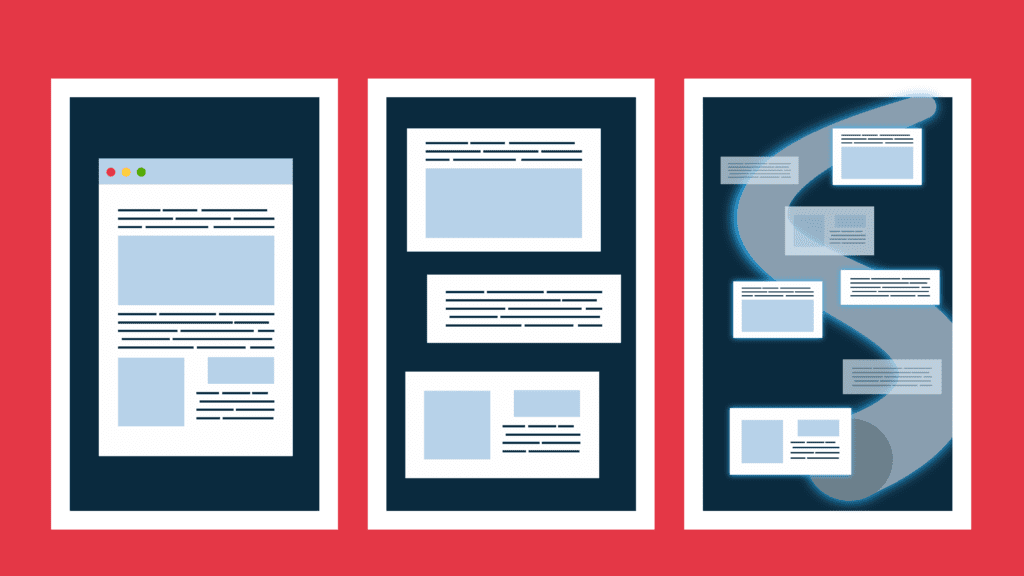
LLMs don’t store pages as a whole. They break them into chunks based on structure: headings, paragraphs, lists, and layout boundaries. If the hierarchy between sections and ideas is unclear, or if multiple concepts are bundled into a single block of text, LLMs have a harder time separating and understanding individual ideas. As a result, that content is less likely to be retrieved when answering user questions.
This is a key gap between SEO and GEO. Pages can rank well but not be cited in LLMs if structure and flow aren’t explicit. While SEO’s EEAT guidelines give a good content foundation, for GEO, focus on short, direct points in a well-structured format.
Embedding: Turning Content Into Searchable Signals
Once an LLM has chunked your content, each chunk is converted into a semantic vector, a numerical representation of its meaning that allows the system to compare it to user questions and other content. Dense writing, heavy jargon, or overloaded paragraphs weaken embeddings because they blur the core idea of a chunk. Clear, direct language strengthens those signals and improves alignment with real user questions.
This is why plain language isn’t just about readability –– it directly affects whether your content can be surfaced at all. For SaaS companies, this means avoiding jargon and unnecessary complexity and talking about your vertical and product in a straightforward way.
Indexing: Context Is Declared, Not Assumed
Chunks are indexed alongside signals like titles, headings, URLs, internal links, and schema. These help AI systems understand what a chunk represents and when it should be shown.
For founders, the key takeaway is that indexing depends on both how content is written and how it’s implemented. Clear messaging and reliable site structure need to work together for AI systems to understand when and how your content should be used.
Retrieval: AI Answers Are Built From Fragments
When users ask questions, AI systems retrieve and re-rank individual chunks, not full pages, before synthesizing an answer. They don’t evaluate page importance the way search engines do. Instead of relying on page-level signals like rankings or backlinks, they prioritize whether a specific idea is clear, self-contained, and trustworthy.
If your content can’t stand on its own at the chunk level, it’s far less likely to be cited, no matter how well it ranks. And once you understand that AI systems retrieve individual ideas instead of full pages, it becomes clear why many SEO-optimized sites struggle to appear in AI-generated answers.
Is AI Even Seeing Your Site?
If LLMs can’t read your site, they won’t recommend it. Learn how AI actually indexes content and what founders need to fix first. Want help getting it right? Let’s talk.
8 Practical Steps to Make SEO-Optimized Sites Work for GEO
Having an SEO-optimized site is a great foundation for GEO because it means you have a clear site layout, and content verticals that align with your brand and your buyer.
To improve this foundation, you need to look at refining your material.
At the content level small changes to SEO-optimized content can make a big impact for AI crawlability without impacting human readers negatively:
1. Write descriptive alt text for every image. This gives images semantic meaning, allowing AI systems to understand how they support the surrounding content.
2. Use a clear, consistent heading hierarchy (H1–H3). This defines how ideas relate to each other, making it easier for AI systems to separate, chunk, and retrieve individual concepts.
3. Replace vague links with specific, descriptive link text. Clear link language reduces ambiguity and helps AI systems understand what information the linked page provides and why it’s relevant.
4. Break long paragraphs into short, focused sentences. This strengthens embeddings by ensuring each chunk expresses one clear idea that can be matched more precisely to user questions.
At the technical level, structure and reliability determine whether content is interpreted correctly:
5. Use semantic HTML to clearly mark primary content areas. This helps AI systems distinguish core content from navigation, footers, and other page noise, resulting in cleaner and more accurate chunks.
6. Separate distinct content sections at the layout level. Clear separation prevents unrelated elements from being grouped into the same chunk, which reduces confusion and improves retrieval accuracy.
7. Implement schema markup to explicitly declare key facts. Structured data helps AI systems understand what specific information represents instead of inferring meaning from surrounding text.
8. Ensure critical metadata is server-rendered and consistently accessible. This guarantees that titles, descriptions, and context signals are reliably available to crawlers and AI systems during indexing.
Many SEO strategies assume humans will scroll and infer meaning. LLMs don’t read or interpret the same way humans do. These tweaks will help your content work both for human visitors on your site and for the machine processes that create AI answers.

Accessibility Standards as a Strategic Advantage
Most founders first encounter accessibility through compliance requirements. But accessibility standards exist because they reduce ambiguity. They encourage content to be explicit, structured, and interpretable across technologies –– exactly what AI systems need.
Why Accessibility Improves GEO
Accessibility practices were designed for assistive technologies, but the same signals help LLMs interpret, chunk, and retrieve content accurately.
Proper heading hierarchy, semantic HTML, and clear content boundaries tell machines:
- Where one idea starts and ends
- Which concepts are primary versus supporting
- How sections relate to each other
This directly affects chunking, embeddings, and retrieval. Accessible structure produces cleaner chunks, clearer meaning, and more accurate citations.
Poor structure forces AI systems to guess, leading to missing context, fragmented answers, and misleading summaries. Plain language strengthens embeddings further, making content easier to match to user intent.
For founders, accessibility has benefits beyond inclusion and compliance, it’s one of the highest-leverage ways to ensure AI tools understand and represent your brand correctly.
But the challenge is that accessibility and structure don’t live cleanly in one team. They sit between content decisions and technical implementation, which is exactly where many organizations struggle to execute consistently.
GEO’s Internal Impact for SaaS Startups
Because of the cross-team ownership of GEO execution, SaaS startups need to treat GEO as an operational concern rather than a purely technical one. That is, to think about how content, structure, and delivery work together across the business.
Marketing and Technical Needs Work Together
One of the biggest mistakes founders make is treating SEO and GEO as marketing-only problems. Visibility sits at the intersection of content, structure, and delivery.
Marketing owns messaging. Engineering and web development owns rendering and structure. SEO, GEO and accessibility sits between them, and fails when no one owns it.
Founders who understand how LLMs work ask a better question than “who writes the content?” They ask: who ensures our content can be reliably understood by humans and machines?
When teams work in silos, content may be well written but poorly structured, or technically sound but semantically unclear. When they work together, improvements reinforce each other across GEO, SEO, UX, and accessibility.
This isn’t about adding processes, it’s about removing friction so content investments scale instead of breaking as the site grows.

Content Systems That Scale
GEO depends on building content systems that ensure every piece is structured, explicit, and able to stand on its own.
This means putting guardrails in place for content to have: clear headings, focused sections, and plain language.
This may be through repeatable processes such as editorial checklists, designating an editor to check over each piece, and outline templates that suggest structures for different kinds of pieces.
These steps make content easier for AI systems to interpret and reuse accurately, while also improving UX, accessibility, and long-term SEO performance as the site –– and your company –– grows.
Marketing Metrics and Revenue Tracking
Marketing metrics and revenue tracking need to expand beyond traditional SEO dashboards. While rankings and traffic still matter, they don’t capture how your product is framed in AI-generated answers or what narratives buyers are exposed to before they ever visit your site.
To close this gap, founders need a system for monitoring AI visibility and message accuracy. This can include regularly sampling AI answers for high-intent queries, documenting how the brand is described, and flagging inconsistencies with your positioning. You can create a simple monthly audit that tracks: which pages are cited, what attributes are emphasized, and whether competitors are being mentioned instead.
Over time, this gives you a clearer signal of how AI systems are shaping early buyer perception, allowing you to connect content decisions to downstream impact on pipeline quality, sales conversations, and revenue.
Ownership of GEO
GEO doesn’t belong to a single function. Marketing may own content creation, engineering owns structure and delivery, and accessibility often sits between them. Without clear ownership, critical details fall through the cracks, especially as AI systems rely on consistency, clarity, and structure to generate answers.
To avoid this, founders need to define GEO ownership early. This doesn’t mean creating a new team, but assigning a clear owner responsible for coordination across functions. You could formalize this through a shared GEO checklist that marketing, engineering, and design all sign off on, or assign a single DRI to oversee content structure, schema, and accessibility standards.
By clarifying responsibility upfront, teams can build a durable content foundation that scales as discovery shifts from clicks to answers, without slowing down execution or creating internal friction.
Bottom Line:
SaaS teams that have success with content marketing over the long-term are the ones that understand why, where and how content is surfaced by potential buyers.
Because buyers are increasingly searching across different types of tools, today, that means working at the intersection of SEO and GEO to structure clear, helpful content that your audience connects with.
This isn’t a job that can be taken care of by one person or even one team at your company, but it is possible if you empower teams to work together to keep up with changes to how your audience searches for and engages with SaaS brands.
At Singularity Digital we focus on helping SaaS teams scale content systems built to perform across search, AI, and real buyer journeys If you are looking for help with being seen, get in touch today!
Is AI Even Seeing Your Site?
If LLMs can’t read your site, they won’t recommend it. Learn how AI actually indexes content and what founders need to fix first. Want help getting it right? Let’s talk.