TL;DR:
- In 2025, OpenAI reports roughly 700 million weekly active users, and ~55% of US adults were using AI across work and personal tasks
- Heavy usage is concentrated among young, educated knowledge workers and students.
- As AI becomes embedded in search and workplace tools, users increasingly ask LLMs for recommendations, comparisons, and alternatives instead of Googling.
- To stay visible in this shift, SaaS companies need GEO (Generative Engine Optimization) so LLMs can actually understand and surface their products where buyers are already searching.
AI is everywhere: it’s in headlines, in product launches, and in every “future of work” prediction you’ve seen this year. With so much hype, it’s hard to tell what the real adoption picture looks like.
As a SaaS founder, knowing who is using AI and why matters because it tells you whether you should invest in GEO and other AI marketing tactics as part of your growth strategy.
Here, we break down what we actually know about how many people are using generative AI from 2025 data, so you can understand how to incorporate GEO into your marketing plan.
How Do Researchers Define “AI” When Measuring Adoption?
“AI usage” is a broad phrase, and most reports mix completely different behaviors into one bucket. To understand a picture of adoption, you need to know what, exactly, is being measured.
A lot of people use ambient AI every day without even realizing it: things like Netflix recommendations, spam filters, fraud detection, keyword suggestions, and photo tagging. By this measure, AI adoption would look nearly universal.
But for understanding how AI affects buyer behavior, and therefore your marketing strategy, you should focus specifically on text-based LLMs like ChatGPT, Claude and Gemini. These are the models people use to ask questions, get recommendations, compare solutions, and make purchase decisions. Adoption of text-generation tools is what actually reshapes demand, discovery, and the SaaS buyer’s journey.
Once you define what kind of AI usage you’re measuring, there’s a second layer that shapes the numbers: how often people are using it. Someone who tried ChatGPT once in 2023 technically counts as a user, but that tells you nothing about ongoing demand. That’s why meaningful adoption data splits usage into frequency bands:
- Ever used: Produces a big number, but not much real value
- Monthly use: Shows consistent interest
- Weekly or daily use: Signals users who rely on these tools
Once you filter AI adoption through these two lenses, the landscape becomes much clearer. For this article, we focused specifically on adoption of text-based LLMs and the frequency of their use to get you only the information you need for your marketing strategy. Let’s dive in.
How many people use AI globally in 2025?
Here’s what the data actually says about who’s using generative AI in 2025.
- Current data suggests that global daily active users (DAU) of generative AI tools likely fall between 115 million and 180 million.
- ChatGPT is the biggest LLM currently, with OpenAI reporting roughly 700 million weekly active users in 2025.
- Google reported in its I/O 2025 keynote that Gemini App has over 400 million monthly active users.
- While Anthropic hasn’t released as much data publicly, Claude is reported as having ~18.9 million monthly active users. While we can’t verify these numbers, it’s clear from the relatively smaller size and from Anthropic’s clearer reporting on usage that Claude is used in a different way than Gemini or ChatGPT.
Although reported user numbers vary across platforms, they all tell the same story: adoption is rising quickly and consistently.
One of the clearest macro signals comes from the Federal Reserve Bank of St. Louis, which shows generative-AI usage (work + non-work) climbing from ~45% of U.S. adults in mid-2024 to ~55% in mid-2025. That’s a huge year-over-year jump, especially for a technology this new.
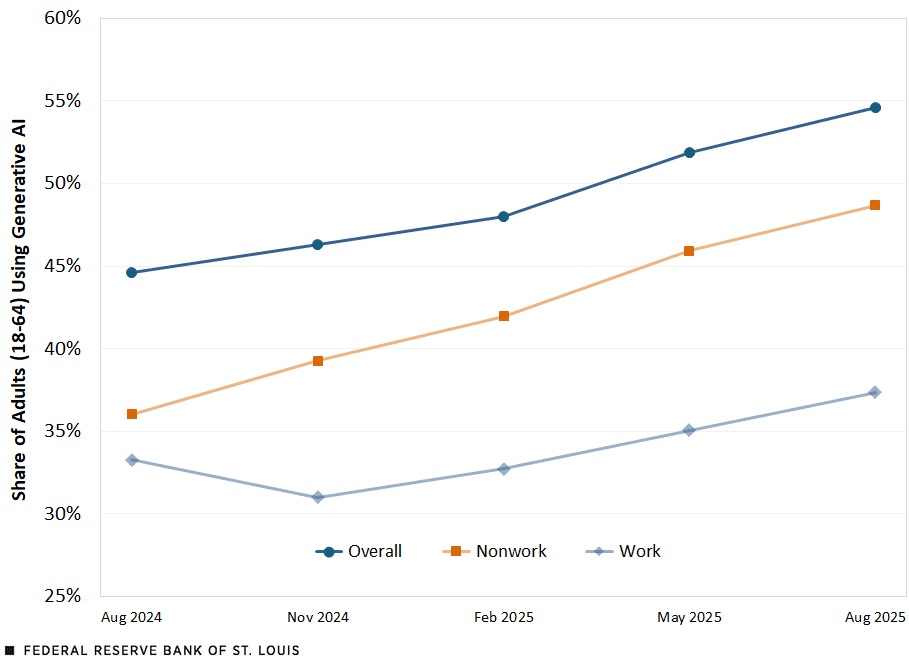
Source: Federal Reserve Bank of St. Louis
This adoption can be split into two parts:
- Consumer adoption is accelerating fastest.
Everyday tasks: search, writing, planning, summarizing, and creative work, are pulling people into LLMs far more rapidly than enterprise rollouts. - Enterprise adoption is growing, but uneven.
Some companies are already deploying gen-AI across workflows; others are in the pilot phase. Surveys repeatedly show a divide between “experimenters” and “scaled adopters.”
AI Adoption Today
AI adoption has quietly become mainstream. We break down what’s happening and what SaaS teams should pay attention to. If you want help, let’s talk.
What Are the Most Popular Uses of AI?
Across datasets, four areas stand out as the clearest indicators of real, sustained AI usage in 2025:
AI-Powered Search Assistants
The widespread use of AI Overviews and generative answers in search is one of the clearest signs that generative AI has reached mainstream adoption. Google has stated that AI Overviews now reach approximately 1.5 billion monthly users, underscoring just how quickly generative AI has become part of everyday search behavior.
Productivity Suites
People may not open ChatGPT every day, but many use AI features embedded in tools like Google Workspace, Microsoft 365, Notion, and SaaS apps that have added LLM-driven features.
Creative and Content Tools
Writers, designers, and marketers are using image models, writing tools, and video generators at scale. A 2025 survey from the American Marketing Association (AMA), found that nearly 90% of marketers have used generative AI tools at work. From that same survey, about 71% use gen‑AI weekly or more, and almost 20% use it daily. Supporting this broader trend, a 2025 study of “LLM‑assisted writing across society” found that by late 2024 up to 24% of corporate press releases analyzed appeared to have been written or edited with LLM assistance.
Coding
AI‑powered coding assistants have become a clear indicator of sustained AI use among developers. According to the 2025 Stack Overflow Developer Survey, 84% of developers say they use or plan to use AI tools in their workflow, and about 51% of professional developers report using these tools daily, making AI a routine part of modern coding and development.

Who’s Most Likely to Use AI?
AI adoption in 2025 isn’t evenly spread. Instead, it’s concentrated in certain demographic and professional groups
Younger adults in the U.S, are substantially more engaged with AI than their older counterparts. A Pew Research Center survey found that 62% of U.S. adults under 30 say they’ve “heard a lot” about AI, compared with just 32% of those 65 and older. This awareness also translates into action: about one-third of under-30s report interacting with AI several times a day, while older adults report much less frequent use.
Education adds another layer. In the same Pew study, nearly 46% of Americans with a postgraduate degree report interacting with AI at least several times a day, compared with roughly 20% of those with a high school diploma or less.
When it comes to professional context, knowledge-intensive roles, such as engineers, marketers, product developers, and researchers, over-index on AI use. According to McKinsey’s Superagency in the Workplace report, nearly half of knowledge workers expect to use generative AI for more than 30% of their daily tasks within the next year. That means these workers are looking seriously at AI as a tool to get work done.
Students also play a critical role in shaping AI’s adoption trajectory. A 2025 survey by the Higher Education Policy Institute (HEPI) found that 88% of university students reported using generative AI tools for coursework or assignments. As these students graduate and enter the workforce, they are likely to bring this familiarity and habitual use of AI with them.
All of this matters because frequent users reflect real engagement, unlike casual one-off interactions.. Ultimately, the demographic story for 2025 is telling us this: the most active AI users are young, educated, and professionally positioned to use AI at their jobs today.
For SaaS companies, this means that starting to experiment with AI visibility now can help you connect with these users and position your product for adoption as their use of AI tools continues to grow.
Research and Decision-Making with AI
The growth curves in AI usage, the rise of conversational search, and the embedding of LLMs into everyday workflows all signal that:
- More users are discovering products through AI-generated answers instead of traditional search.
- Chat-based recommendations are beginning to shape early buying cycles. Our study found 20–25% conversion rates from ChatGPT traffic, compared with lower rates from organic search.
- Visibility inside LLMs is increasingly tied to structured content, clarity, expertise, and entity-level signals, all things founders can control today.
Bottom Line: What This Means for B2B SaaS Founders
AI-driven discovery is becoming a real acquisition channel, not a novelty. As tools like ChatGPT, Gemini, Perplexity, and Claude continue to shape how users research products, so your product’s visibility inside these ecosystems matters more every month.
This is where GEO (Generative Engine Optimization) becomes relevant. The question isn’t “Is GEO mature?” It’s whether there’s enough demand and momentum to justify starting to invest in the channel. And the current data says yes.
For B2B SaaS specifically, this matters because your buyers (knowledge workers, operators, ICs, engineers) are overrepresented among the heaviest AI users. They are the exact demographic most likely to ask an LLM:
- “What’s the best OKR tool for a remote team?”
- “What’s a cheaper alternative to HubSpot for startups?”
- “What CRM integrates natively with Slack and Notion?”
- “What SaaS can automate weekly reporting for my product team?”
If LLMs can’t understand what your product does, who it serves, and why it’s different, you’re effectively invisible in a discovery channel that’s scaling faster than anything we’ve seen since early-era SEO. The companies investing in GEO now will be more likely to surface in LLMs default in 2026-27.
If you want your product to show up where buyers are already searching, Singularity Digital can help. We focus on GEO and SEO for SaaS. To stay ahead of the curve on LLM discovery, contact us today.
AI Adoption Today
AI adoption has quietly become mainstream. We break down what’s happening and what SaaS teams should pay attention to. If you want help, let’s talk.