We hear this a lot in client conversations lately: Search has changed, results are harder to predict, and AI keeps shifting how people discover information. Does SEO forecasting even matter anymore?
Our answer is always, yes, it does.
To manage SEO as a growth channel, you need a way to plan work, set expectations, and understand how your strategy might play out under different conditions. That matters even more for SaaS companies, because SEO remains one of the few acquisition channels that can lower costs over time.
In this article, we break down what SEO forecasting is actually useful for today. We’ll show you how to build a keyword-based SEO forecast using real inputs from your own site, with assumptions about rankings/SERPs, and multiple scenarios you can use to explain outcomes when things don’t go exactly to plan.
TLDR
- SEO forecasting in 2026 is about planning for how SEO might perform under different SERP, demand, and ranking conditions.
- Keyword-based forecasting is the most practical way for SaaS teams to start. It models growth by combining keyword demand, realistic ranking ranges, and conservative CTR assumptions.
- Forecast scenarios should reflect both SEO effort and the search environment: baseline for adverse conditions, expected for planned execution, and stretch where things break in your favor.
- Anticipating leads or sign-ups using forecasts requires applying historical conversion rates based on page type, not a single blended sitewide number.
- The output of a forecast should be a clear view of priorities, realistic contribution from SEO over time, and the risks that could impact performance.
What is SEO Forecasting?
SEO forecasting involves estimating future organic traffic or conversions based on current performance, search demand, and planned SEO efforts. It helps teams plan marketing budgets, set realistic growth expectations, and understand how SEO could contribute to revenue over time under different conditions.
For a long time, this was a routine exercise because search behaved in fairly predictable ways.
But AI Overviews, featured answers, and other zero-click experiences now sit between users and websites. This means that ranking pages can drive less traffic than historical models. Plus, Google ships major algorithm updates almost every 3 months, and that shifts ranking behavior for reasons that aren’t directly tied to content quality alone.
That means forecasts are planning tools rather than predictions.
Why SEO Forecasting Matters
Being responsible for SEO at a SaaS company, you’re expected to drive growth and explain when and how that growth will show up. SEO forecasting helps with that in a few very specific ways.
Better resource management
SEO forecasting helps you see whether the growth targets set for SEO are achievable with the resources you have. For example, if leadership expects organic traffic to double within a specific timeframe, a forecast forces you to think about whether that is even possible with your current domain authority, ranking positions, link-building budget, and a content team of one.
With forecasting, you can lay out the conditions required to hit the target upfront, and align expectations and resources to match your company’s goal.
Effective communication with stakeholders
SEO outcomes are hard to explain, especially now. Attribution is fuzzy, AI has changed how people discover and evaluate solutions, and even when SEO is influencing results, it’s not always easy to point to a clean traffic lift and say, “this came from SEO.”
Forecasting gives you a shared reference point for these conversations, and provides context for the marketing landscape early on. So if performance fluctuates, you can point back to the forecast and say, “We expected variability here,” or “This is one of the scenarios we accounted for, and here’s our plan moving forward.” This reporting keeps conversations grounded and solutions-oriented, rather than turning into opinion-based debates.
Improved SEO strategy
At its core, SEO forecasting helps you make better strategic decisions over time. A forecast lays out the “ifs” and “buts” upfront – what happens if rankings improve, what happens if they don’t, what happens if competition increases, or SERP layouts change.
When things go well, the forecast helps you see what’s working and where to double down. When they don’t, you’re not starting from scratch because you already have alternative paths modeled, so you can more easily shift focus, test a different approach, or reallocate effort.
Ready to Scale Your SEO?
At Singularity Digital, we help SaaS teams turn SEO forecasts into something they can actually plan around and defend internally – if that’s something you’re working through, we’d love to talk!
Core Methods of SEO Forecasting
The mechanics of SEO forecasting haven’t changed much over the past few years. We still forecast using keyword demand, historical data, and competitor benchmarks. What’s changed is how those inputs are adjusted and how the outputs are explained in current search landscape.
Keyword-Based Forecasting
Keyword-based forecasting estimates potential traffic by looking at search demand and modeling what happens if rankings improve.
You start with the keywords you want to rank for, look at how often they’re searched, and then estimate how many clicks you could earn at different ranking positions. This method is most useful when you want to answer questions like: If we rank higher for these terms, how many more leads could that realistically bring in based on increased traffic?
This approach works best for:
- clear, high-intent keywords
- topics with relatively stable SERP structures
- growing SaaS sites that don’t yet have long traffic histories
The main limitation of keyword-based forecasting is that it assumes rankings translate into clicks in predictable ways. In today’s SERPs, features like AI Overviews, featured snippets, and videos can reduce available clicks, so keyword-based forecasts need conservative CTR assumptions and regular recalibration.
Historical Trend Analysis
Historical forecasting projects future performance by extending patterns from your existing data.
This method looks at impressions, clicks, and conversions over time, usually from tools like Google Search Console, and asks what happens if those trends continue at a similar pace. It’s most useful for answering questions like: If nothing major changes, where does SEO performance likely land over the next few months?
This approach works best for sites with:
- established organic traffic
- multiple quarters of relatively stable data
- clear conversion paths and consistent performance
The main limitation of historical trend analysis is that it assumes past performance drivers still hold. For example, if SEO performance was driven by a feature that’s now fully adopted, or replaced, or if SERP layouts or ranking behavior have changed, historical trends reflect conditions that no longer exist, making them a weak predictor of what comes next.
Competitor Analysis
Competitor-based SEO forecasting is used to understand how your brand stacks up against competitors today, where they are getting visibility (in SERPs and AI answers), and how long it would realistically take you to show up in those same places with comparable or better positioning.
To assess this, you need to factor in your competitors’:
- domain authority and backlink strength
- depth and consistency of topical coverage
- internal linking structure
- ranking stability across core terms
- frequency and sentiment of AI answer mentions
Competitor analysis works best for:
- competitive or crowded product categories
- markets where multiple brands target the same core keywords and SERP positions.
This method’s limitation is that it does not estimate traffic or leads. It only helps you understand how you compare to competitors, how fast you could realistically close the gap, and what level of effort that would require.
How to Build Your SEO Forecast
In this section, we focus on keyword-based SEO forecasting only because it the simplest place to start and the easiest method to apply. But if you’d like to explore other forecasting approaches, these guides are useful starting points:
Step 1: Pull the keywords you want to forecast
The goal of this step is to identify the keywords that will actually be impacted by SEO work. That means focusing on product-relevant, non-branded queries. such as feature terms, use-case searches, integrations, comparisons, and “best” or “alternatives” keywords, while leaving out branded searches like your company or product name.
Doing this isolates the portion of organic traffic that can change through content, rankings, and authority improvements, rather than traffic driven by existing brand awareness or sales activity.
To pull the keywords:
- Open Google Search Console and go to Performance → Search results.
- Switch the view to Queries.
- Export the data into a spreadsheet.
If you’re forecasting for new content, add those keywords manually in the same sheet. Only include keywords you actually plan to create or meaningfully improve content for, so the forecast stays tied to execution.
Step 2: Get search volume for each keyword
This step helps you see how keywords compare in demand, so you can prioritize SEO work that follows, such as in-depth SERP analysis.
To do it:
- Paste your keyword list into Ahrefs or Semrush and pull the average monthly search volume for each keyword.
- Cross-check important keywords in another tool to understand the range, since different tools report different estimates.
- Add the search volume next to each keyword in your sheet.
Step 3: Review the SERP for competitiveness
When you look at search volume for keywords in Ahrefs or Semrush in Step 2, you’ll also see SEO difficulty scores. These are useful for a quick overview, but they’re not enough to base ranking or traffic expectations on. For that, you should go deeper and manually review the current top-ranking pages to understand what you’re really competing against.
As you review the SERP, pay attention to:
- The types of sites ranking (large brands, niche blogs, SaaS companies)
- Domain authority of sites
- Frequency of AI overviews appearing
- Whether the same sites rank consistently for similar topics (topical authority)

Step 4: Set ranking expectations
By this point, you’ve narrowed the keyword list and reviewed the SERPs, so you know who you’re competing with and how strong your site is relative to them. Use that context to decide where each keyword could realistically rank (give it a range, e.g., position 5-8), given the SEO work you’re actually planning to do.
Which might include:
- Creating new pages or heavily refreshing existing ones
- Improving internal linking to those pages
- Building relevant backlinks or strengthening authority around the topic
- Fixing technical issues that block performance
Write the ranking range next to each keyword or keyword group in your sheet. These ranges are what the rest of the forecast will build on.
Step 5: Apply click-through rate (CTR) assumptions
Let’s say you’re forecasting a keyword to rank around position 3, look at the CTR of other keywords on your site that already rank around position 3 and use that.
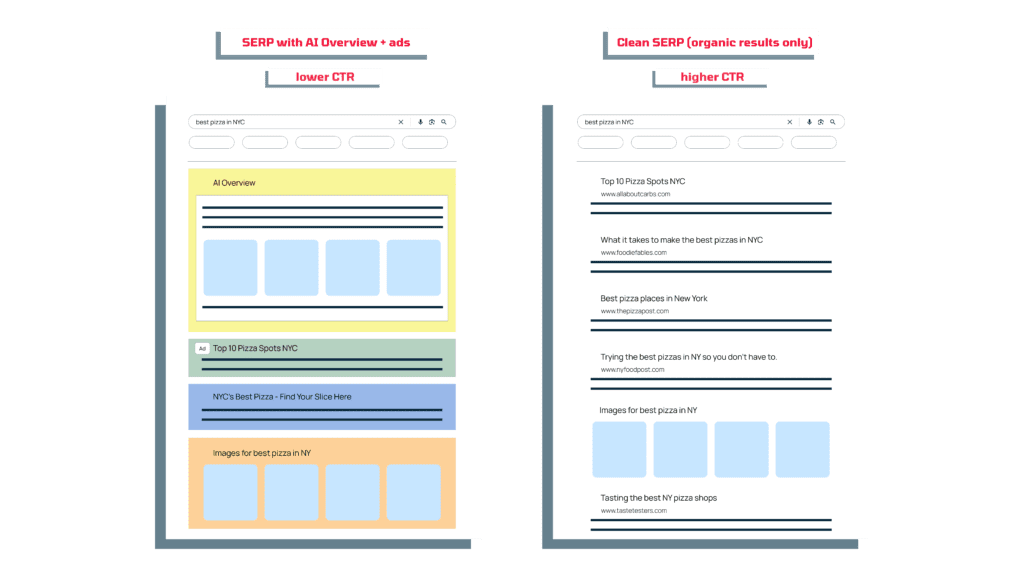
If you don’t have enough of such organic data yet, use a conservative baseline CTR of around 1%. This gives you a defensible starting point that reflects modern SERPs, where AI Overviews, ads, and rich results reduce the number of available clicks.
From there, adjust CTR expectations based on what you see in the SERP:
- Heavily crowded SERPs with AI Overviews or multiple paid placements should stay closer to the baseline – 1%
- SERPs with mostly organic results can support higher CTR assumptions
- Bottom-of-funnel pages, like comparisons or alternatives, may justify higher CTR once rankings improve
Add the final CTR assumption next to each keyword or keyword group.
Step 6: Calculate traffic potential
This step shows you how much of the search volume could realistically turn into visitors on your site once rankings and SERP structure are factored in.
Remember, high search volume on its own doesn’t guarantee visitors – if the SERP structure reduces clicks (eg, with AI overviews) and CTR is low, that demand won’t translate into traffic for you.
So, for each keyword, calculate: monthly search volume × assumed CTR = estimated monthly traffic.
With every keyword measured in visits like this, you can add them together to see the total traffic your SEO program could deliver if the assumptions hold.
Step 7: Create forecast scenarios
A lot of times, even when your SEO inputs stay the same, results can change because of external factors like SERP layouts or search demand. So, when you lay out scenarios ahead of time, it helps evaluate how resilient your plan is and keeps later conversations about performance anchored to expectations you already agreed on.
Start by duplicating your entire forecast sheet into three versions.
- Baseline scenario
The baseline scenario assumes SEO work continues as per the plan, but external conditions aren’t especially favorable.
- Content is published and maintained, but authority gains are limited.
- SERP layouts may shift in ways that reduce available clicks (for example, more AI Overviews)
- And search demand may reduce for some keywords due to seasonality or broader market changes.
These factors don’t all have to happen at once, but even one or two happen, they’re enough to constrain the gains.
Result in your baseline scenario: Rankings see no sustained improvement and traffic stays close to current levels with none or only minor increase.
- Expected scenario
The expected scenario reflects what happens when the planned SEO work addresses the right gaps, and SERP conditions stay broadly similar to what you observed during the SERP review.
As a result:
- New content adds depth around priority topics and strengthens topical coverage.
- Content refreshes close gaps between what your page showed before and what people are actually searching for.
- Links strengthen overall domain authority, making it easier for pages to rank over time.
Results in your expected scenario: Rankings move into the ranges you modeled, and traffic grows in line with those ranking gains, and leads or sign-ups increase accordingly.
- Stretch scenario
The stretch scenario assumes the same SEO effort as the expected case, but the conditions are more favorable.
Search demand increases for some keywords, competitors lose visibility or slow down, and your site’s authority grows faster than anticipated. Your content may also appear more often in prominent SERP placements, including AI-generated answers.
Results in your stretch scenario: Rankings move higher than the ranges you initially modeled, and traffic grows beyond what you planned for. MQLs and revenue increase accordingly.

Step 8: Convert traffic into leads or signups
This step is about turning rankings and traffic into something measurable (e.g. leads, sign-ups, or demos) adjusted for each scenario.
Choose conversion rates based on the type of pages you’re forecasting:
Start by looking at historical organic conversion rates in your analytics tool (GA4, e.g.). Note that different types of pages convert at different rates, with blogs and educational content converting less than feature, solution, or comparison pages. You will use a combination of your historical data for specific pages and general trends to create estimates for each scenario
For the baseline scenario, apply current or even slightly depressed conversion rates to baseline traffic, to reflect rankings that don’t meaningfully improve, and traffic and leads staying close to current levels.
For the expected scenario, apply the same page-type specific conversion rates to the expected traffic numbers using the simple formula: forecasted traffic × page-specific conversion rate. Eg, if you predict 10,000 people would visit your comparison article, and 2% of them convert, the calculations would be 10,000 × 0.02 = (potential) 200 sign-ups.
For the stretch scenario, model improvements in two ways.
- First, apply historical conversion rates to stretch traffic for pages that aren’t changing significantly but may benefit from stronger authority or link-building.
- Second, for pages you plan to substantially refresh or improve, account for higher conversion or sign-up rates alongside the increased traffic.
Important reminders:
- Always document your assumptions. Note which conversion rates were used and why, and call out if rates are based on limited data or estimates.This makes it easier to revisit the model later without redoing the entire forecast.
- Regularly update your forecasts so you can track progress, prove results, etc.
- Adjust projections if and when external factors hit, like a google algo change
The Power of SEO Forecasting
You can align execution with the goal you’re accountable for
Once you calculate expected traffic and conversion rates, it becomes clear which keywords and pages are most likely to drive real outcomes like leads or sign-ups. Those pages should be worked on first, because they contribute more directly to the goal you’re trying to hit. For instance;
- If the goal is traffic growth, the forecast shows which topics have enough search volume (usually TOFU terms) to move that number. You can focus on getting those topics live earlier so they start contributing sooner.
- If the goal is leads, the forecast points you toward pages that historically convert better (like BOFU keywords), so effort goes where returns are more likely.
You can explain priorities and budget needs with confidence
The forecast gives you a clear way to explain why certain work needs to happen now and what additional resources would help reach the target faster. That makes budget and headcount conversations much easier.
Final Thoughts
Given how search has evolved, SEO forecasting is now a tool to think through different scenarios ahead of time and estimate your marketing performance. Forecasting allows you to understand where your budget is best spent and to plan how you would respond if conditions change.
For SaaS marketing leaders, it also helps you bring everyone onto the same page. It lays out what could happen, what assumptions are being made, and what risks exist. This reduces time spent defending SEO or re-explaining decisions, and can help you pivot quickly to keep your SEO engine running, because the team already agreed on the range of outcomes and troubleshooting.
Reach out to us if you need help building or reviewing your existing SEO forecast. We’ll take a look at your current assumptions and discuss what’s realistic for your SaaS.
Ready to Scale Your SEO?
At Singularity Digital, we help SaaS teams turn SEO forecasts into something they can actually plan around and defend internally – if that’s something you’re working through, we’d love to talk!
FAQs
How do you forecast SEO for a new website?
You forecast SEO for a new site by relying on keyword demand and competitor analysis rather than historical performance. That means modeling search volume for the keywords you plan to target, estimating realistic ranking ranges based on competitor strength, and using conservative CTR and conversion assumptions. Early forecasts for new sites should be treated as rough and updated once real data starts coming in.
How often should you update your SEO forecasts?
You should revisit your SEO forecasts every six months.
Updating too frequently usually leads to chasing short-term noise, especially with conversion rates that can fluctuate month to month. Longer windows smooth out variability and give you a clearer signal. Forecasts should also be updated if there’s a major change in strategy, product, or market conditions.