
You and your competitors are both publishing regularly, and both have technically sound sites — but they’re showing up in AI answers, and you’re not? Well, that’s because getting AI to find and read your content is only half the battle.
Once AI finds your content, it runs everything through a series of filters, and only the content that clears them makes it into the final answer. And getting through those filters comes down to how your content is written.
This guide covers the patterns we found in content that consistently gets cited — drawn from our research into how ChatGPT, Gemini, Perplexity, and Claude cite sources.
TL;DR
- Write with the specific details your buyers include in their LLM queries — integrations, team sizes, price points, use cases
- Front-load the answer at the page and section level so LLMs can find your key points immediately
- Cite recognised, authoritative sources inline + hyperlink so LLMs can confidently verify your claims
- Use consistent language to describe your product so LLMs can correctly place your brand in the right category
- Structure your content with clear points and formatting so LLMs can chunk it accurately and completely
Quick refresh: How large language models (LLMs) choose which answers to cite
Large language models are advanced AI systems — like ChatGPT, Gemini, Perplexity, and Claude – that ingest vast amounts of information from the web to understand user queries and respond to them as accurately as possible.
When a user asks an LLM a question, the model doesn’t just find one best page to create an answer with. Instead, it picks several pages that meet its quality benchmarks to cite in its final answer. Here’s how it finds those pages:
1. Finding related questions (Query Expansion). The model takes the user’s prompt and rewrites it into multiple related sub-queries to cover every constraint and angle it contains. For example, “best project management tool for remote engineering teams under $20 per user” might get split into “project management tools for engineering teams”, “project management software under $20 per user,” and more.
2. Pulling candidate pages (Retrieval). For each of those sub-queries, the model pulls a wide pool of pages from across the web that are relevant to them.
3. Breaking pages into chunks (Chunking). Each retrieved page gets broken into ~200-word chunks, and each chunk is evaluated independently on whether it usefully addresses a specific constraint from the query.
4. Comparing the best chunks (Comparison). Chunks that passed as useful get compared against other useful chunks from competing pages. Then the ones that best satisfy the query’s intent make it into the final answer.
Most content gets filtered out somewhere in this process. That’s why the strategies below show you how to clear each stage and get cited in the final answer. (Based on our best knowledge of how major LLMs work)
For a full breakdown of how this works across ChatGPT, Gemini, Perplexity, and Claude, read our guide on how to rank in LLMs.
1. Write with specifics that match how users prompt LLMs
To get mentioned in LLMs, your content needs to spell out all the specifics people are looking for when they chat with AI. Unlike the keywords we used to search in Google (“best project management software”), searchers use long, fully built-out sentences when prompting LLMs (“best project management tool for remote engineering teams under $20 per user”).
These prompts contain multiple details that the LLM needs to address, so it breaks them into sub-queries to answer every part of the question (best remote project management tool, project management tool cost, etc) .
A lot of SaaS content has cliche phrasing like “powerful integrations,” which LLMs won’t cite because it’s too vague to answer people’s questions.
To do: Be explicit about details – name the integrations you support, state the price, describe the exact team type and use case you’re built for. Instead of “Supports integrations with major HR tools,” write “Connects directly with BambooHR, Greenhouse, and Rippling — no middleware required.”
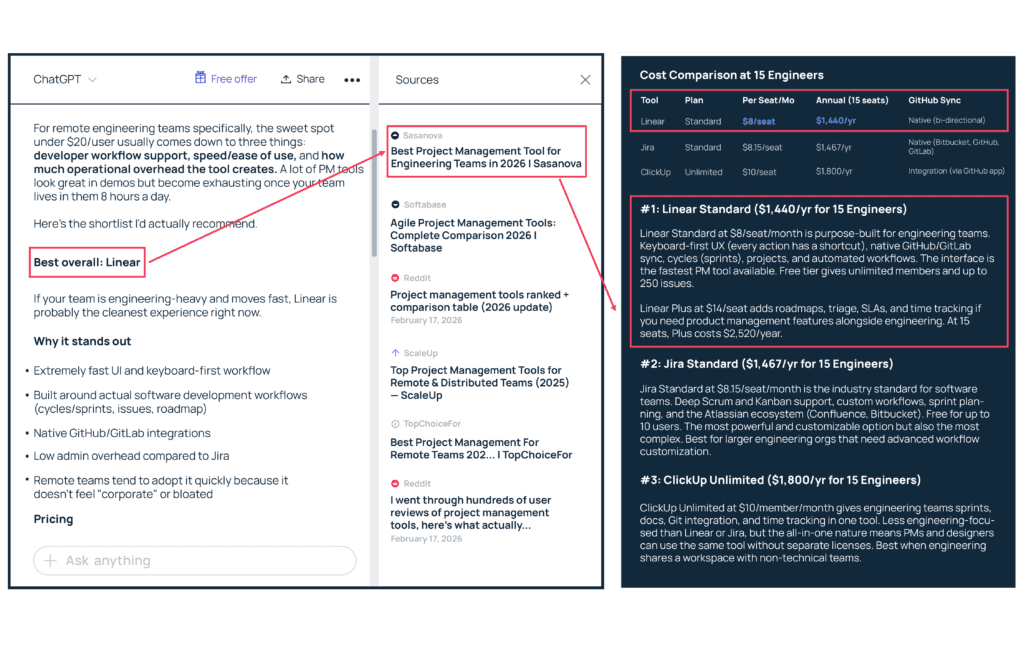
For example, Sasanova’s page on project management tools for engineering teams names exact pricing, native integrations, and team-specific trade-offs throughout. When ChatGPT answered “best project management tool for remote engineering teams under $20 per user,” it cited Sasanova as its top source — because the content already spoke the language of the query.
2. Lead every page and section with the most useful information
You need to state your conclusions early to get mentioned by AI. Humans and LLMs both lose patience with content that takes forever to get to the point — but where a human might scroll to find it, an LLM won’t. It pays most attention to the first 30% of a page, so the further down your answer sits, the less likely it is to get picked up.
And when your page does make it through the page-level filter, LLMs break it into blocks of around 200 words to evaluate your content section by section. Each block needs to stand on its own as a clear, complete answer to whatever the section promises — so keeping paragraphs short and leading with the key point of each section gives the model the clarity it needs to determine your content is worth citing.
Some LLMs take this a step further. Google’s AI Mode, for example, takes the chunks that have passed as useful and compares them against other useful chunks from competing pages. So even if your content made it through earlier stages, a competitor whose section was more complete and direct can knock you out at the final stage.
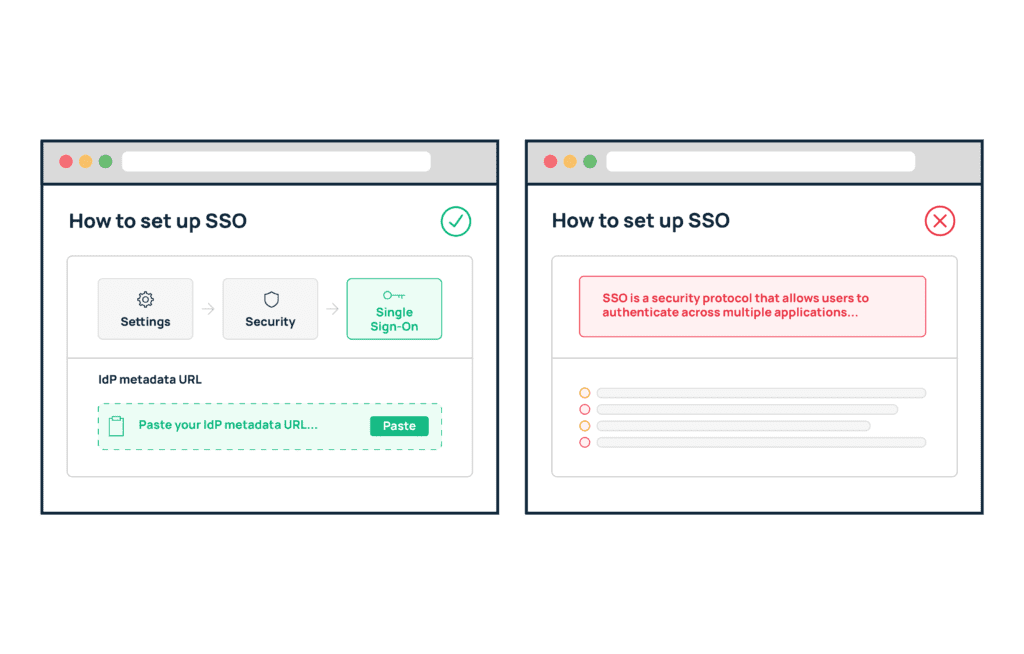
To do: open every page with a TL;DR, and start every H2/H3 with its conclusion. Context, examples, and supporting details can come after the answer.
3. Back every claim with a source the LLM already trusts
Cite the sources LLMs are majorly trained on and trust, such as research firms, industry publications, and recognised authorities in your niche. This helps you align your content with information the model already has confidence in.
For example, Metehan’s research on Perplexity’s ranking factors revealed that the model maintains a list of manually whitelisted trusted domains per industry and favors content that references or connects to them. The same underlying logic applies across all LLMs: a claim backed by a source the model recognises carries more weight than one it can’t verify.
To do: Write statements with the source linked and named inline — “According to Gartner [hyperlink the URL], 58% of B2B buyers now use AI tools during the research phase”.
4. Use consistent language to describe your product across all content
Describe your product the same way everywhere it appears on the web.
LLMs use entities — the specific, recurring words and phrases that identify your brand name, product category, and the problem you solve — to build a picture of who you are across your site, review platforms, directories, and third-party mentions. When those descriptions aren’t consistent, the model gets mixed signals about what you are and where you fit.
For example, if your site calls you a “customer support platform,” a review site calls you a “helpdesk tool,” and a comparison article calls you a “ticketing system”, the LLMs wonder if that’s one product or three? Because of this confusion, it either misrepresents you or cannot confidently place you in the right product category. As a result, you don’t show up as a solution at all in AI conversations where buyers are looking for a solution to a problem your product solves.
To do: Define your product in one clear sentence covering category, audience, and problem solved, and use that exact same definition across your website and any PR publications .
Read our full guide onwhat is an entity and how to become one.
5. Break your content into clearly defined sections
Use proper formatting to give LLMs clear boundaries around each idea on your page.
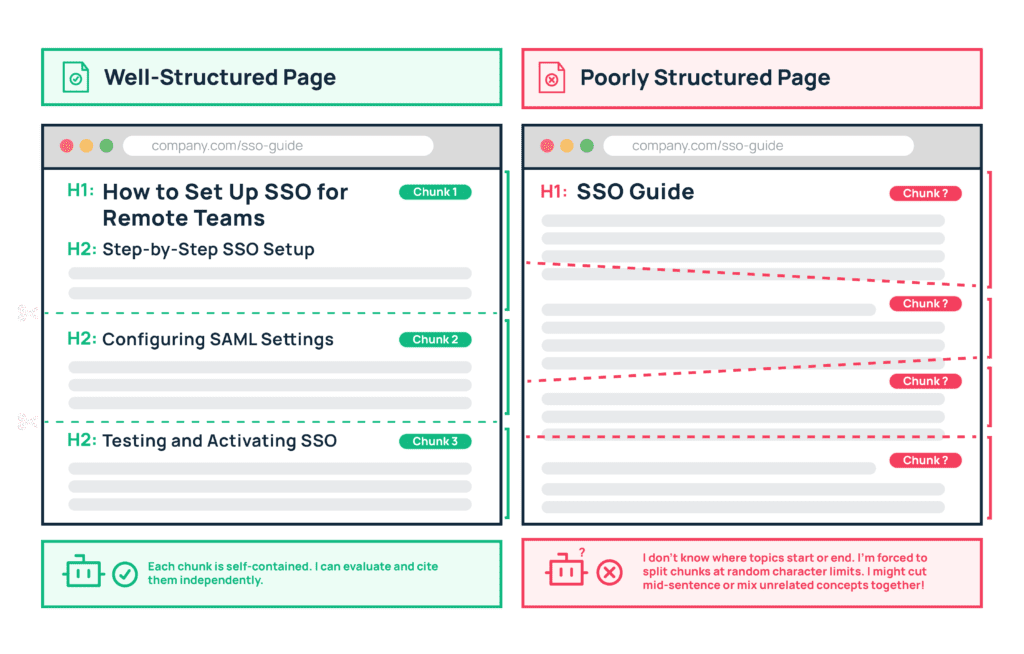
An LLM reads your page by breaking it into several 200-word parts called chunks. This chunking follows the page’s Document Object Model (DOM) (the underlying hierarchy of headings (H1, H2, H3), sections, and formatting) to identify where one idea ends and another begins. When that structure is broken or inconsistent, the model chunks arbitrarily, pulling incomplete information that doesn’t fully explain any single idea. Those incomplete chunks get compared against self-contained chunks from competing pages — and lose.
Not to mention human readers don’t like walls of text either, so the same structure that helps LLMs helps them too.
To do: Use a logical heading hierarchy — H1 for the page title, H2 for major sections, H3 for sub-points. Keep one idea per section. Use bullet lists for facts and criteria, numbered steps for processes, tables for comparisons, and FAQs for common questions.
GEO Writing Checklist: Before You Hit Publish
Write with specifics
- Every integration, tool, team size, price point, and use case is named explicitly
Front-load the answer
- Page opens with a TL;DR
- Every H2/H3 opens with its conclusion
- Context and supporting detail come after the answer, not before it
Cite trusted sources
- Sources are research firms, industry publications, or widely recognised authorities
- Every stat or claim has a named source cited inline, not just hyperlinked
Use Consistent product language
- Product description — category, audience, problem solved — is the same across every page
Use Clean structure
- Heading hierarchy is logical — H1, H2, H3 — no levels skipped
- One idea per section
- Comparisons in tables, processes in numbered steps, facts in bullets, common questions in FAQs
Final Thoughts
Based on our research into how major LLMs retrieve and evaluate content up to mid-2026, these writing strategies hold across all of them. Getting them right gives you a solid generative engine optimization (GEO) foundation — one that produces results regardless of algorithm updates because it’s built on how all major LLMs work at their core.
If you want to go deeper on a specific LLM — how it ranks content, what it prioritizes, and what you can do to show up in its answers — we’ve broken each one down separately:
- How to Get Mentioned in ChatGPT
- How to Get Mentioned in Gemini and Google AI Mode
- How to Get Mentioned in Perplexity
- How to Get Mentioned in Claude
And if you want advice on GEO from people who are in the trenches doing it — for their own site and for SaaS clients — get in touch with us.