You’ve done the research, but you’re still staring at a pile of interview notes, reviews, lost-deal insights, and search data wondering what actually belongs in the persona.
The solution is a finished persona that separates the buying signals that matter from the evidence that doesn’t. You may also already have a provisional persona from early market research that needs the same treatment.
The job now is synthesis: find the signals that repeat, decide which findings matter, resolve the contradictions you can, and turn the result into a short profile your team can actually use.
By the end of this guide, you should have at least one B2B buyer persona built from your own evidence, plus a process you can repeat for the next one using our persona template. We’ll focus on how someone makes a purchase decision, not hobbies, stock-photo demographics, or a general biography, so you know what to say, ask, and show when you market or sell to them.
TL;DR
- A useful B2B buyer persona comes from repeated signals in real buyer evidence.
- To find those signals, bring all your buyer evidence into one place, including interviews, reviews, lost-deal insights, search behaviour, Sales or Customer Success notes, and any provisional persona.
- As you group like items together, keep the patterns that affect the buying decision and connect to a problem your product can realistically solve. Leave weak or unresolved evidence open rather than filling gaps with assumptions.
- When evidence conflicts, decide whether you need more information or whether it is normal variation, an assumption to test, or a meaningful difference.
- Build the finished persona around the buying decision: the buyer’s trigger, desired outcome, barriers, comparison criteria, decision process, and language. If it changes what you say, ask, or show to buyers, it is specific enough to use.
- Keep updating your persona as new evidence appears.
Bring all your buyer evidence into one place
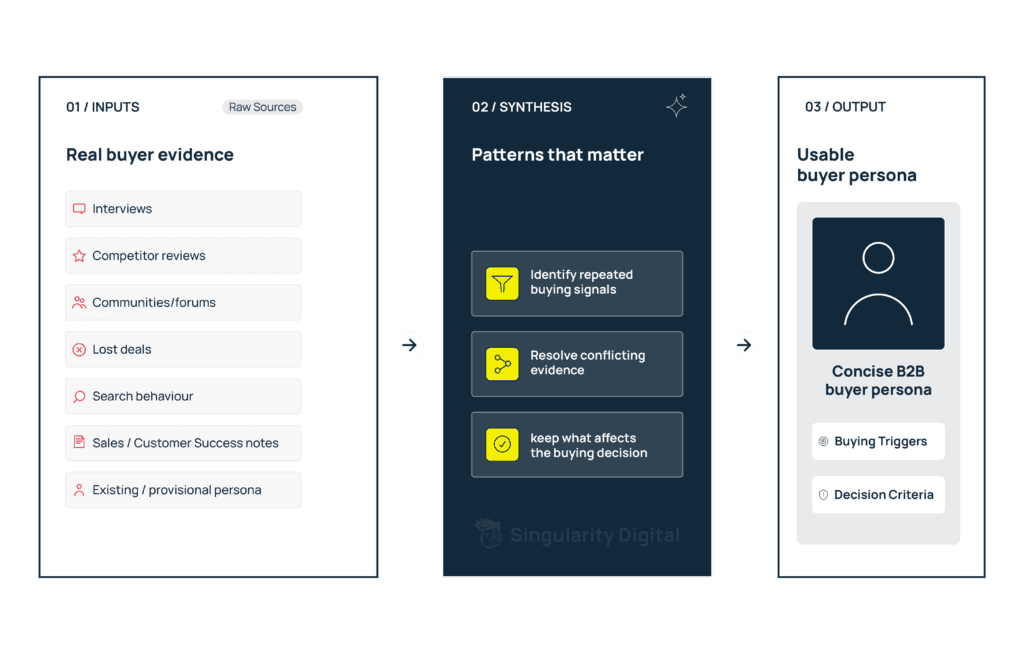
Take every scrap of evidence you have and get it all into one document. We will start with one buyer role, so include a provisional or older persona for that person if you have it. Your sources will probably be:
- Customer or prospect interviews
- Competitor reviews
- Communities and forums
- Lost deals
- Search behaviour
- Sales or Customer Success notes
If you still need to collect the evidence itself, start with How to Build a SaaS Buyer Persona When You Don’t Have Customers Yet or our guide to buyer persona interviews for conducting the research itself.
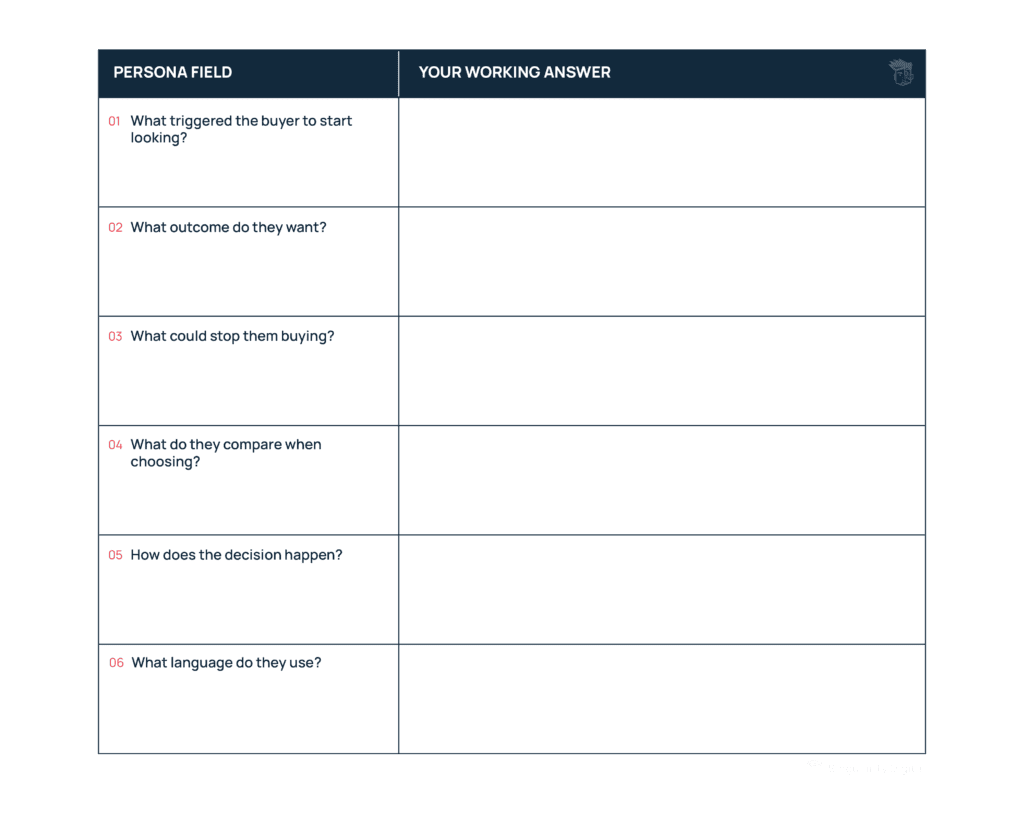
Now, fill in our worksheet with the actual evidence, using direct quotes where possible, that answers each question. We designed these six fields around the buying decision, drawing on Gartner’s guidance that B2B personas should reflect real buying situations and on the decision-focused evidence we use throughout this persona series. The goal is to keep the exercise focused on information your Marketing and Sales teams can actually use.
Find the buyer patterns worth keeping
Now that you’ve sorted your evidence, it’s time to identify the patterns that will form the backbone of your persona. A useful persona needs to reflect how buyers actually make decisions rather than functioning as a static description of a job title. Start by looking for ideas that repeat among comparable buyers. You may see the same trigger in three interviews, the same concern in competitor reviews, or similar language appearing independently in sales calls and community discussions.
Do not treat every observation as equally important, and where possible, look for support across more than one source. One memorable quote is evidence worth investigating, but it is not automatically a persona insight. You need enough evidence to know that the idea matters beyond one buyer or one conversation. Prioritize patterns that:
- Affect the buying decision.
- Connect to a problem your product can realistically solve.
This is where a lot of personas go wrong. Gartner warns that B2B buyer personas can fail to reflect how buyers actually behave during the sales cycle. A profile that tells you who someone is but not how they buy will not help you decide what to say or show them.
As you work through the evidence, keep the strongest candidate insight for each field in your sheet. Leave a field open if the evidence is not good enough yet. A visible gap is more useful than a confident-sounding assumption.
What if your buyer evidence conflicts?
First, see whether more evidence can resolve the conflict. Patrick Herbert, CEO of Singularity Digital, recommends talking to more buyers when you can. More conversations can show whether you’re looking at a real pattern or simply normal variation between buyers.
As you collect more data, or even if you can’t, use the context you have to make a working decision and test it rather than forcing every variation into the persona.
Do this by asking what the disagreement represents:
- Normal variation within the same buyer type?
- An unresolved assumption that still needs testing?
- A meaningful difference that may point to a separate persona?
Strong qualitative signals deserve a closer look. If broader market data points one way but several real buyers independently describe the same issue, do not average those responses away. Treat the disagreement as something to test: it may reveal a specific buying context, an emerging pattern, or an emotional trigger that aggregate data misses.
Keep unresolved questions visible. Do not smooth them over just to make the persona look finished. If your buyer evidence is scattered across interviews, reviews, sales notes, and research, or the patterns still aren’t clear, talk to Singularity Digital. We can help you turn that evidence into buyer insights your Marketing and Sales teams can actually use.
Build your persona from the evidence that matters
Once you have a working answer for each field, compress it to create the clearest version of what matters to this buyer. The persona should not become a research archive – nobody is going to sift through three dozen quotes when they are creating sales collateral.
Here’s what the finished version can look like. Using the Up2Speed engineering-manager example from our earlier persona work:
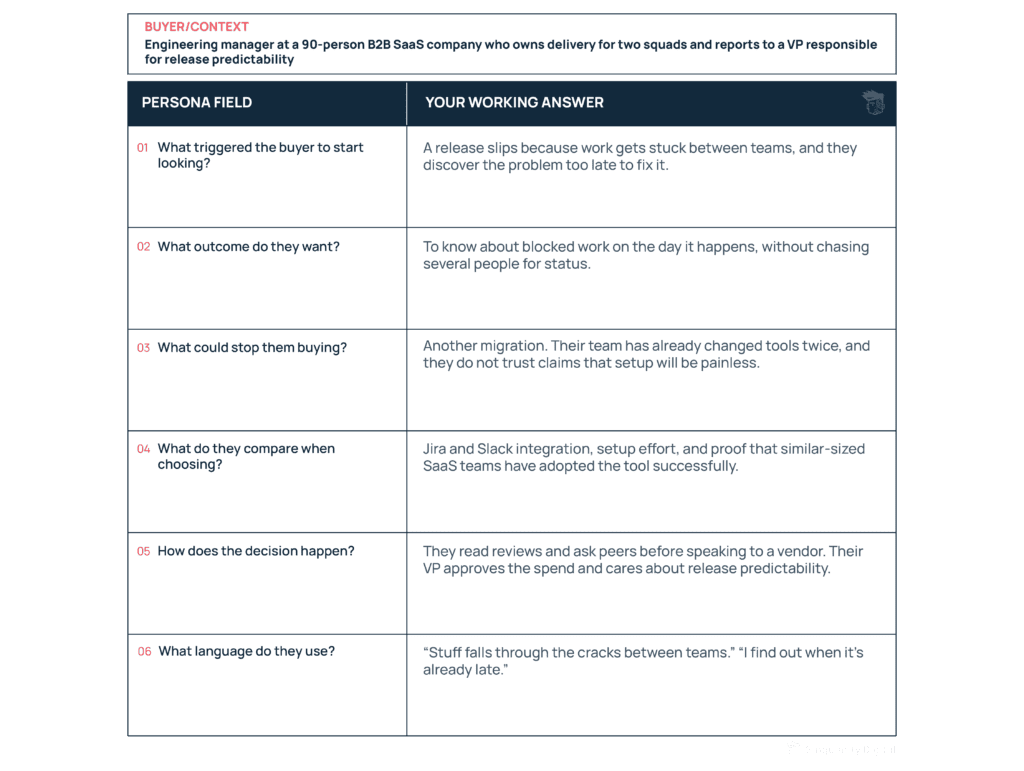
Resist the urge to cram every interesting detail into the final profile. One or two strong insights per field are enough, and your buyer’s own words will usually be more useful than polished marketing language.
Done? You have your first buyer persona. Now comes the tougher test: is it specific enough to change what your team actually does?
Vague, boring, bland personas help nobody. So, is yours specific enough to use?
Forrester describes effective B2B buyer personas as both informative and actionable for Marketing and Sales. That gives you a practical standard: your persona should change what the team does.
Our test, backed by years of marketing work from Singularity Digital founder Patrick Herbert, is to put the persona next to real work, such as an existing campaign, landing page, sales email, content piece, or sales conversation, and see whether it removes uncertainty.
Ask:
- Do you know who you are speaking to?
- Do you understand why this issue matters to them now?
- Do you know what they care about most?
- Do you know which objection or concern needs answering?
- Does the persona change what you would say, ask, or show?
If you still feel lost about who the message is for or why they should care, the answer is not to add generic detail. Go back to the unresolved evidence.
At the same time, don’t worry about achieving absolute perfection, if that’s even possible. “When you’re not confused about who you actually want to talk to, and why and what’s important to them, then I think that you are relatively in the right area,” says Herbert. You can still have open questions, as long as you have the clarity to act.
Use the persona, then keep testing it
Once the persona passes that practical test, you now have one completed persona and a repeatable process for building the next one. Go ahead and use it immediately. Make a concerted effort to use your new buyer information across:
- Messaging: decide which problem or outcome to lead with.
- Content: prioritize the questions, objections, and proof the buyer needs.
- Sales: improve outreach, discovery questions, and what you emphasize in a demo.
- Campaigns: check whether the creative and offer match what matters to the buyer.
- AI testing: use the evidence-based persona to stress-test messaging with AI.
And remember: treat the persona as a working model. New interviews, lost deals, customer behaviour, or market changes may give you better evidence later. Update the persona when the ground changes.
Want help building buyer personas and making sure your marketing reaches the right people? Contact Singularity Digital for a free consultation to see how we can help.
Frequently asked questions
How many buyer personas do you need?
There is no useful universal number. Build separate personas when different buying roles or decision patterns genuinely require different messages, proof, or sales conversations. Do not create extra profiles just to reach a target number.
What is the difference between a buyer persona and a user persona?
A buyer persona focuses on someone involved in the purchase decision. A user persona focuses on the person using the product. In B2B SaaS, those may be the same person, but they often are not.
Can AI build a buyer persona?
AI can help test a persona after it is grounded in real buyer evidence. It should not invent buyer motivations, objections, or decision criteria that your research has not established.
How do you know when a buyer persona is finished?
It is finished enough to use when it reduces uncertainty about who you are speaking to, why they care, what matters to them, and what Marketing or Sales should do differently. Keep updating it as new evidence appears.