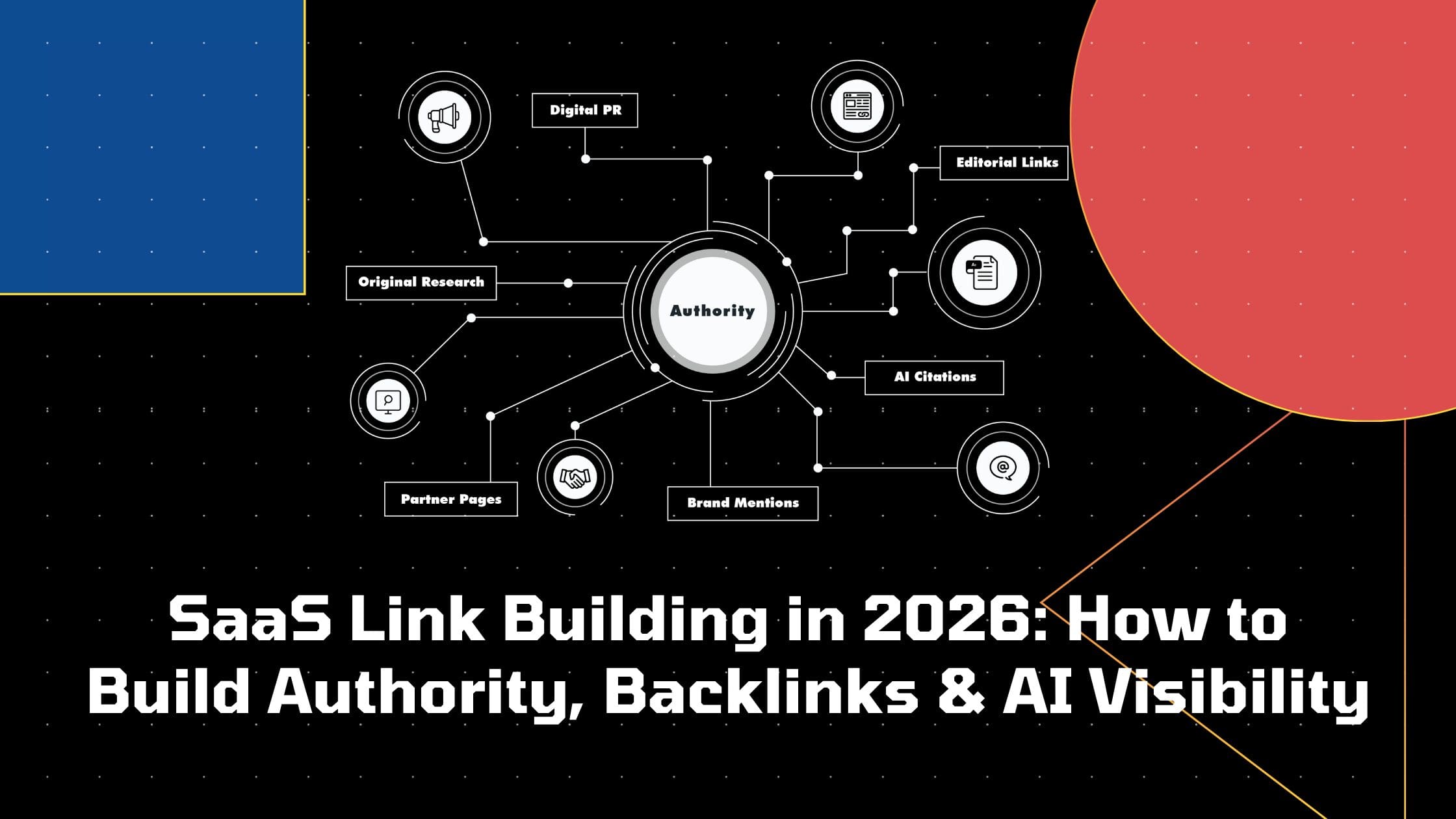
Most link-building guides for SaaS were written for a different era, one where stuffing backlinks everywhere was enough to climb rankings. That era is over.
In 2026, SaaS founders and marketers face a harder challenge: specialized markets, constant algorithm updates, and AI tools like ChatGPT and Perplexity changing how buyers find software. Add in a competitive SaaS search landscape with many companies targeting the same keywords, and the old logic of “earn more links, get better rankings” no longer reflects how search visibility actually works.
Backlinks still matter. Google’s documentation confirms that links help it discover pages and determine relevance, while its ranking systems evaluate many signals rather than links in isolation.
What separates the brands that build long-term visibility is whether the right buyers, publishers, industry experts, AI discovery systems consistently recognize them as credible authorities in their category.
The goal and results of SaaS link building have shifted. That’s why we wrote this guide, to update the playbook for SaaS teams building organic growth in 2026: what still works, what doesn’t, and how to prioritize the tactics that actually move the needle.
What Is SaaS Link Building?
Link building is the process of getting other websites to point back to your brand with a hyperlink. In the SaaS space, that basic principle holds, but the context makes it harder.
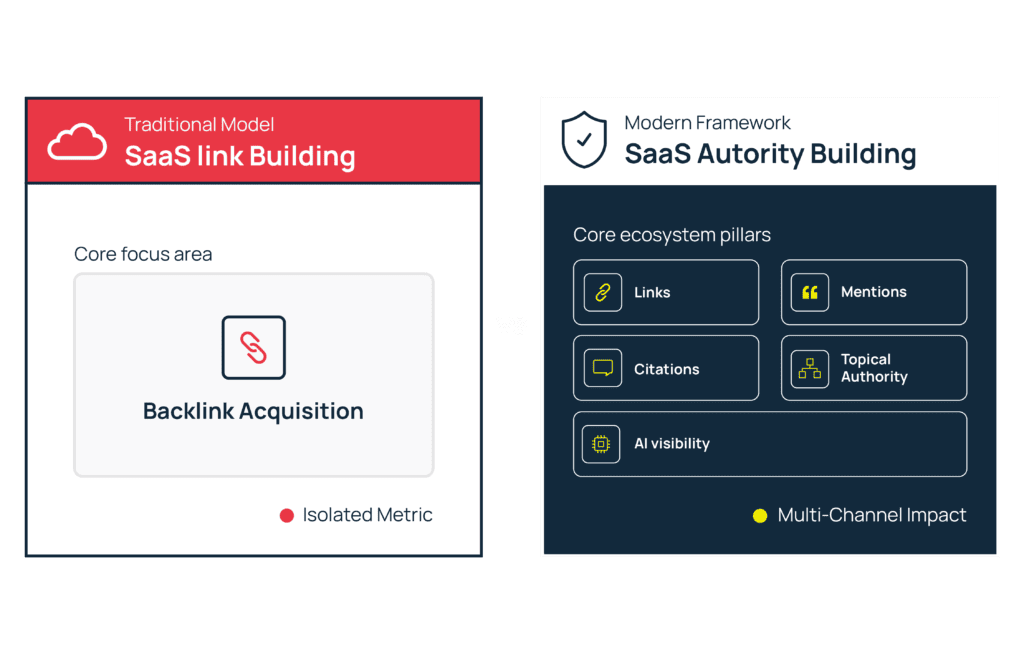
Link building works best as part of a larger strategy, not as a standalone channel. Backlinks are one outcome, not the whole goal. The companies that get this right build content, research, and assets that make external sources want to engage with their expertise.
SaaS companies operate in highly specialized markets with sophisticated buyers, crowded keyword landscapes, and content that often looks similar across competitors. In that environment, raw link volume matters less than who is linking to you and why.
That’s why a good SaaS link building strategy prioritizes earning recognition from publications, directories, partner ecosystems, and industry resources that speak to your audience, to reinforce your expertise within your category.
Links on these pages are more likely to reach relevant potential buyers while giving search engines useful context about how your site relates to the topic. The goal isn’t more SaaS backlinks. It’s earning the right links from the right sources. Around the topics your buyers actually care about.
What Actually Builds Visibility and Authority in 2026
Relevance
Relevance means you’re getting links on sites that actually matter to your audience and your sector. When done right, a backlink isn’t just a mention; it’s a clear contextual signal for both search engines and readers.
Relevance exists when four elements align:
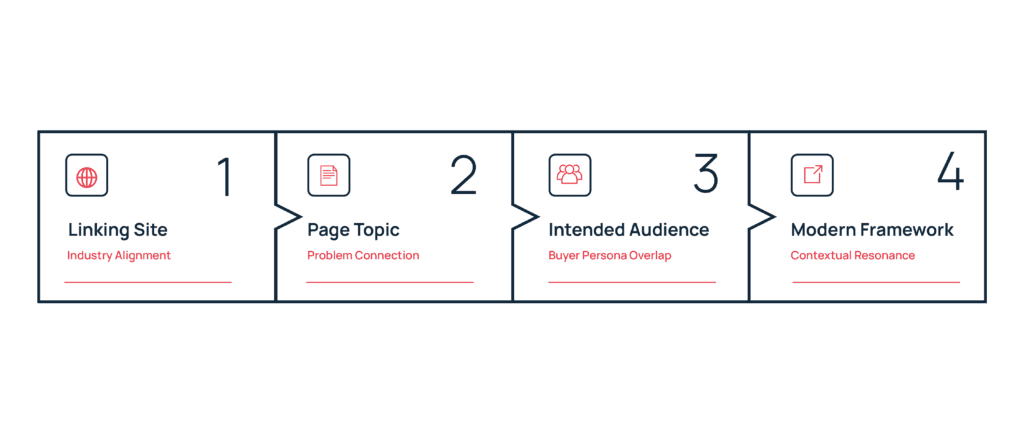
The linking site operates in the same category, workflow, or industry as your product. The page topic connects directly to the problem your product solves. The intended audience overlaps with your buyers. The destination page resonates with the context of the linking page, whether that’s a feature page, a blog post, or even help documentation. What matters is that the link makes sense to the reader who clicks it.
In practice, a workflow automation company should usually prioritize a relevant operations publication over generic marketing blogs, because the topic, audience, and reason for the link are more closely aligned with its product. The goal isn’t just to earn backlinks, it’s to strengthen your position within a specific category, workflow, or use case.
Editorial Quality
SEO tools are going to show you dozens of sites that appear to have high domain authority and are tempting to go after. Don’t.
It doesn’t matter how strong the domain score is if the site runs primarily on sponsored placements, publishes bad content, or has no audience in your category. The backlink might exist, but do almost nothing for your authority.
What you want instead are links inside genuinely useful content, created for real readers, with a real editorial process behind it. Before pursuing any placement, ask:
- Does this link come from a relevant source?
- Does it appear in real editorial content?
- Does it point to the right page?
- Could it reach the audience I’m trying to reach?
If not, move on, regardless of what the domain score says. For a full framework, see How to Choose the Right Backlinks for Your Business.
Authority
Building links has to be part of your larger SEO strategy and brand position. That means instead of asking “How can we get more backlinks?”, you ask:
- “Which topics do we want to own?”
- “Which pages matter most to our business?”
- “What assets are worth citing?”
- “Which publications influence our buyers?”
When you approach link building this way, backlinks become a byproduct of authority, not the other way around.
Mentions and Citations
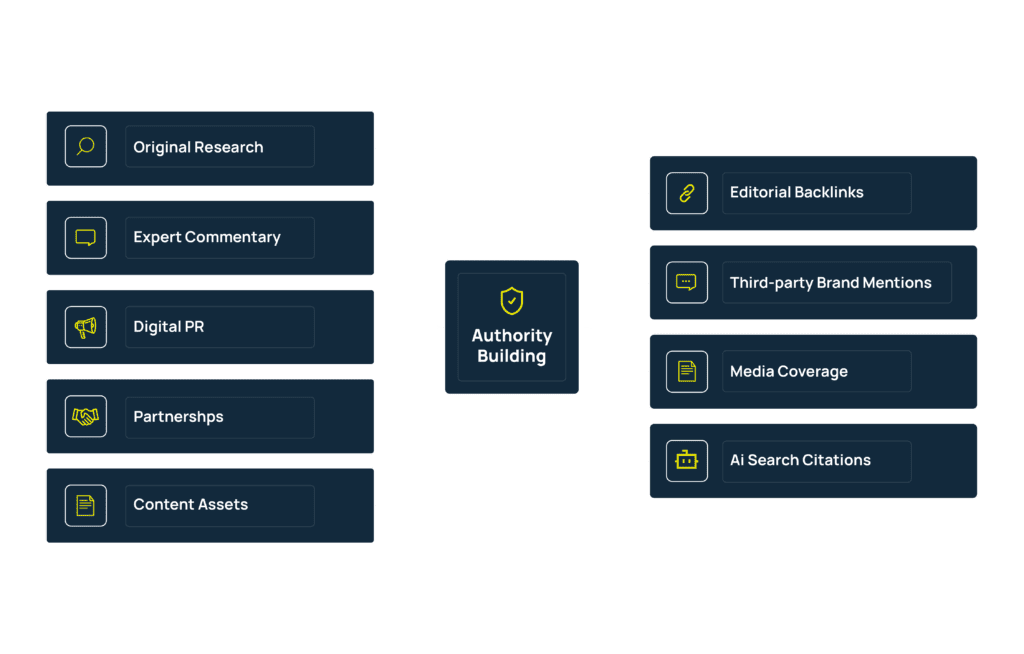
Unlinked brand mentions are not backlinks, and they should not be measured as if they were. But they can still put a SaaS brand, its expertise, or its data in front of relevant audiences across industry roundups, expert commentary, and editorial coverage. That makes them useful as a separate visibility outcome, even when no link is earned.
AI citations are different again. In Google’s AI features, supporting links can surface web pages alongside AI-generated responses. Google says AI Overviews integrate its core web ranking systems and are designed to surface information backed by web results, which is why established SEO fundamentals still matter for visibility in these experiences.
A third-party mention is not itself an AI citation, and neither should it be treated as interchangeable with a backlink. Each represents a different form of earned visibility that can be measured separately within a broader authority-building strategy.
What Are the Best SaaS Link Building Strategies?
The tactics below work best when they serve the principles above: relevance over volume, editorial quality over easy placements, and authority creation as the goal. Use them to target the right pages, reach the right sources, and build topical depth.
Original Research
Original research can create a strong reason for other publishers to reference your SaaS company because it gives them source material they cannot simply reproduce from every competitor. Benchmark reports, proprietary datasets, industry surveys, pricing studies, and usage analyses are especially useful when they answer questions writers and practitioners already need evidence for.
Ahrefs offers a useful example. The company says four of the five most-linked pages on its blog were studies, which it attributes partly to having proprietary data and insights other publishers could not access elsewhere. In a separate link-building campaign built around an SEO statistics resource, Ahrefs sent 515 outreach emails and earned 36 backlinks from 32 websites.
The lesson isn’t that publishing a study automatically earns links. The asset still needs information worth citing and a distribution strategy that puts it in front of the people most likely to reference it. The same logic can apply to other cite-worthy assets such as free tools, calculators, directories, and templates.
Patrick Herbert, CEO of Singularity Digital, saw this firsthand while working with Reedsy. The company built a directory of writing scholarships and used the resource as part of outreach to universities and other organizations serving writers and students.
“We were basically offering something of value,” Herbert explains. By listing writing scholarships in one place, Reedsy had something useful to offer the universities it approached rather than simply asking them for a backlink.
The important part wasn’t the directory format itself. The asset matched an information need for the organizations being approached, giving them a reason to reference it beyond simply helping Reedsy acquire a backlink.
Digital PR
SaaS digital PR is about earning editorial attention rather than requesting a link directly. Proprietary data, expert commentary, and timely perspectives can give journalists and industry publishers a reason to reference a company or its experts.
The outcomes can vary: a campaign may generate editorial coverage, backlinks, unlinked brand mentions, referral visibility, or exposure to relevant audiences. Those outcomes should be measured separately rather than assuming that coverage automatically produces a backlink or AI visibility.
Singularity Digital has used expert contribution as one route to third-party visibility. Patrick Herbert, for example, has contributed to industry platforms including Semrush, where he is identified as the founder of Singularity Digital.
Partner Pages
Partner ecosystems can create naturally relevant link opportunities for SaaS companies. Integration directories, marketplace listings, implementation guides, and co-marketing pages already exist to help users understand how products work together, so a link can serve a genuine product and user need rather than being added purely for SEO.
Think of a SaaS product listed in an integration marketplace or documented on a technology partner page: the relationship between the two companies explains why the link exists, while the page itself reaches users already interested in that workflow or ecosystem.
That is what makes partner links useful when they are genuine. Google explicitly warns against partner pages created exclusively for cross-linking, so the business relationship and usefulness of the page need to come first.
Comparison Pages
Comparison and alternative pages target some of the highest-intent searches in SaaS. Users searching for alternatives are actively evaluating software solutions and often sit close to purchase decisions. Well-executed comparison content can attract backlinks from review sites, industry publications, communities, and software roundups.
The key is credibility. The best comparison pages provide objective evaluations, realistic use cases, pricing considerations, and clear differentiation rather than promotional sales copy, and this makes them easier to reference and cite.
Selective Guest Posting
Guest posting can still contribute to authority building when approached selectively. The standard for quality should be:
- Does this publication reach buyers or practitioners in our category?
- Does the topic connect to a page we want to strengthen?
- Is there a real editorial review process?
When those conditions are met, guest posts serve two purposes: they earn a contextual backlink to a priority page, and they put your expertise in front of an audience that doesn’t know you yet.
The distinction is intent and execution. A selective contribution written for a publication’s actual audience is different from producing guest posts at scale primarily to manufacture links.
Google explicitly lists link spam practices such as paid guest posts with links that pass ranking credit, and it has separately warned about excessive sponsored and guest-post campaigns used primarily for link building. If a contribution is worth pursuing, the editorial and audience value should make sense even without the backlink.
Direct Outreach
Direct outreach works best when there is a specific editorial reason for someone to act, rather than simply a reason for you to want the backlink.
Patrick Herbert recalls one example involving HubSpot, a backlink the company has previously highlighted as an example of a high-authority, highly relevant placement. The team found a broken tool linked from a HubSpot article about SEO analysis tools, licensed a white-label SEO checker that could serve the same purpose, and approached HubSpot with a specific replacement rather than a generic link request. HubSpot added the Singularity Digital tool to the article.
“We saw that there was a link on their site that was broken to a tool like this,” Herbert recalls. Instead of simply pointing out the broken link, Singularity had a working alternative ready for HubSpot to evaluate.
The HubSpot placement did more than earn Singularity one backlink. Herbert says it created “a lot of flow-on effects,” as other sites published similar tool lists: “We got a lot of links because of that.”
The page also gained search visibility. “We started to rank relatively well for, like, SEO checker and things like that for quite a long time,” Herbert says.
But the case also illustrates why link acquisition cannot be separated from the business objective. Despite the links and search visibility, Herbert says the tool did not generate qualified leads for Singularity and was eventually discontinued. A tactic can succeed at earning links without necessarily delivering against the business objective behind it.
4 Reasons SaaS Link Building Efforts Underperform
Link-building programs often underperform not because of bad tactics, but because of how success is being measured. Here’s what gets in the way:
1. Treating it as a volume exercise. When the goal is “more backlinks,” relevance and editorial quality become secondary. Teams focus on growing their referring domain count without reinforcing topical authority, which limits impact on the queries that actually matter.
2. Generic outreach at scale. Guest posting without a strong editorial angle produces placements on sites with no real audience in your category. The backlink exists. The authority signal is weak.
3. Manipulative shortcuts. Google’s spam policies explicitly classify links created primarily to manipulate rankings as link spam. Beyond the compliance risk, these tactics distract from the work that actually compounds over time.
4. No topical foundation. Links are more useful when they support pages that already satisfy the search intent and provide strong, relevant content. Google explains that Search systems assess both relevance and quality when deciding which results to surface, so backlinks cannot compensate for a page that is fundamentally unhelpful or irrelevant to the query.
This helps explain why backlink acquisition alone does not always translate into stronger visibility for category, comparison, or product-related searches.
How to Prioritize SaaS Link-Building Opportunities
Not every link-building opportunity deserves the same investment. Use these four filters to decide where to focus:
- Topical relevance: Does this source operate in your category or reach your buyers?
- Editorial quality: Is there a real audience and a real editorial standard here?
- Business value: Does this link point to a page that matters to your pipeline?
- Effort: Is the return worth the outreach cost?
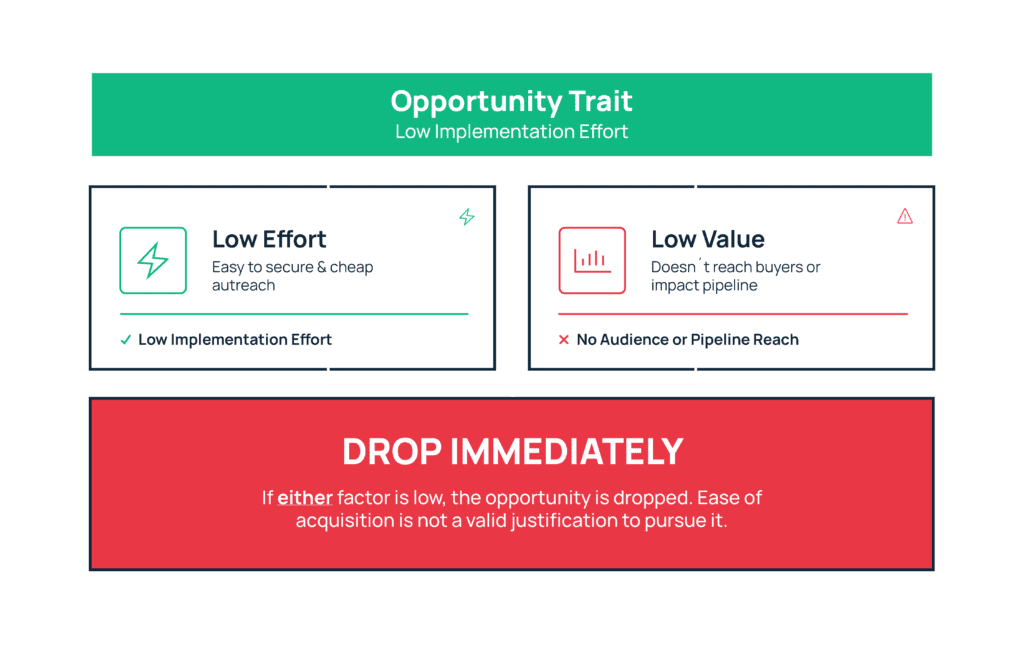
High-priority opportunities score well on the first three and require moderate effort. Anything that scores low on relevance or business value should be dropped, regardless of how easy it is to get.
Building Authority, Not Just Backlinks
The strongest SaaS programs don’t measure success by backlink totals. They track whether authority is growing around the topics that drive buying decisions: category queries, comparison searches, use-case content, and the publications your buyers read when they’re evaluating tools.
And that matters more than ever now. AI-powered discovery adds another visibility layer beyond traditional search results. For Google’s AI features specifically, core Search ranking and quality systems remain part of how supporting information is surfaced. That doesn’t make backlinks or brand mentions direct AI-citation signals, but it does mean SaaS teams should build strong search foundations while measuring AI visibility separately.
Ready to create a SaaS SEO strategy that compounds over time? Singularity helps SaaS companies build authority that actually drives pipeline. Contact us!
FAQ
Does link building still work for SaaS companies?
Yes, but what “working” means has changed. Links still help search engines understand relevance and discovery, and in competitive SaaS categories they can differentiate pages that are otherwise closely matched.
The caveat: links work best when they reinforce content quality, topical depth, and commercial relevance. They can no longer be treated as a volume exercise.
For a deeper look at how links interact with AI discovery, see: Do Links Still Matter for Generative Engine Optimization?
How many backlinks does a SaaS company need?
There is no universal answer. The better question is: what’s the authority gap between your priority pages and the pages outranking them?
Google explains that its ranking systems use a mix of factors that can identify content demonstrating experience, expertise, authoritativeness, and trust, with trust being the most important of those aspects. That is another reason not to reduce the question to a backlink target: relevance and editorial context matter alongside quantity.
For a practical framework: How to Choose the Right Backlinks for Your Business.
Is guest posting still effective for SaaS?
Yes, when approached selectively. The determining factors are relevance, editorial standards, and audience fit.
What no longer works is scale for its own sake. Google’s spam policies are clear that large-scale guest posting built primarily for link acquisition falls within link scheme guidance.
For help finding the right publications: Find the Right SaaS Blogs Faster.
Can link building improve AI citations?
Link building can support AI visibility indirectly, but there is not enough evidence to say that earning a backlink will cause a page or brand to be cited in an AI-generated answer.
For Google’s AI features specifically, traditional SEO remains relevant because Google says AI Overviews and AI Mode rely on its core Search ranking and quality systems. That means the same fundamentals that help pages become discoverable and eligible in Search still matter, without making backlinks a direct AI-citation signal.
GEO research also needs to be interpreted carefully. The foundational GEO study showed that certain content changes could increase visibility when source material was already available to the generative engine; it did not establish that backlinks cause organic discovery or AI citations.
A 2026 critical review of 45 GEO studies reached a similar caution: the foundational results were valid within their experimental setting, but did not establish organic discoverability or durable traffic effects.
See: Do Links Still Matter for Generative Engine Optimization? and How to Optimise Your SaaS Site for GEO