If you’re a SaaS founder or Head of Marketing trying to improve who your team focuses on for customer acquisition, an ICP should help you focus on accounts that are more likely to become valuable long-term customers.
And once you have enough customer history, you have the evidence to build your ICP. Some accounts retain, expand, and create value over time, while others churn, stall, or take disproportionate effort to win and keep.
But your existing customer base is evidence, not the answer. Your biggest contracts, most familiar customers, or one or two standout accounts are not enough to define who you should target next. You need to look across customer outcomes to find the characteristics that actually distinguish stronger-fit customers from weaker-fit ones.
In this guide, you’ll use that evidence to identify, test, and document the characteristics that define a defensible working ICP.
Not enough customers have reached a renewal decision to compare outcomes yet? Part 1 “How To Build An ICP From Scratch” is the better starting point.
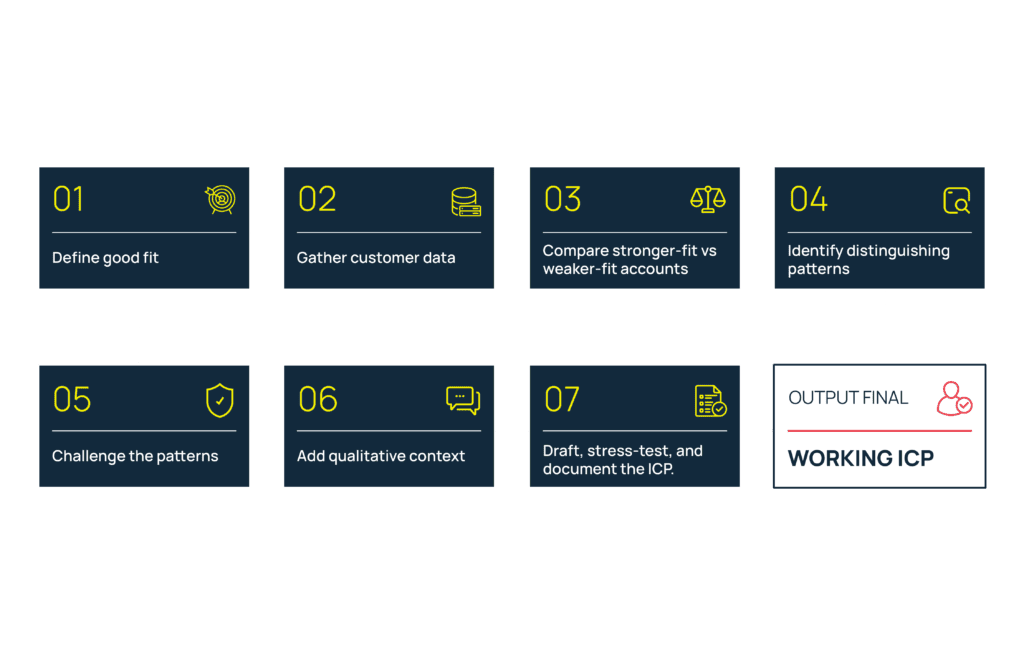
Start by defining what “good fit” actually means
A good-fit customer gets meaningful value from your product while producing the business outcomes you want to repeat over time.
To find the hallmarks of a good-fit customer, don’t start by listing the accounts you already think are ideal.
Your biggest contract, longest-standing accounts, or broad firmographics such as industry or company size may not actually tell you what combination of traits is a good, repeatable framework.
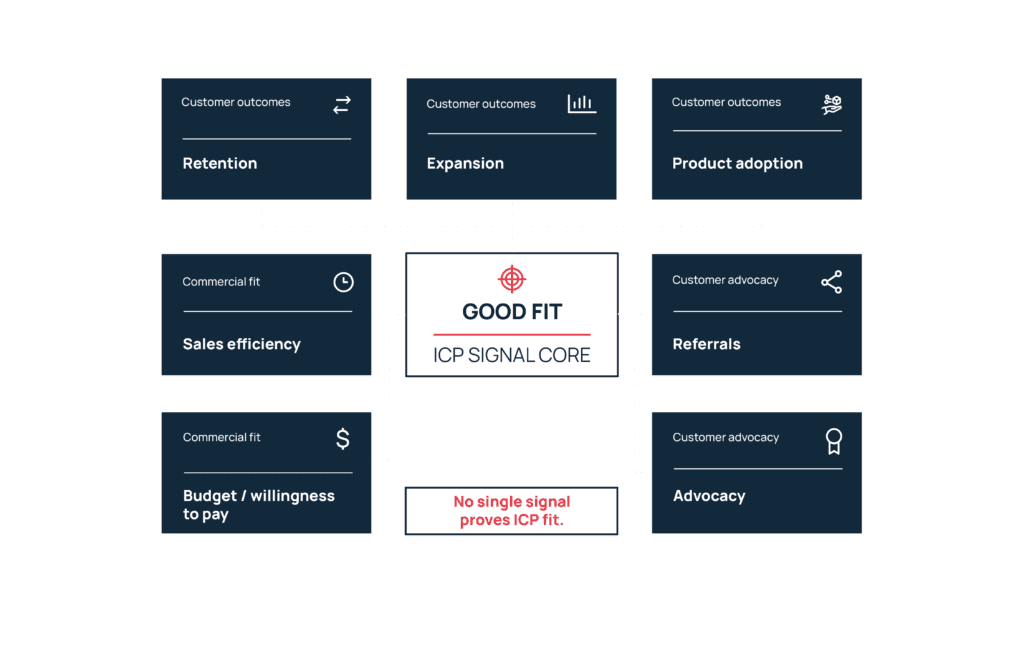
Instead, first decide what evidence of good fit looks like for your business. Choose a small set of measurable outcomes that matter to you. Depending on your business, these could include:
• retention
• expansion
• product adoption
• sales efficiency
• budget or willingness to pay
• referrals
• advocacy
Patrick Herbert, founder of Singularity Digital, points to practical signals including contract value, time to sale, retention, referrals, advocacy, and whether customers see the value and have the budget to buy.
“One of the biggest reasons why I prefer looking at various signals is that we want to eliminate oversimplification. ICPs and personas are already a simplification of who a person is, who a company is, or what a client is. The goal isn’t to create more complexity, but to add nuance to our understanding of exactly who those customers are today. Combining those factors gives me a more nuanced view of who they are and how they fit into the strategy I’m planning around them,” explains Patrick Herbert.
You will need at least three signals to prove ICP fit.
For this article, we’ll use a fictional HR onboarding SaaS company called Up2Speed. It chooses contract value, retention, and referrals as its fit signals.
Once you have your signals, decide what observable metric you will use and define it before comparing customers. Be explicit about what counts as “long-term,” “activation,” “expansion,” or “advanced product adoption” so different people reviewing the same account would classify it consistently.
Up2Speed will evaluate those signals using annual contract value, renewal status after 12 months (retention), and qualified referral activity. With those definitions set, you can now use the same rules to sort your customer base.
Gather your customer data and separate stronger-fit, weaker-fit, and churned accounts
Pull the data you need for your fit signals into one spreadsheet, dashboard, or other working view. You may need to combine information from several places, such as:
• Your CRM
• Billing or subscription data
• Product usage data
• Spreadsheets or other records your team already maintains
Include current customers and churned accounts with enough history to compare outcomes such as revenue, retention or churn, and product adoption.
In our Up2Speed onboarding tool example, the team will pull annual contract value, 12-month renewal status, and qualified referral activity for each account.
Then, separate accounts into stronger- and weaker-outcome groups using the same definitions you set in the previous step.
For Up2Speed, renewing customers that also generate qualified referrals would sit in the stronger-outcome group, while churned or non-renewing accounts would remain visible as weaker or churned comparisons. Contract value gives you another business-value signal to compare within those groups.
Your exact grouping will depend on the signals you chose. The important thing is to apply the same definitions consistently across the accounts you are grouping.
Tip: If your data is incomplete, use the fields and metrics you can apply consistently. Gaps may limit how confident you can be in the profile today, but they don’t stop you from building a working hypothesis and refining it as better evidence becomes available.
Tip²: Keep closed-lost opportunities separate. They can add useful buying context, but they don’t have post-sale outcomes such as retention, expansion, or product adoption.
Look for patterns that distinguish stronger-fit customers
Before you look for traits that distinguish stronger-fit customers, make sure you are comparing customers that are meaningfully similar. Where relevant, group accounts by plan, region, acquisition channel, or behavior so broad averages do not mask structural differences.
Stripe’s SaaS cohort analysis guidance uses these kinds of cohort dimensions to compare retention, churn, and expansion over time. Once you have comparable groups, look at your stronger-fit and weaker-fit customers and identify the characteristics that appear more often among the stronger-fit accounts.
Remember: You are not trying to describe your average customer. You are building candidate traits across three areas: firmographic, behavioral, and situational, which you will test against weaker-fit customers before adding them to the ICP.
Firmographic traits
Start with account-level attributes you can retrieve reliably:
- Industry
- Company size
- Revenue band
- Geography
- Business model
Look for concentrations or ranges that appear more often among stronger-fit customers. For now, record those patterns as candidate traits rather than deciding whether they belong in the ICP.
Behavioral and usage patterns
Next, examine how customers use and adopt the product. Depending on your product, look for patterns such as:
• Activation
• Feature adoption
• Consistent usage
• Time-to-value
• Engagement with onboarding or customer success
Record the behavioral patterns that appear more often among stronger-fit customers, but keep them as candidate traits for now.
Situational factors to examine beyond size or industry
Finally, look at the conditions surrounding the purchase and implementation:
• Buying urgency
• Internal team maturity
• Implementation complexity
• Budget readiness
• Compliance needs
• Existing tech stack
Look for situational patterns that distinguish customers that otherwise look similar on paper. For Up2Speed, a dedicated People Ops owner might emerge here as a candidate situational trait. Record it for now rather than deciding it belongs in the ICP.
The next step is to challenge the patterns you have found.
Test whether the patterns actually hold up
Before any candidate trait becomes part of your draft ICP, try to disprove it. For each trait, test whether it really separates stronger-fit customers from weaker-fit customers and whether another factor could explain the pattern.
Check it against weaker-fit and churned customers. Compare how often the trait appears in your stronger-fit group versus weaker-fit and churned accounts. If it appears just as often in both groups, it is weak evidence of fit: Downgrade it or remove it.
Suppose Up2Speed finds that accounts with a dedicated People Ops owner appear frequently among stronger-fit customers. If that trait is just as common among churned or weaker-fit accounts, Up2Speed should leave it out of the ICP.
Check for acquisition bias. Some patterns may reflect how customers entered the business rather than who is actually a strong fit. If most early wins came through one channel or sales motion, the same types of account may dominate the dataset without producing better post-sale outcomes.
For example, if Up2Speed’s founder recruited and personally onboarded some accounts, compare those customers with accounts acquired through other motions before treating their shared traits as fit signals. The founder’s actions may have influenced the outcome.
So, where possible, compare the pattern across acquisition sources or sales motions. If a supposed fit signal appears mainly in one acquisition path, investigate whether you are seeing customer fit or the effect of that acquisition motion.
If a trait survives both checks, you have stronger evidence that it belongs in the profile.
Now you need to understand the buying context behind the pattern.
Use qualitative research to understand and challenge the patterns
Quantitative analysis shows you where differences exist. Qualitative inputs help you test your interpretation and may also reveal that you missed or misattributed what was driving an outcome. Use three qualitative inputs to understand and challenge the patterns you just found in your customer data:
• Direct customer conversations to understand buying decisions and context
• Frontline insight from the founder, sales, customer success, or support
• Customer language from calls, transcripts, support interactions, and customer communities
Here’s how to handle each.
Direct customer conversations
Reach out to a small set of existing customers for focused informational interviews. Rather than asking whether they think they’re a good fit, ask about the buying decision so you can test your interpretation of the account.
Ask:
• What problem first made you start looking for a solution?
• Why did that problem become important when it did?
• What alternatives did you consider?
• What may have stopped you from buying?
• What internal constraints shaped the decision?
• When you bought, what did success look like to you?
After the interviews, review your notes for repeated buying conditions or motivations across accounts.
Frontline insight from people close to customers
Next, talk to the people who have a direct line to customers. In a founder-led SaaS company, that may simply mean writing down the recurring patterns the founder has observed. In a larger team, ask sales, customer success, or support to surface recurring observations from deals, onboarding, and ongoing customer conversations.
Ask for specifics:
- Which objections keep coming up?
- Where does onboarding repeatedly stall?
- Which customers reach value quickly?
- What patterns tend to appear before churn or expansion?
Again, look for recurring patterns, then take them back to your customer data before adding anything to the ICP.
Customer language
Finally, look at the language customers actually use to describe their problems, priorities, triggers, and decision criteria.
Patrick Herbert says Singularity typically looks at call recordings and transcripts for this purpose. You may also find useful customer language in support conversations or communities such as Slack or Discord.
“Call recordings let you read between the lines and pick up the underlying feeling behind what someone is saying. People may say something more politely than they mean it, or vice versa, and that qualitative context can be the difference between making something good from the data and making something great,” Herbert says.
Capture repeated phrases and framing across these sources rather than relying on one memorable quote. At this stage, use that language to add buying context to the ICP. Messaging and content applications come later.
Turn the evidence into a working ICP
At this point, you have tested quantitative patterns and added qualitative context. Now it’s time to turn that evidence into a working ICP that is specific enough to guide targeting and qualification, without pretending the profile is set in stone.
Create a draft ICP
Bring your analysis into a first-pass ICP. A shared Google Doc, spreadsheet, or similar working document is enough; it does not need to be polished yet.
Include:
• The list of customers that currently qualify as stronger-fit accounts
• Relevant firmographic, behavioral, and situational characteristics
• Important problems or buying context
• Supported disqualifying signals
• The evidence behind each defining characteristic
• Assumptions that still need validation
If two distinct groups emerge within your stronger-fit customers, keep them as separate draft profiles rather than averaging them together. Stress-test both against named accounts in the next step before deciding whether they represent separate ICPs or whether one holds up better.
When building this initial profile, use practical ranges or conditions rather than hyper-specific absolutes. For example, imagine your data shows that businesses with 500+ employees tend to have the budget for your product. Your draft ICP might say, “Businesses with 500+ employees tend to have the budget for our product,” rather than, “Any business with fewer than 500 employees can’t afford us.”
Choose one person to lead the synthesis and keep the draft coherent. For example, Up2Speed is a founder-led SaaS company, so it will use the founder as a check to keep the draft in line. In a larger company, the lead may sit in marketing, sales, customer success, product, or another team with enough customer context.
Tip: If you want a starting structure rather than a blank document, HubSpot’s ICP template covers the basic fields you can adapt to your evidence.
How to stress-test your draft ICP against named accounts
Now it’s time to test your draft against real accounts. Choose a small set that includes obvious strong-fit customers, clear weak-fit or churned customers, and a few edge cases. For each account, ask whether the draft profile can explain consistently why it does or doesn’t fit.
Then compare that answer with the outcomes you originally used to define “good fit”. If a weak-fit account matches the profile perfectly, or an obvious strong-fit account falls outside it for reasons the ICP can’t explain, refine the criteria. The goal is to pressure-test the ICP, not validate existing assumptions.
Document your working ICP
Once the draft survives the stress test, update your shared ICP document to reflect what held up. Keep the defining characteristics, the customer evidence behind them, relevant problems or buying context, disqualifying signals, and any assumptions that still need validation.
This becomes your working ICP: one shared reference you and your team can use now and refine as new evidence appears.
Keep your ICP current as customer evidence changes
Have one clear owner. Give one person responsibility for maintaining the ICP and coordinating the evidence behind it. In a founder-led company, that may be the founder. In a larger organization, several teams can contribute while one person remains accountable. Document the owner and update process so refinement doesn’t depend on someone remembering to revisit it.
Revisit the ICP regularly. There is no universal review cadence. Check whether recent customer outcomes still support the profile rather than reviewing it simply because the document feels old.
Ask:
Do the customers producing your strongest outcomes today still support the profile you’ve documented?
Herbert uses advocacy as an example of how fit signals can change in importance as a business matures:
“If I’m relatively new, I would have no advocacy, but I may have the other signals. Three years on, those things may still be very important to me, but the advocacy side is actually growing in importance,” Herbert says.
Tips for using this process to refine an existing ICP
If you already have an ICP, treat your current profile as a hypothesis and test it against the customer evidence you have now.
Validate it against real customer outcomes. Check whether the characteristics in your current ICP appear more often among stronger-fit customers than weaker-fit customers. Keep criteria supported by current evidence, and refine or remove those that no longer distinguish better outcomes.
Tighten an ICP that feels too broad. If the profile doesn’t help you prioritize or disqualify accounts, take each trait back to the stronger-fit versus weaker-fit comparison. Remove characteristics that appear just as frequently in both groups and keep the smaller set that actually distinguishes fit. The objective isn’t to describe everyone who could buy your product. It’s to identify the accounts that deserve focus.
Re-test after a product or business change. Don’t rewrite the ICP based on what you expect a product launch, pricing change, new sales motion, or market expansion to do. Treat that expected change as a hypothesis. Once you have enough post-change customer evidence to compare outcomes, re-run the relevant parts of the process. There is no universal number of weeks or months to wait; re-test when the changed customer reality has produced enough evidence to challenge the existing profile.
Conclusion: Put your evidence-based ICP to work
Your existing customers give you evidence for building, refining, or validating an ICP. They are not automatically the ICP.
The useful profile is the one that survives comparison: its defining characteristics show up more consistently among customers that produce the outcomes your business wants than among weaker-fit accounts. That stress test gives you a defensible working ICP grounded in customer evidence rather than assumptions alone.
In Part 3 “How to Build an ICP-Focused SEO Strategy for B2B SaaS”, we’ll show how to connect the ICP you’ve built or validated to your SEO strategy, so you can turn the profile into clearer decisions about who your organic strategy needs to reach.
And if your B2B SaaS team needs support turning customer and market evidence into a more focused organic growth strategy, reach out to Singularity to talk through your next steps.