There’s no shortage of SEO prompts for ChatGPT: most lists give you 100 ways to ask AI to write a blog post. The problem? Content is only one part of SEO. If you want prompts that improve how you research, plan, and optimize (the work that actually earns rankings and leads), the 12 below cover everything before, during, and after content creation. How do we know they work? We ran every single one, and the screenshots throughout show the real outputs:
The 12 Prompts at a Glance
| # | Prompt | Use it to |
| 1 | Analyze Search Intent | Classify intent and pick the right content format before you write |
| 2 | Uncover Hidden User Questions | Find the questions behind a keyword for FAQs and subheadings |
| 3 | Compare Audience Perspectives | See how different roles approach the same topic |
| 4 | Build a Topic Cluster | Map pillar and supporting content, and find missing coverage |
| 5 | Map Topics to the Buyer Journey | Match each topic to the right funnel stage and format |
| 6 | Discover Entities | Identify the concepts that make your coverage complete |
| 7 | Find Content Gaps in the SERP | Spot what competitors consistently miss |
| 8 | Prioritize Content Opportunities | Rank gaps by business value, not just interest |
| 9 | Simulate Audience Questions and Pain Points | Research an audience before you write for it |
| 10 | Extract Voice-of-Customer Insights | Turn reviews and sales calls into content direction |
| 11 | Create a Research-Informed Outline | Turn your research into a brief-ready outline |
| 12 | Generate Titles and Meta Descriptions | Draft metadata options aligned with intent |
First, the Framework: 4 Elements Every Good SEO Prompt Needs
Vague prompts get vague answers. Prompt engineering research consistently shows that structured prompts outperform generic ones in reasoning, planning, and analysis tasks: exactly the tasks SEO depends on. Every prompt in this article follows the same four-part structure:
· Context: who ChatGPT should be, and who the work is for.
· Objective: the specific question you’re answering or decision you’re supporting.
· Constraints: the format, scope, and organization of the response.
· Analysis: a request to reason before concluding, instead of jumping straight to output.
The difference in practice:
❌ “Write an article about SEO prompts.”
✅ “’You’re an SEO strategist for a SaaS company. [Context] Analyze the search intent, audience questions, and content opportunities behind the keyword “SEO prompts”. [Objective] Present your analysis as a table. [Constraints] Then explain your reasoning before recommending an article structure. [Analysis]”
The bracketed labels show the four parts in action. You’ll see the same pattern, without the labels, in all 12 prompts below.
What ChatGPT Can (and Can’t) Do for SEO
One rule keeps every prompt in this article honest: never ask ChatGPT to measure anything. It reasons well, but it has no data of its own.
SEO tools tell you what’s happening. ChatGPT helps you decide what to do about it. Pull your numbers from Ahrefs, Semrush, or Google Search Console, then use these prompts to turn that data into decisions. Ahrefs itself has shown why AI models can’t estimate metrics like difficulty or volume.
| Use ChatGPT for | Don’t trust ChatGPT for |
| Search intent analysis | Search volume |
| Topic clustering | Keyword difficulty |
| Audience research | Backlink quality analysis |
| Entity discovery | Ranking forecasts |
| Content gap analysis | Traffic estimates |
| Content optimization planning | Performance metrics of any kind |
1. SEO Prompts for Search Intent
Get the intent wrong, and no amount of traffic or #1 rankings will get you leads. Search intent decides your format, structure, examples, and CTA, so run these prompts before you write a word. “What are SEO prompts?” wants a definition; “best SEO tools for SaaS” wants a comparison. Google’s own guidance on helpful, people-first content asks you to understand what the user is trying to do and meet intent clearly.
Prompt #1: Analyze Search Intent
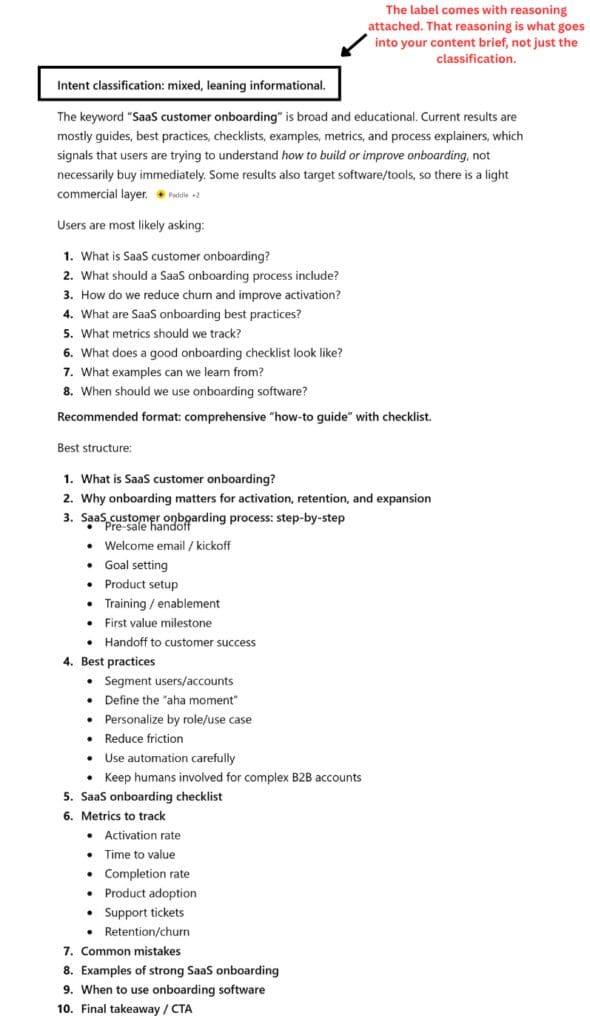
| The prompt (copy and paste) | You’re an SEO strategist for a B2B SaaS company. I’m planning content targeting the keyword “[KEYWORD]”. Before I choose a format, analyze the search intent behind this keyword. Classify the intent as informational, commercial, navigational, or mixed, explain your reasoning, and identify the questions users are most likely trying to answer. Present your analysis first, then recommend the single most appropriate content format and structure. |
| What is it useful for? | Preventing the most common SEO mistake: answering a different question than the one searchers are actually asking. |
| Expected output | An intent classification with reasoning, a list of likely user questions, and a format recommendation you can paste straight into a brief. |
Prompt #2: Uncover Hidden User Questions
| The prompt (copy and paste) | You’re an SEO content strategist. A user searches for “[KEYWORD]”. Your goal is to uncover the questions sitting behind that search that a keyword report won’t show. List the underlying questions they may be trying to answer and group them into four categories: immediate questions, comparison questions, implementation questions, and decision-stage questions. For each group, analyze which questions existing content usually ignores. |
| What is it useful for? | A keyword rarely tells the full story. This output becomes FAQs, subheadings, and brief requirements. |
| Expected output | Four grouped question lists, with the most neglected questions flagged –– your shortcut to differentiated coverage. |
Prompt #3: Compare Audience Perspectives
| The prompt (copy and paste) | You’re a content strategist for a B2B SaaS company researching the topic “[TOPIC]”. Compare how these four audiences approach it: SaaS founder, Head of Marketing, growth marketer, and content strategist. Present a table with one row per audience covering their goals, concerns, key questions, and content needs. Then, analyze the two biggest differences that should change how I write for each group. |
| What is it useful for? | Different roles search the same topic with different goals. Knowing the differences improves relevance and conversion potential. |
| Expected output | A four-row comparison table plus two concrete writing implications. |
2. SEO Prompts for Topic Clusters
One article rarely builds authority, but topic clusters do. If you’re building content clusters for your SaaS website, this is where to start; these prompts will help you organize a pillar topic and supporting pages, and show you gaps in your content plans.
Prompt #4: Build a Topic Cluster and Find Missing Coverage
| The prompt (copy and paste) | You’re an SEO strategist for a SaaS company. I want to build topical authority around “[TOPIC]”. Create a topic cluster: define the core pillar topic, supporting subtopics, beginner-level and advanced content, missing subtopics, unanswered user questions, and internal linking opportunities. Organize the results into a logical cluster structure, then analyze which gaps I should address first and explain why. |
| What is it useful for? | Moving from a single keyword to a complete topic ecosystem, and spotting the holes before your competitors do. |
| Expected output | A structured cluster map with a prioritized gap list you can turn directly into a content calendar. |
Prompt #5: Map Topics to the Buyer Journey
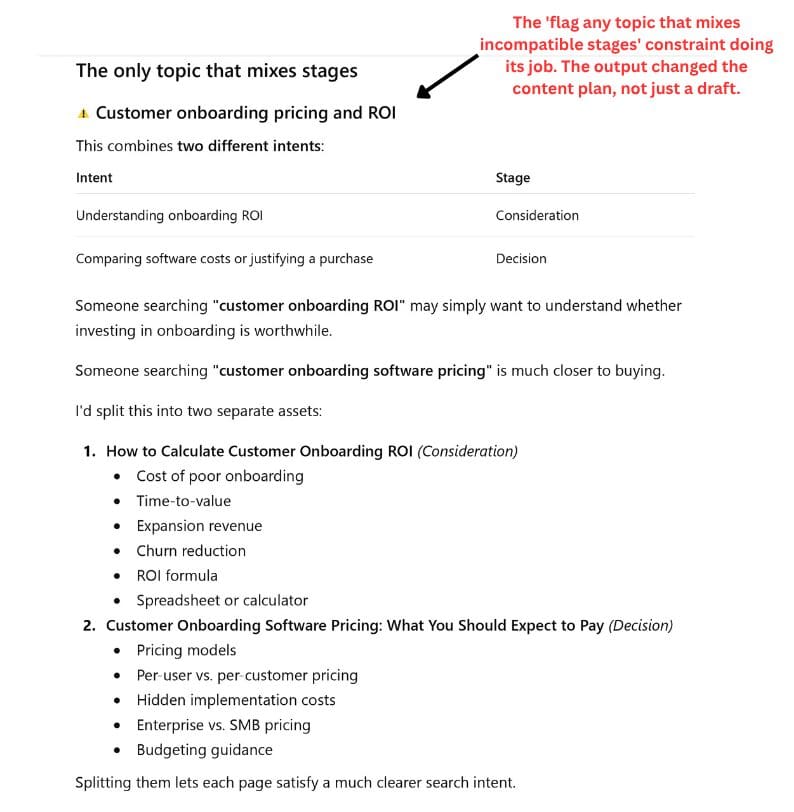
| The prompt (copy and paste) | You’re a SaaS content strategist. Here’s a list of topics from my content plan: [PASTE TOPICS]. Categorize each into awareness, consideration, evaluation, or decision stage. Present the result as a table with the topic, the stage, your rationale, and the content format that best fits that stage. Flag any topic that mixes incompatible stages. |
| What is it useful for? | Not every supporting topic should become the same type of asset. This keeps funnel stages from colliding on a single page. |
| Expected output | A stage-mapped content plan with format recommendations and mixed-intent warnings. |
3. SEO Prompts for Entity Discovery
Search engines and AI systems don’t just match keywords; they interpret concepts, brands, products, and the relationships between them. Those are entities: the “things” a system recognizes and connects, whatever exact words the searcher uses. Covering the right entities makes your topic easier to understand and more complete.
If you want your product to become an entity that LLMs recognize, start by mapping the concepts around your topics.
Prompt #6: Discover Entities and Content Opportunities
| The prompt (copy and paste) | You’re an SEO strategist who understands how search engines and LLMs interpret topics through entities. Analyze the topic “[TOPIC]”. Identify the primary entities, secondary entities, supporting concepts, related technologies, and industry frameworks that a complete piece of content should cover. Then recommend supporting articles, FAQ opportunities, and internal links, and explain how each recommendation strengthens topical coverage. |
| What is it useful for? | Turning an abstract concept (entities) into an actionable content plan. |
| Expected output | An entity map plus a list of supporting assets, each justified by the coverage it adds. |
4. SEO Prompts for Content Gap Analysis
The fastest way to get an edge on your competition is knowing exactly where everyone else falls short. Feed ChatGPT real SERP material (competitor outlines, summaries, People Also Ask questions), and let it find the patterns. Pair these prompts with a proper content audit of your own site.
Prompt #7: Find Content Gaps in the SERP
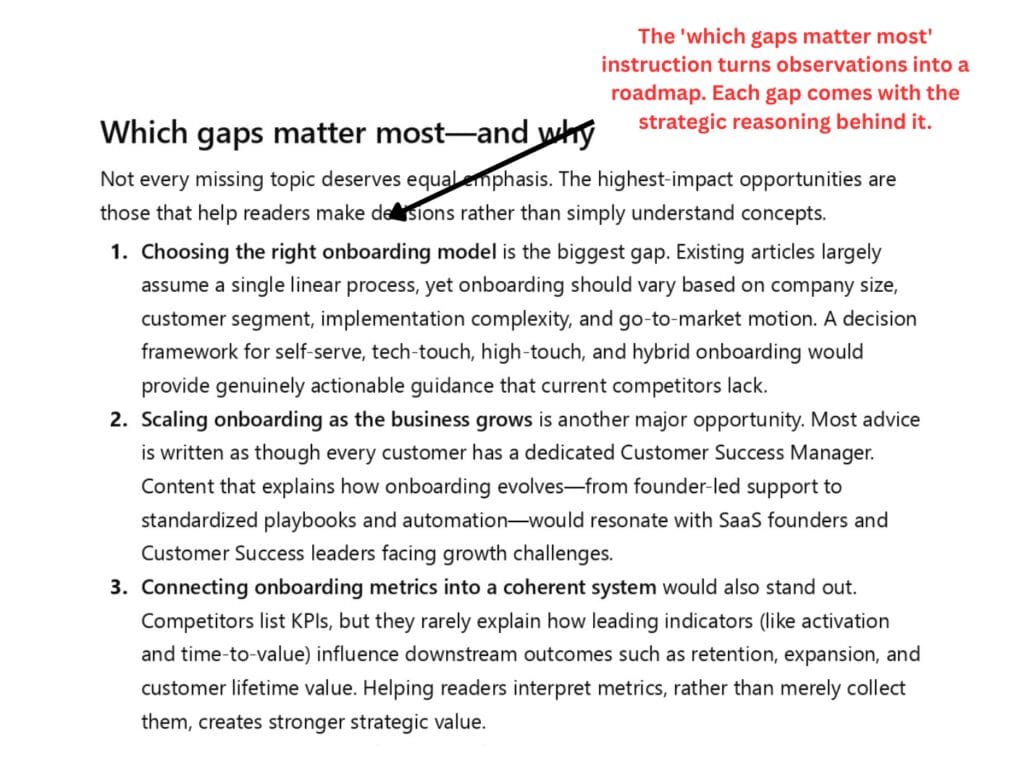
| The prompt (copy and paste) | You’re an SEO analyst. Below are competitor outlines and SERP summaries for the keyword “[KEYWORD]”: [PASTE OUTLINES]. Identify recurring themes, repeated advice, missing perspectives, unanswered questions, weak explanations, and audience needs that go unaddressed. Finish with an analysis of which gaps matter most for a new piece of content, and why. |
| What is it useful for? | Learning from the search landscape without copying it. The goal is a clearer, more useful answer than what’s ranking. |
| Expected output | A pattern analysis of the SERP with a shortlist of gaps worth building content around. |
Prompt #8: Prioritize Content Opportunities
| The prompt (copy and paste) | You’re the Head of Content at a B2B SaaS company with limited resources. Here are the content gaps we’ve identified: [PASTE GAPS]. For each one, assess audience relevance, business alignment, and buyer-journey impact, then rank them by strategic value. Present a ranked table and explain the reasoning behind your top three. |
| What is it useful for? | Not every gap deserves investment. Some are interesting; few connect to positioning, objections, or decision-stage questions. |
| Expected output | A ranked opportunity list with explicit reasoning; a starting point for roadmap conversations, not a final verdict. |
5. SEO Prompts for Audience Research
Keywords tell you what people search for. Audience research tells you why, and the why is what makes content convert. Understanding real customer language often improves SEO results more than another round of keyword analysis.
Prompt #9: Simulate Audience Questions and Pain Points
| The prompt (copy and paste) | Act as a [TARGET AUDIENCE, e.g., SaaS founder] researching “[TOPIC]” for the first time. Describe your primary questions, concerns, frustrations, desired outcomes, evaluation criteria, and the information you’d need before taking action. Stay in character for the description. Then step out of character and analyze: what problem is this person ultimately trying to solve? |
| What is it useful for? | Getting past keywords to the person behind the search: their objections, criteria, and real goal. |
| Expected output | A first-person needs profile plus a root-problem analysis you can write against. |
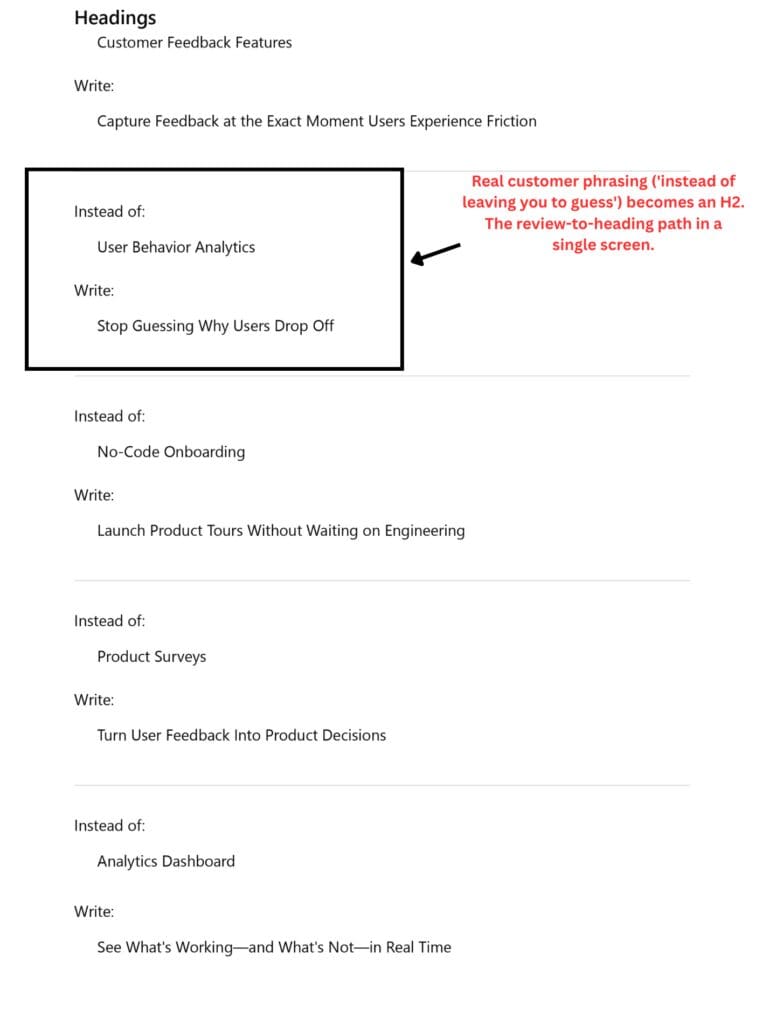
Prompt #10: Extract Voice-of-Customer Insights
| The prompt (copy and paste) | You’re a content strategist analyzing raw customer language. Here’s a set of reviews, support tickets, and sales-call notes: [PASTE INPUT]. Identify recurring phrases, common concerns, emotional language, and decision-making factors, quoting exact wording where it’s revealing. Then recommend how these insights should change our headings, examples, and content briefs. |
| What is it useful for? | Unlike Prompt #9, this uses real customer inputs, not simulated ones. The exact words your buyers use to describe their problems. |
| Expected output | A voice-of-customer summary with verbatim phrases and specific recommendations for briefs and headings. |
6. Content Creation and Optimization Prompts
Yes, ChatGPT can help you write, but the research comes first. These two prompts turn everything above into outlines and metadata. Skip the research, and you’ll get generic AI content that’s easy to identify and unlikely to earn trust. AI is a powerful writing assistant, but it still takes human expertise to shape a compelling narrative, verify accuracy, and produce content that’s genuinely worth publishing.
Prompt #11: Create a Research-Informed Outline
| The prompt (copy and paste) | You’re an SEO content strategist. Create a detailed outline for an article targeting “[KEYWORD]”, written for [AUDIENCE]. Use these research inputs: search intent = [PASTE], key audience questions = [PASTE], content gaps = [PASTE]. Structure the outline with H2s and H3s, note where each research input is addressed, and include FAQ and internal linking suggestions. Flag any section that isn’t justified by the research. |
| What is it useful for? | A strong outline is the product of strong research. This prompt forces every section to earn its place. |
| Expected output | An outline ready to drop into a brief, where each section traces back to a research input. |
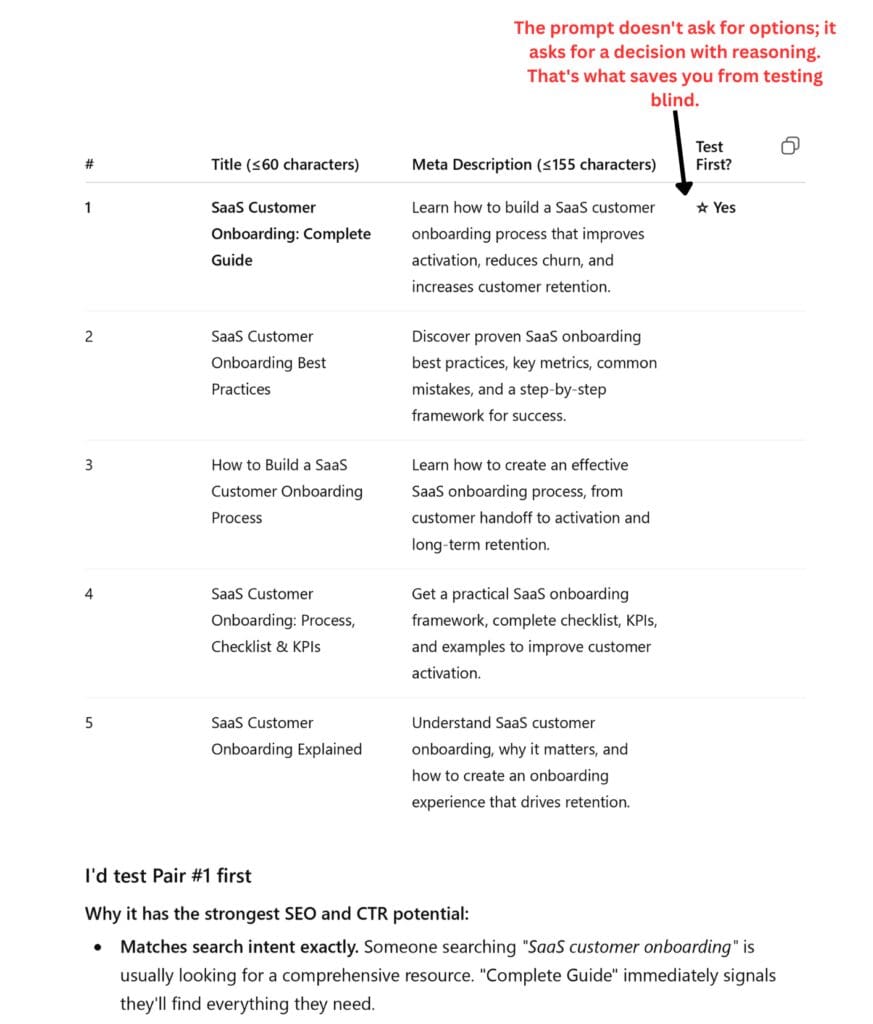
Prompt #12: Generate Titles and Meta Descriptions
| The prompt (copy and paste) | You’re an SEO copywriter. The article targets “[KEYWORD]” for [AUDIENCE], and the search intent is [INTENT]. Write five title options under 60 characters and five meta descriptions under 155 characters. Prioritize clarity, intent alignment, and click-through potential over cleverness. Present them in a table and mark which title/description pair you’d test first, and why. |
| What is it useful for? | Fast metadata options grounded in the intent analysis you’ve already done. Treat them as starting points; human review stays essential. |
| Expected output | A 5×2 options table with a recommended pair and rationale. |
Why These Prompts Also Matter for GEO (AI Search)
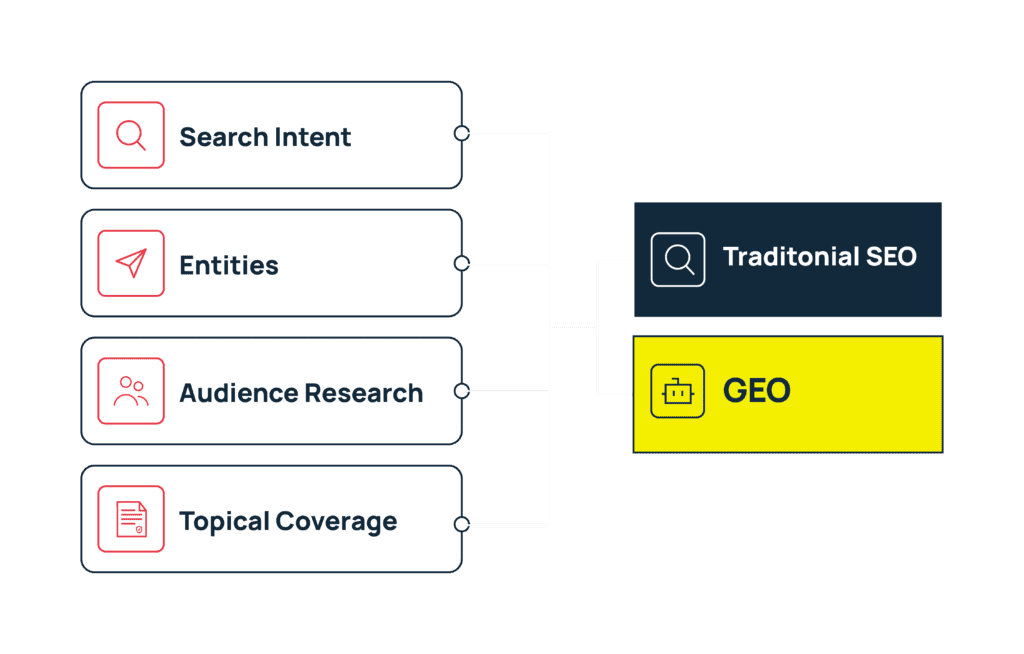
SEO is now being asked to bridge into AI search and LLMs. While it can seem like the wild west, the approach we’ve covered above can also help you with optimizing for AI.
AI search systems increasingly retrieve and synthesize information through questions, entities, and contextual relationships rather than keyword matching alone. Google describes this shift in its documentation on AI features in Google Search, and we’ve covered how AI is reshaping SEO for SaaS marketers and how LLMs index and retrieve information.
That’s why the same research work (intent, entities, audience questions, topical coverage) also strengthens your visibility in AI-driven results, i.e. Generative Engine Optimization (GEO). Different surface, same foundations: understand the question, cover the topic completely, and be genuinely useful. If you want to go deeper, here’s how to rank in LLMs.
Final Takeaway: SEO Prompts for ChatGPT Help You Think, Not Just Write
The real value of SEO prompts isn’t that they help you write faster; it’s that they help you think better. The marketers getting the most out of AI aren’t the ones generating the most content; they’re the ones asking better questions before, during, and after creation.
“The biggest mistake we see is treating ChatGPT as a writing tool. In our client work at Singularity, the prompts that actually move the needle are the ones we run before anyone writes a word; they change decisions, not just drafts.” Patrick Herbert, CEO, Singularity Digital.
That’s also where prompts reach their limits. They can’t set priorities, interpret your data, or align SEO with your business goals. That’s still judgment work. If you want a tailored SEO and GEO strategy for your SaaS, built by experts who combine research, strategy, and content, talk to us.
FAQ: SEO Prompts for ChatGPT
What are SEO prompts for ChatGPT?
Structured instructions that direct ChatGPT to support a specific SEO task: analyzing search intent, mapping topic clusters, finding content gaps, or drafting outlines and metadata. The best ones give the model context, a clear objective, constraints, and a request to analyze before concluding.
Can ChatGPT do keyword research?
Partially. It’s useful for brainstorming seed keywords, questions, and topic angles, but it cannot provide search volume, keyword difficulty, or competition data. Validate every idea in a tool with real search data before you invest in it.
Can ChatGPT replace SEO tools like Ahrefs or Semrush?
No, they solve different problems. SEO platforms measure what’s happening in search; ChatGPT helps you interpret those findings and decide what to do next. The strongest workflows combine both.
Which SEO tasks should you not use ChatGPT for?
Anything that requires live or measured data: search volume, keyword difficulty, backlink quality, ranking forecasts, or current SERP results. Treat any number ChatGPT gives you in these areas as fiction.
How do I know these prompts actually work?
We tested all 12 prompts on a live example. The screenshots throughout this article are the actual outputs. Each prompt follows a structure that prompt engineering research has repeatedly shown to outperform generic prompting, but the best answer is still: run them on your own topics. The expected output notes above tell you what a good result looks like.