TL;DR
- E-E-A-T stands for Experience, Expertise, Authoritativeness, and Trust. Google uses these qualities in its Search Quality Rater Guidelines to evaluate content quality, with Trust at the center.
- E-E-A-T isn’t a direct Google ranking factor, but demonstrating experience, expertise, and trust can help you create more useful, credible content that competes more effectively in search.
- When improving your E-E-A-T, start with your most important website pages. Check what evidence is missing, document specific improvements, and prioritize which pages you update first.
- Best practice for long-term SEO is to make E-E-A-T part of your content production process.
What is E-E-A-T in SEO, and why does it matter?
Your SaaS website might explain your product’s features, pricing, and benefits. But does it give potential customers enough reason to trust your claims and consider buying from you?
That’s where E-E-A-T comes in. It stands for Experience, Expertise, Authoritativeness, and Trust. Google uses these concepts in its Search Quality Rater Guidelines to help human evaluators assess the quality of search results.
Each attribute addresses a different question:
- Experience: Has the creator actually used the product, performed the work, or participated in the activity they’re describing?
- Expertise: Does the creator have the knowledge or skills needed to explain the topic accurately?
- Authoritativeness: Is the creator or website recognized as a credible source on the subject?
- Trust: Can readers rely on the information and the people or business responsible for it?
Google added Experience to its original E-A-T framework in 2022 to recognize the value of firsthand knowledge as a cornerstone of why people engage in content.
For your SaaS business, that means giving visitors reasons to believe your claims, whether they’re reading a product page, comparing pricing plans, or evaluating a customer success story.
And what about AI search? These same credibility questions matter when your brand appears in AI-generated answers. Explore how E-E-A-T connects to GEO and AI Overviews in Singularity Digital’s guide to E-E-A-T in the AI era.
E-E-A-T isn’t a ranking factor. So why should you care?
Is E-E-A-T a Google ranking factor? Not directly. Google uses multiple systems and signals to identify helpful, reliable content. Human quality raters assess search results using Google’s guidelines, but their individual assessments do not directly determine how pages rank.
That distinction matters because there’s no E-E-A-T score you can improve, and adding author biographies, citations, or expert quotes won’t automatically boost your search rankings. But you’re competing with other websites for the same readers, and those readers care about what they find in search.
Imagine two articles about implementing a CRM platform. One summarizes a product’s features and provides general setup advice. The other walks through an actual implementation, includes configuration screenshots, explains problems encountered during setup, and shows how the team solved them.
Which article would you trust more? Which would make you seriously consider that software? The one that shows how the work actually gets done gives readers a stronger reason to trust its advice, and remember the company behind it.
How to demonstrate Experience: Share product tests and lessons learned
Useful ways to show firsthand experience include:
- Product screenshots and configuration walkthroughs.
- Testing observations and implementation lessons.
- Customer case studies that explain what happened in practice.
For example, an article about customer support automation becomes more useful when it explains how a team selected workflows to automate, what happened during testing, and which adjustments improved the process.
Intercom, a customer service software company, offers an example of firsthand product experience. In an article, the company explains how it implemented Fin, its AI customer support agent, within its own customer support operation.
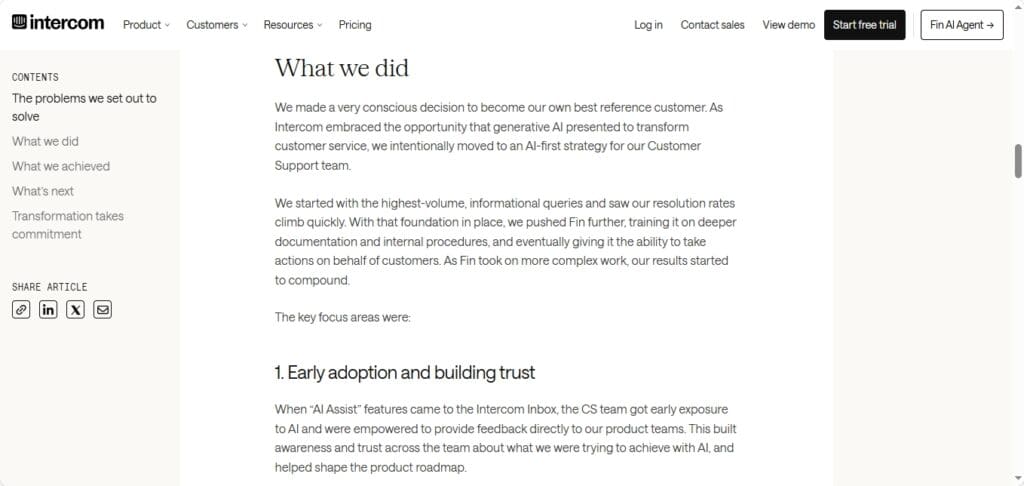
Intercom explains how it tested Fin with a small group of customers, improved its knowledge base, and adjusted support workflows. The company now reports that Fin resolves over 81% of its support volume. Readers get to see both the work behind the rollout and the result.
You don’t need a result of that scale to demonstrate experience. A clear explanation of how your team actually implemented a feature, resolved a technical issue, or improved a workflow can provide useful firsthand evidence.
Don’t make up customer experiences to make your content sound more credible. If you’re using a hypothetical example to explain a problem or solution, say so. Readers should be able to tell what your team has actually done.
How to demonstrate Expertise: Answer customer questions with expert insights
You demonstrate expertise when you use what you know to help readers solve real problems.
To find those problems, look at the questions customers ask during sales calls, onboarding, and support conversations. Then use internal experts to strengthen your articles, product pages, and case studies.
While you need to identify relevant authors, reviewers, or subject-matter specialists, simply adding their names to an author biography won’t cut it. Their knowledge should appear in the substance of the article, through specific explanations and recommendations.
When Singularity Digital redesigned Careerflow’s resume-builder landing page, we rewrote the content and added expert profiles to help visitors see the expertise behind the advice. This was part of a broader set of improvements that helped increase monthly organic clicks by 47%, as detailed in our Careerflow case study.
Note: The level of expertise required also depends on the topic. Google uses the term Your Money or Your Life (YMYL) for topics where inaccurate information could significantly affect someone’s health, financial stability, safety, or well-being.
A tutorial explaining how to configure a project management tool carries different risks from an article offering medical, mental health, or financial guidance. Higher-risk advice may require qualified specialist input, stronger sourcing, and additional review.
How to demonstrate Authoritativeness: Highlight third-party recognition
It’s easy to call your company an industry leader. It’s more convincing when other credible sources recognize your expertise.
Look for evidence beyond your own website: contributions to industry publications, relevant awards, independent references, or a track record of work that readers can verify. Then make it easy to find. Link to the original publication, award announcement, or supporting project on your site and in your content.
For example, Patrick Herbert, Director of Singularity Digital, shared his insights on specialized, experience-based content in Zapier’s article about Google AI Overviews. That gives readers an independent source where they can see his expertise in action.
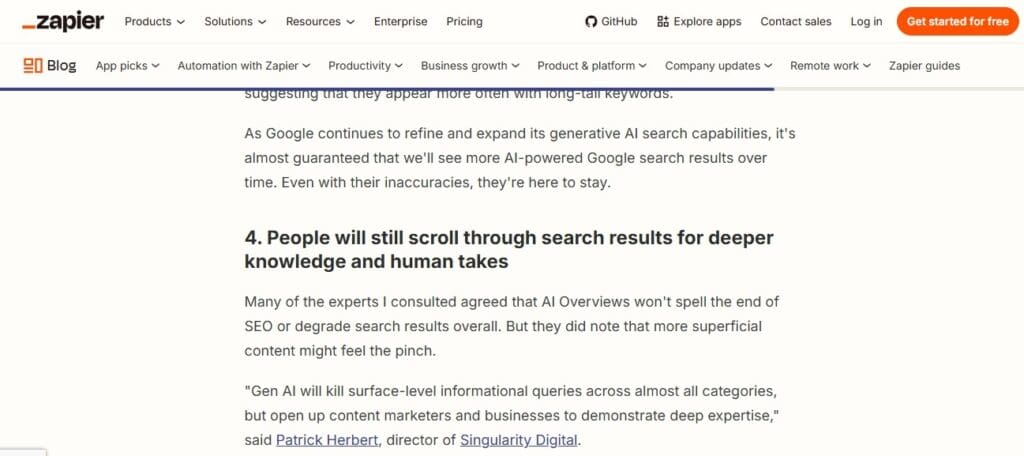
Check your About page and leadership profiles, too. Can visitors see who’s behind your business and find evidence of the experience you claim? A few relevant, verifiable examples will do more for your credibility than a long list of unsupported superlatives.
If your SaaS company needs help developing content that demonstrates its expertise and builds a credible organic search presence, contact Singularity Digital to discuss your content and SEO strategy.
How to demonstrate Trust: Back claims with evidence
If your product page says your software cuts response times by 40%, can you prove it? And would a potential customer understand where that number came from?
That’s the kind of question to ask when reviewing your website for Trust, which Google considers the most important part of E-E-A-T.
For any important claim, check what supports it. If you’re citing a customer result, explain what was measured, over what period, and whose result it was. If the number comes from internal testing, make the methodology and relevant limitations clear.
Klaviyo, a marketing and customer relationship management platform, does this in its case study about Caitlyn Minimalist, a jewelry brand. It reports 144% year-over-year growth in Klaviyo-attributed revenue and names Anthony Ponce, the customer’s Head of Growth. The result is clearly attributed to that customer rather than presented as something every user can expect.
Trust also comes down to the information people need before buying. Are your product capabilities described accurately? Do your pricing pages and support documentation explain the same terms and limitations? Klaviyo’s help center, for example, specifies that its free email plan includes up to 250 active profiles and 500 email sends per month, and explains what happens when customers reach those limits.
Review your key pages for unsupported claims, outdated information, and inconsistencies. Give visitors the evidence they need to evaluate your product without having to guess or take your word for it.
How to audit your website for E-E-A-T improvements
Now that you know what to look for, it’s time to improve your content. In our four-step audit, you’ll check what’s missing, document the changes, and decide what to tackle first.
As you go through your site, Google’s people-first content guidance gives you three useful questions to keep in mind:
- Who created the content, and can readers identify the people behind it?
- How was it produced, and what experience or research supports it?
- Why was it created, and does it help readers accomplish something useful?
Use these questions alongside the E-E-A-T checklist below as you review your pages.
Step 1: Choose the pages that matter most to your potential customers
First, make a shortlist of pages to audit. Focus on pages that bring potential customers to your website or help them decide whether to buy, such as your homepage, product pages, pricing pages, and high-value articles.
With your pages selected, prepare a working copy of each in a shared document where reviewers can leave comments and track edits.
Your output: A manageable set of priority pages, with docs ready for review.
Step 2: Review each page and flag improvements
Now, it’s time for you or your SEO content specialist to review each page for relevant evidence of Experience, Expertise, Authoritativeness, and Trust.
Evaluate the page according to what visitors need from it. A product page may need clearer evidence supporting its feature claims. An educational article may need more specific implementation examples or better sourcing. A pricing page may need clearer conditions.
Use these questions to guide your review:
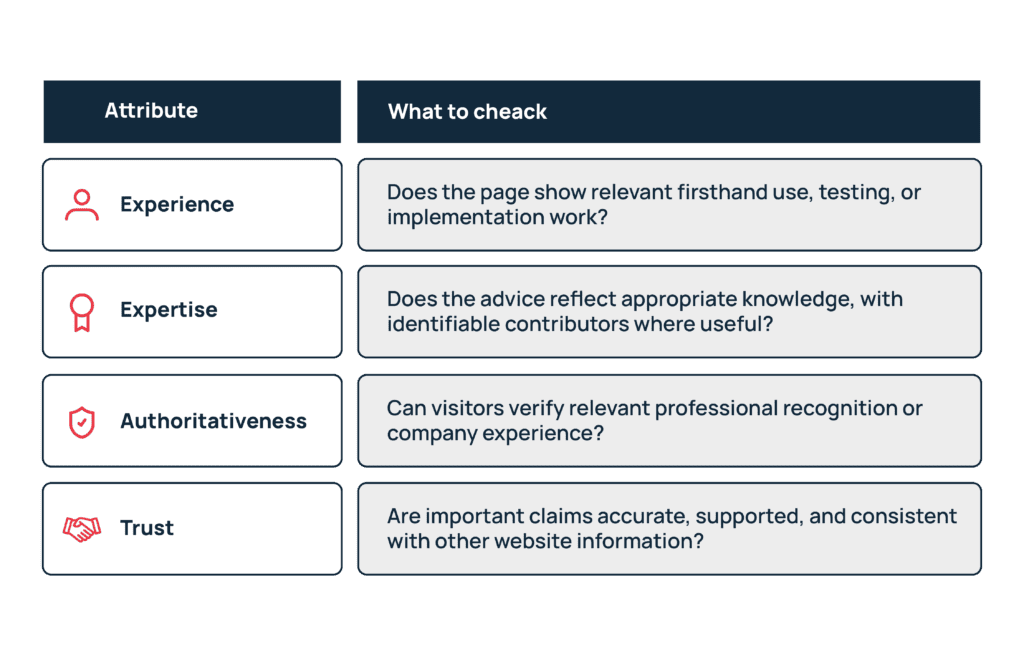
Record each improvement directly in the page’s working copy. For example:
- Product claim: Add the source and measurement details behind the response-time reduction figure.
- Implementation article: Ask the product specialist for a real configuration example and supporting screenshot.
- Company page: Link the stated industry recognition to its original source.
You can document these changes in comments or a short action list at the top of each page.
Your output: Reviewed pages with specific, actionable feedback alongside the content.
Step 3: Prioritize, implement, and review improvements
Once you’ve reviewed your pages, decide which changes deserve attention first.
Use a simple priority-effort matrix. Assess each improvement according to its importance to the page and the work required to implement it.
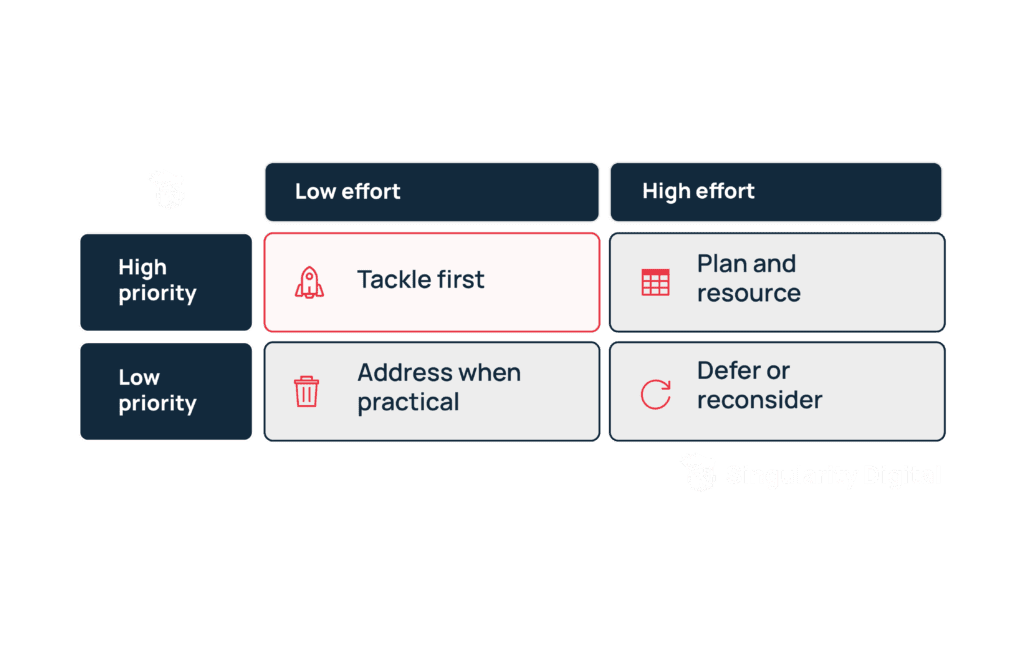
A missing source link on a key product page may be straightforward to fix. Producing a new implementation case study may require interviews, screenshots, technical review, and additional writing.
Both can matter, but they need different plans. Start with high-priority improvements that your team can complete quickly. Schedule larger projects according to their importance and the resources they require.
When you’re ready to make edits, have your content team reach out to internal experts with specific requests from the audit. For example, a product specialist might need to confirm a feature claim. This way, experts can contribute the information without having to write or edit the page themselves.
Your content specialist can then make the updates and check that the claims and supporting evidence are accurate before publishing.
Your output: Pages reviewed with quality changes, completed in strategic order.
Step 4: Build E-E-A-T checks into your content workflow
Your audit will probably reveal issues that appear across several pages. You may find that product claims frequently lack supporting evidence, articles are published without input from relevant specialists, or company information is inconsistent.
Use what you’ve learned to improve your content workflow. Add the checks you need to your briefs and editorial reviews, and make time to gather input from internal experts and company data.
For any SaaS team, but especially a lean one, it’s more efficient to get these details right during production than to keep fixing the same problems after publication.
Your output: A repeatable content review process that helps your team make E-E-A-T improvements before publication.
You already have the expertise. Now show it.
Your team probably has more to work with than you realize: firsthand product knowledge, customer stories, specialist insights, and results worth sharing. The opportunity is to bring that experience into your content so potential customers can see why they should trust you.
Start with the pages that matter most to your business. Show what you know, support your claims, and give readers something useful they won’t find in another generic article.
If you need help turning your expertise into content that attracts the right audience, contact Singularity Digital for a free consultation about your SEO and content strategy.