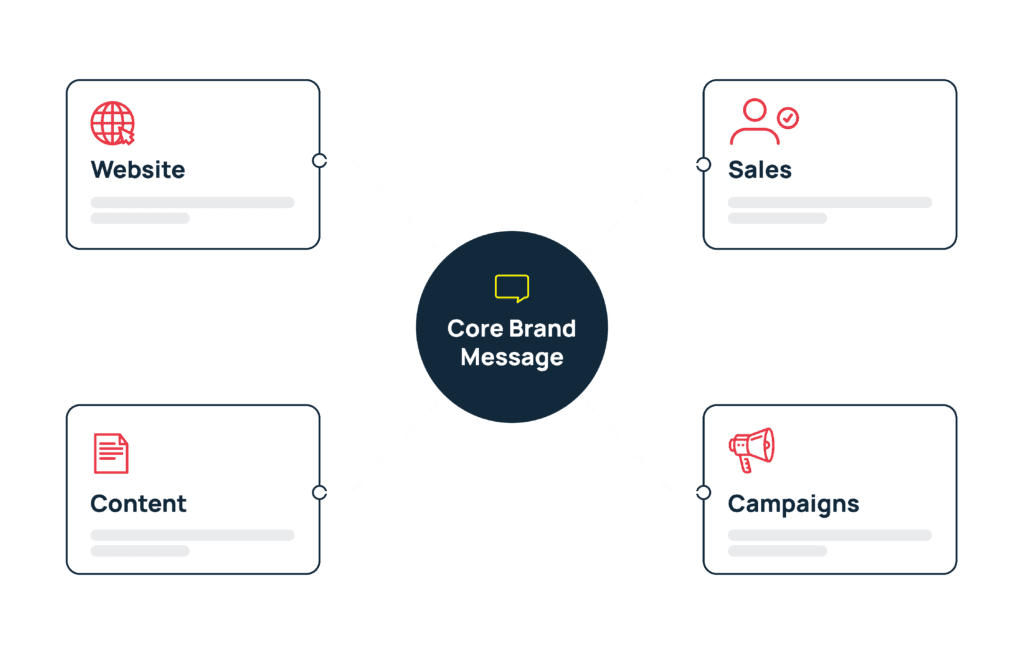
Your homepage says one thing, but your sales team says another. Then you get on a customer call and explain your product in a third way. Those mixed messages make it harder for buyers to understand your value and harder for your team to make the sale.
If that sounds familiar, you don’t need better copy. You need one agreed way to explain your product, the value it creates, and why buyers should believe the message. The wording can change for different buyers. The core message should not.
This guide gives you a five-question framework for finding clarity. Work through the questions in order, and you will end up with a shared set of brand messages you can use across your website, sales materials, content, and campaigns.
Once you have your messaging drafted, we’ll show you how to test it with buyers in How to Test Brand Messaging and use it in search and AI discovery in How to Use Brand Messaging in GEO/SEO. But for now, let’s build the messaging itself.
What Is Brand Messaging – and Why Do You Need to Use a Framework?
Brand messaging is the set of ideas and statements you use to explain what your product offers, why it matters to buyers, and why they should believe you. A tagline, homepage headline, sales pitch, or campaign line can express that messaging, but none of them is the messaging on its own.
The framework gives your team one place to start as you work towards consistency. Everyone works through the same questions, then you use the answers to shape your messaging. You might keep the final version in a table, a slide, or a short document. The format matters less than making it easy for anyone on the team to see the core message and where there is room to adapt it.
At its simplest, the framework asks:
- Who are you talking to?
- What value do you offer?
- What problem does that solve for them?
- Why should they believe you?
- What should your team consistently say about your product?
Positioning, Messaging, and Brand Voice: What Each One Actually Does
It helps to separate three things that often get mixed together. April Dunford, author of Obviously Awesome: How to Nail Product Positioning so Customers Get it, Buy it, Love it, draws a useful line between them: positioning is not the same thing as messaging.
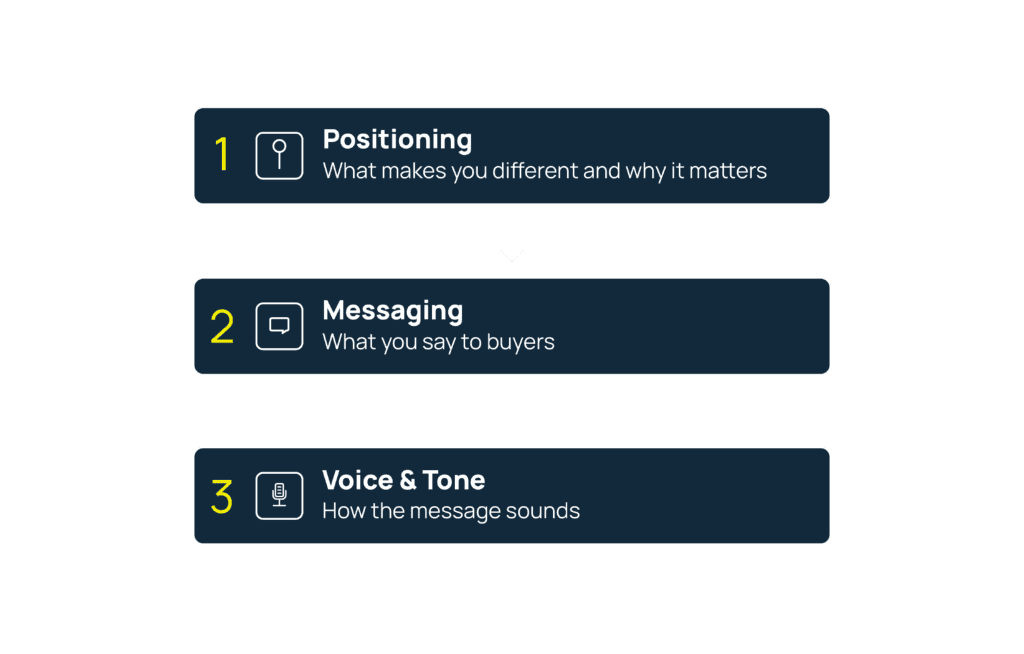
Positioning comes first. Positioning defines:
- Where does your product compete
- Who is it for
- What makes it meaningfully different, and
- Why should that difference matter?
Kellogg professors Alice Tybout and Brian Sternthal argue that clear positioning needs both customer and competitor insight: you need to understand how your product fits into the buyer’s life and why they should choose it over the alternatives.
Messaging is one of the ways you express your positioning. It turns those choices into what you actually say to buyers. Then, voice and tone shape how that message sounds.
That order matters because it keeps you from trying to solve a market problem with nicer wording. The framework in this guide starts from those positioning decisions and helps you turn them into messages your team can use.
Get the Positioning Clear Before You Write the Messaging
If you cannot clearly explain who your product is for, what it does differently, and why that difference matters, you cannot move forward with your marketing and expect it to work. David Aaker and J. Gary Shansby describe positioning as a strategic decision that should be made deliberately, not decided on the fly when you start writing copy.
Before you write your messaging, your positioning should already tell you which buyers matter, what alternatives they compare you with, and what differentiated value you can credibly claim.
Once those choices are clear, you can move on to explaining that position in a way your buyers can understand and care about. If you cannot articulate your positioning yet, stop here and refine it before moving forward. Otherwise, you risk ending up back at square one, with different people saying different things about your product.
Use These 5 Questions to Develop Your Core Messaging
Our framework consists of five questions. Each answer builds on the one before it. By the end, you should have the raw material you need to write the messages your team will actually use.
1. Who Are Your Buyers?
In B2B SaaS, separate the type of company you want to win from the people inside that company who influence or make the decision.
Your ideal customer profile (ICP) helps you define which companies are a fit. Your buyer persona research helps you understand the people involved: what they are trying to achieve, what makes the problem urgent, what they do today instead, what objections they have, and how they describe the problem in their own words.
That distinction matters because the same product can matter for different reasons. A marketing leader may care about visibility and speed. The person running campaigns may care about fewer manual follow-ups. Finance may care about cost or predictability. You do not need a different brand for each buyer, but you do need to know what part of the value matters most to each one.
Use your positioning, ICP and personas to create a list of each buyer you want to serve and what they need to get from your product or solution.
2. What Core Value Do They Need to Understand?
Once you know who you are talking to, decide the main value you need that buyer to understand. This connects what your product does to why the buyer should care.
For each buyer, write one or two sentences that explain the value they get in plain language. Avoid jargon that hides what actually changes for them.
Take “all-in-one platform.” That describes the product, but it does not yet explain the value. What changes for the buyer because everything is in one place? Maybe the team spends less time handing work off, managers can spot delays earlier, or people stop duplicating updates across tools. Those outcomes are the value. “All-in-one” can help describe the product, but it should not carry the message by itself.
If you are still reaching for words like innovative, seamless, flexible, or customer-centric, go back to the positioning. Those words sound positive, but almost any competitor can use them. Your core value should give the buyer a concrete reason to care about your product instead of another option.
3. What Problem Does the Product Solve for Each Buyer?
Now connect that core value to the specific problem or outcome that matters to each buyer group. This is where your supporting messages come from.
Say your core value is giving a marketing team one place to coordinate campaign work. A marketing leader may care because they can catch delays before deadlines slip and spend less time chasing updates. A campaign manager may care because clearer ownership and approvals reduce missed handoffs and keep work moving. The emphasis changes, but the product is still solving the same larger problem.
You do not need three, five, or seven supporting messages because a template says so. Keep only the ones that answer a real buyer question and make the core value more concrete. One gut check: if a message cannot be traced back to your positioning, it probably does not belong.
4. Why Should Buyers Believe the Claims?
Customers have no reason to believe you when you say your product is faster, easier, safer, or more reliable without proof. After all, you’re trying to sell it.
Give buyers a reason to believe your specific claims. For example, a product demo can show how a feature works. A customer result can support an outcome claim. An independent review or certification can demonstrate security, reliability, or trustworthiness.
If you cannot prove a claim yet, do not make it louder. Narrow it to what you can support, or find the evidence before you build the message around it.
Overstating your product is a reputation and branding problem. If your product does not live up to the promise, that gap can surface in reviews, forums, and customer complaints. Research on conflicting online reviews found a significant negative effect on purchase intent, particularly when people disagreed about specific product attributes.
For each core value or benefit you have written down, add at least one piece of concrete proof: a case study, customer result, certification, independent review, or product demo.
5. What Are the Final Messages Your Team Will Use?
Now bring the answers together. Write the core message your team should keep consistent, then the supporting messages that matter to each buyer. Use the language you have heard in customer interviews, sales calls, reviews, support conversations, or buyer research instead of defaulting to internal terms your customers may not use.
Put the core message, supporting messages, and proof into one reference document that Sales, Marketing, PR, and founders can use when creating pages, campaigns, sales materials, or customer communications. Using the same reference helps everyone tell the same core story while still adapting the wording for different buyers and channels.
Test the Messaging Before You Treat It as Final
Your team agreeing with the messaging does not mean buyers will understand it the same way. Before you use it everywhere, test the first version with people who match the buyers you defined at the start. You want to know whether they understand the value, believe the claims, and read the language the way you intended.
Testing is a separate step from developing the messaging, so we’ve written another piece to cover it – check out How to Test Brand Messaging for the testing process.
Example: What a Completed SaaS Brand Messaging Framework Looks Like
Here is a fictionalized example for a project-management SaaS used by marketing teams. The wording is illustrative, and the proof is intentionally generic because a real company should only use evidence it can verify. Your answers are likely to be more in-depth, and you may have more buyers, more proof, or more features to cover. The point is to show how the five answers connect.
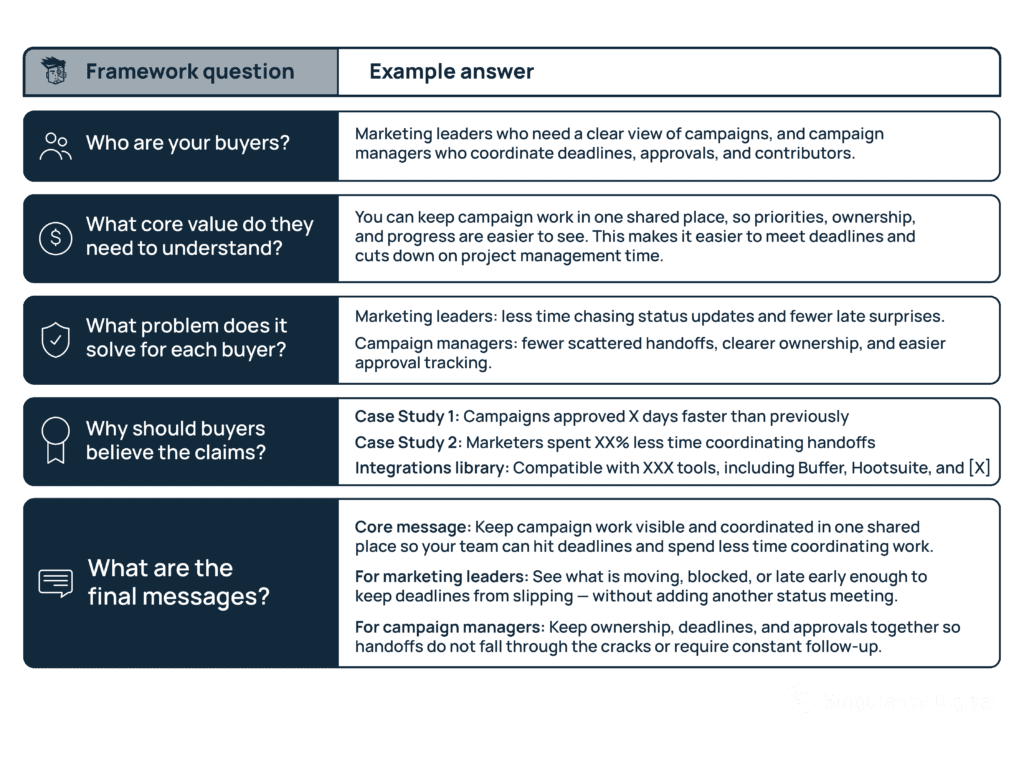
Notice what stays stable: the product is still about keeping campaign work visible and coordinated. What changes is the part you lead with for each buyer. That gives your team room to adapt the message without inventing a new version of the brand every time.
Strong Brand Messaging Starts Before the Copy
Strong brand messaging is not about finding a cleverer headline; it starts with the decisions behind the copy. A strong framework gives you a simple way to turn that thinking into something your team can use:
- Define the buyers
- Clarify the core value
- Connect it to the problem each buyer cares about
- Add proof, and
- Bring those answers together into the final messages.
Once that is clear, your homepage, sales deck, content, and campaigns can change the wording without changing the story. Buyers get a clearer picture of the company, and your team spends less time reinventing the message.
This article is part of our brand messaging series. Once you have your messaging drafted, use How to Test Brand Messaging to test it with buyers, then How to Use Brand Messaging in GEO/SEO to apply it to search and AI discovery.
If you want to connect clearer messaging with a broader organic search strategy, contact the Singularity Digital team to discuss the next step.