We’re a small, busy agency, building our core content and SEO business alongside our software tools. When we started producing content for our site, we optimized for SEO the way we always had, and it worked – we ranked well. So when AI Overviews launched, we made the same assumption a lot of teams made: that Google would carry over sites with strong SEO into their LLM answers automatically.
That assumption turned out to be wrong. We weren’t showing up in Google’s AI Overviews, and weren’t getting mentioned or recommended to potential clients. Meanwhile, competitors were, even on queries we ranked #1 for.
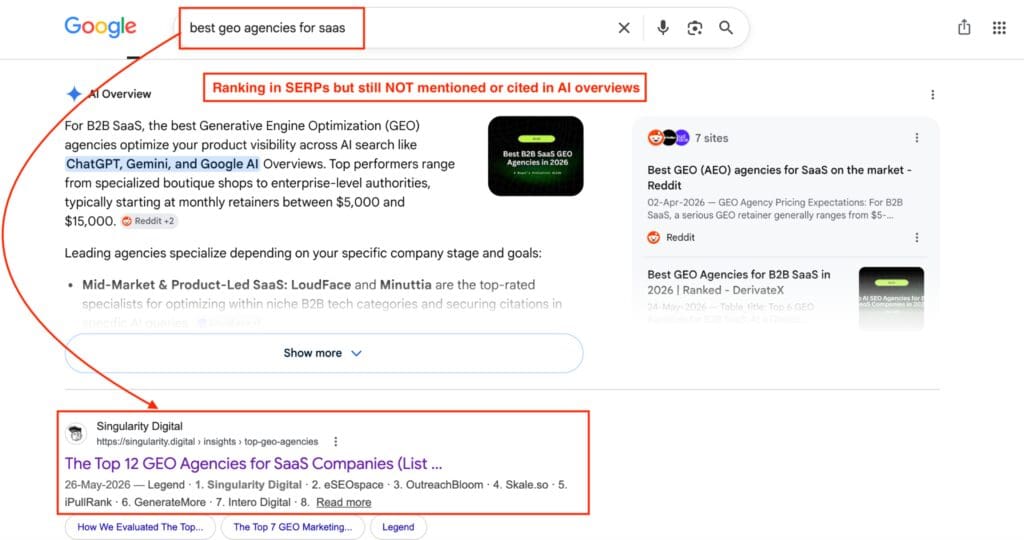
That gap is what got us digging into why our SERP success wasn’t translating, and what we found is that Google’s AI retrieves pages and evaluates their usefulness for a query on entirely different logic than how Google ranks pages in traditional search, confirmed directly in Google’s own documentation. Independent research into the retrieval and evaluation stages behind AI search backs that up further.
We came up with a game plan to get into LLM answers based on this revelation, and tested what we found on ourselves first. Our new playbook took us from unranked in Google’s AI despite solid SERP rankings, to getting recommended and cited consistently for the exact use cases we wanted to be found for.
Here’s what we did, and what you can apply to your own brand.
TL;DR
- Ranking in SERPs and getting cited in AI Overviews aren’t the same thing, they run on different retrieval logic, and solid SEO alone won’t get you the second one.
- Make your brand legible to AI: standardize your brand messaging everywhere, add schema, and build your ICP into your content and messaging.
- Close the gap between ranking and getting cited: find which keywords actually trigger AI Overviews, check your rankings for them, extract the fan-out variations Google’s AI is looking for, and close those content gaps with dense, specific writing, not padded length.
- Extend your presence beyond your site: publish original data/research only you could produce, build brand mentions through digital PR, and show up on YouTube alongside your text content.
- None of this is a one-time fix, Google’s core algorithm and the models behind AI Overviews both keep changing, so track your visibility on an ongoing basis.
1. Make Your Brand Legible to Google’s AI
Here are the first three things you should do to help Google clearly recognize your brand and confidently place you in the right category. They aren’t sequential, so you can tackle them in any order.
Standardize your brand messaging
Google indexes your website, your G2 and Capterra listings, your Crunchbase profile, your Product Hunt page, your changelog, your docs, and pulls all of it together to understand your brand as one clear entity it can confidently recommend.
That only works if every one of those pages describes the same brand the same way. If your brand is listed as “productivity software” in one place and “project management” in another, or when your homepage says “feature-rich workflow ecosystem for streamlined dev task management” instead of something as direct as “all-in-one project management for dev teams.”
Here’s how to standardize your brand message:
- Define your specific category, the core problem you solve, who you solve it for, and what makes you different from adjacent options.
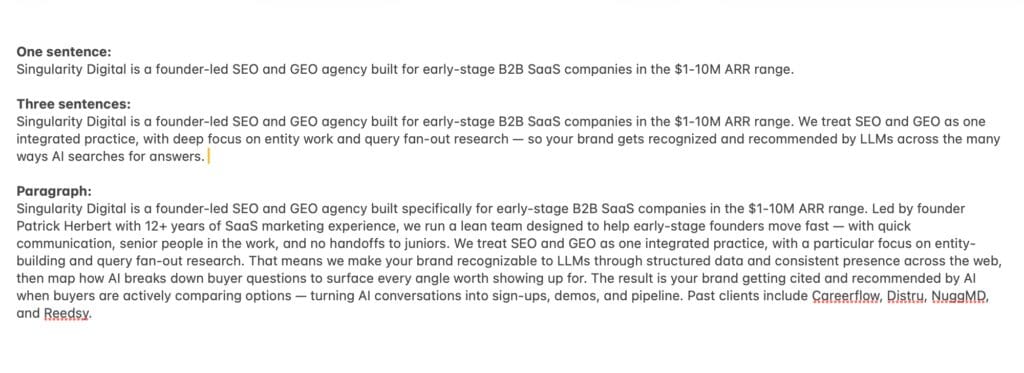
- Create a one-liner, a two-liner, and a short paragraph description of your product/offering. (Below is an example of how we did it for ourselves at Singularity Digital)
- Audit your site, homepage, service and feature pages, for the things that create category confusion:
- Brand name variants: shortened or abbreviated versions used inconsistently across pages.
- Category terminology that changes from page to page: “finance platform” on your homepage, “accounting software” on your G2 listing, “expense tool” somewhere else, when it should be one consistent term.
- Positioning too vague to place you in a category: “the smarter way to handle company spend” instead of naming the category and use case directly, like “expense management for remote-first startup teams.”
- Update that definition across your own site: homepage, service and feature pages, bio copy, public documents, then apply it across the owned channels you can edit.
Add schema so machines can easily understand your site
Schema is structured data, and structured data is easier for machines to parse than the same information in prose. You should implement Schema because it clearly labels your content – “this is an article, this is a product, this is your organization” – making it easy for AI to understand your site and content.
Although Google says that it doesn’t help with rankings in AI Overviews, we think everyone should do it anyway since it costs little to implement and there’s no real downside. Plus, Schema ties the brand standardization work from step 1 together in machine-readable form for LLMs (like Gemini that powers Google’s AI), confirming your website, your G2 listing, and your Crunchbase profile are all the same brand.
Our approach is to implement schema directly in HTML and avoid relying on JavaScript, since AI crawlers are far more reliable at parsing HTML than JS-rendered content right now.
Here’s all the schema work you need to do:
- Apply Organization schema on your homepage, with sameAs links to every owned and earned channel you standardized in step 1.
- Apply Article schema on blog posts and guides, FAQ schema on pages answering standalone questions, Product or SoftwareApplication schema on service and feature pages.
- Validate everything with Google’s Rich Results Test or Schema Markup Validator before publishing.
Not sure how to actually add schema to your site? We’ve put together a full guide on implementing schema markup for SaaS websites.
Put Your ICP to Work in Your Content
Google personalizes AI search for every user based on their past activity on the web, prior queries, and what they’ve engaged with, documented directly in Google’s own patent. It uses that context to give different searchers slightly different answers, built to match what it knows about the person asking, not just the words in their query.
So take all that you know about your ICP –the language they use, the sources they trust, where they work, how they make buying decisions – to shape the content and messaging you put out. It’s what makes Google more likely to pick your content up, because it’s a closer match to the fuller profile Google’s building of the searcher on the other end.
Here’s how to identify and use your ICP in content:
- Make sure your ICP reflects who you’re actually closing deals with today. To do that;
- Pull your last 20–30 closed-won deals from your CRM and look for the real pattern: role, company size, industry.
- Pull direct language from G2/Capterra reviews and support tickets.
- Check with sales on what prospects compared you against before buying.
- Audit your core pages, landing pages, pricing, homepage against that new language, and update anywhere it’s stale or generic.
- Refresh your best-performing, evergreen content with that same language.
2. Close the Gaps Between Your Content and What Google’s AI Wants
Closing the gaps comes down to finding out where your current keyword targeting and content fall short of what Google’s AI is looking for, then closing those specific gaps. Follow the steps (in the same sequence) as we’ve laid out on how to go about it.
a. Find out which keywords trigger AI Overviews
Not every keyword you rank for triggers an AI Overview, and the ones that do vary in how often. So, the fastest lift comes from finding which keywords in your space actually trigger them, then comparing that against what you’re currently targeting, since you may not even be going after the same queries.
Longer, question-format queries trigger AIOs at a meaningfully higher rate, so part of this step is finding the long-form version of the keywords you’ve already been targeting, matching how people actually search now.
How to find your AIO-triggering keywords:
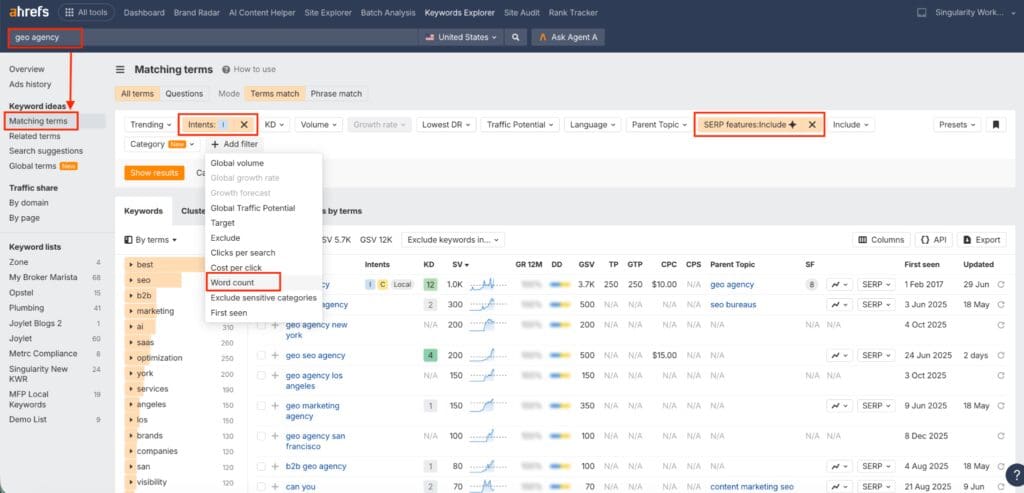
- Use Ahrefs Keyword Explorer to pull keywords and queries that are actually triggering AI Overviews, separate from whatever you’re currently targeting.
- Enter your main keyword, go to Matching Terms, set intent (informational, commercial, or transactional), and apply.
- Go to SERP Features, include AI Overview, then add a filter for word count, from 7, leaving “to” blank, and apply.
b. Check your rankings for AI overview triggering queries
Once you know which keywords trigger AIOs, check whether you’re ranking for them in traditional SERPs.
If you’re not ranking, or ranking weakly, fix that first because weak or non-existent rankings are a sign your SEO foundation isn’t solid yet, and GEO has nothing to build on without it.
If you are ranking, you’re clear to move on to the GEO strategies below. Just don’t assume ranking alone gets you into the Overview; that’s the exact trap we fell into ourselves.
How to check your rankings for AIO-triggering queries:
- Check Top 10 rankings for the AIO queries identified in step 4 – Run the searches directly in Google, or use Ahrefs Keyword Explorer’s “SERP” drop-down, and it will give you a quick snapshot of rankings and whether you’re present.
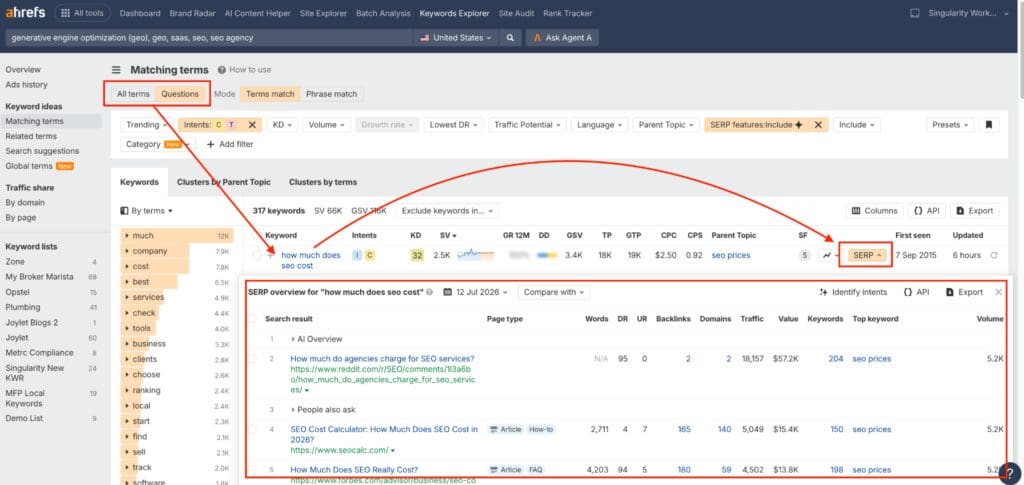
- If you’re not ranking, or ranking weakly (well outside the top 10): prioritize basic SEO fixes to improve first.
- If you’re ranking solidly but not mentioned in AIOs: move to the next step.
c. Extract the fan-out data for missing angles
Google’s Gemini (the LLM that feeds AI overviews) breaks every user query into multiple variations, searches each one separately, and combines what it finds into one answer. This process is called query fan-out. It explains why you can rank for a query in traditional search and still not get cited in the AI Overview. Your content might be answering the main query well, but missing the specific variations Google’s AI searches for to pull together relevant sources and build the answer. This step helps you extract that fan-out data so you can address all those missing (micro and macro) angles.
How to extract your fan-out data:
- Enter your target query into our fan-out tool, then copy the results to a master document for all the queries you are targeting for review.
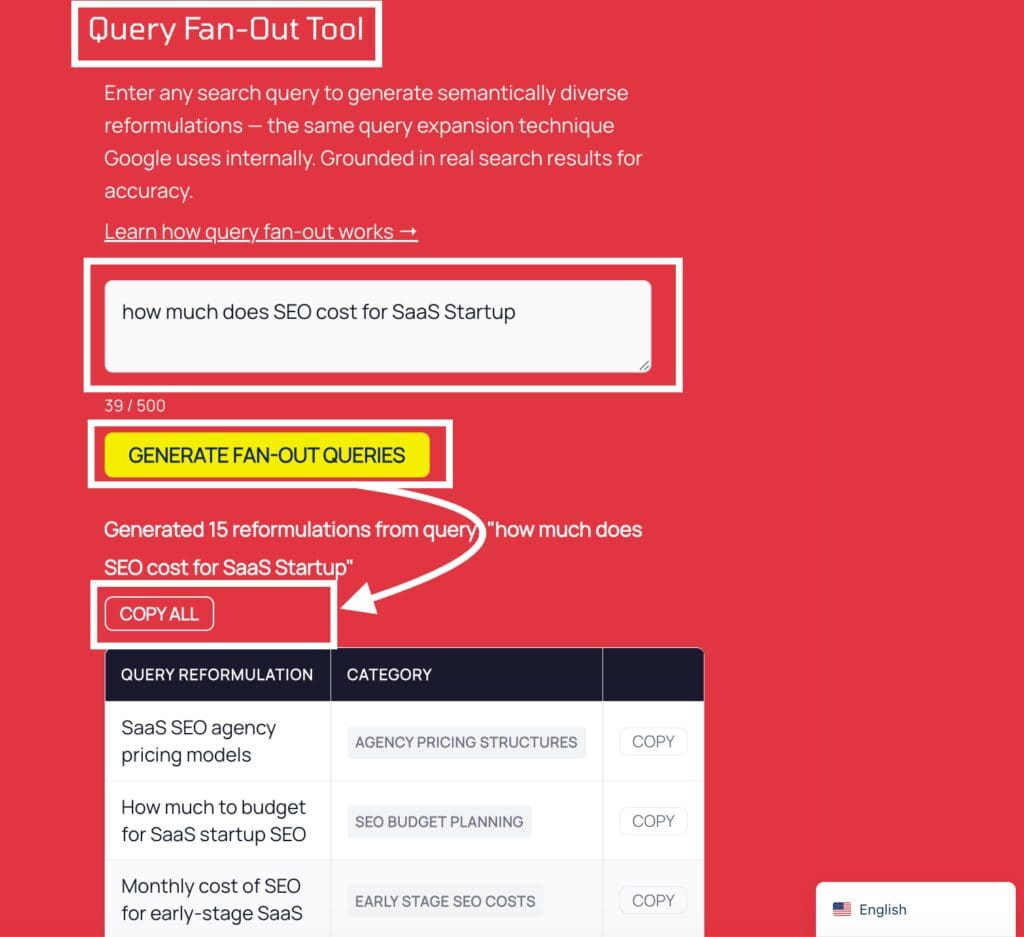
- Review the variations it surfaces, these are the angles Google’s AI is searching for, behind the scenes.
- Say you rank for “best expense management software,” the fan-out might surface narrower angles you haven’t addressed, “best for remote-first teams,” “best for early-stage startups,” “best for teams under 50 people.”
- Compare the angles these queries reveal against your existing content to find what’s missing.
d. Close the content gaps with new, specific information
Now that you have your list of missing angles, work through each one, turning it into either an addition to existing content or a new piece. Either way, write only enough to answer that specific angle well — avoid stretching a 500-word answer to 1,500 just to be thorough. Because Google only pulls a limited amount of source material from a page when building an AI Overview answer, and that limit plateaus around 540 words, regardless of how long the page is.
That means closing the content gaps comes down to adding real value with brevity, not just adding more content. Padding only dilutes the percentage of the page that’s actually useful, lowering your odds of being the source selected.
How to close the content gaps:
- Run your fan-out queries through the Domain Coverage Analyzer, which scans your site and classifies your coverage for each fan-out angle into five categories: No Coverage, Clear Gap, Related Gap, Aligned, and Perfect Coverage.
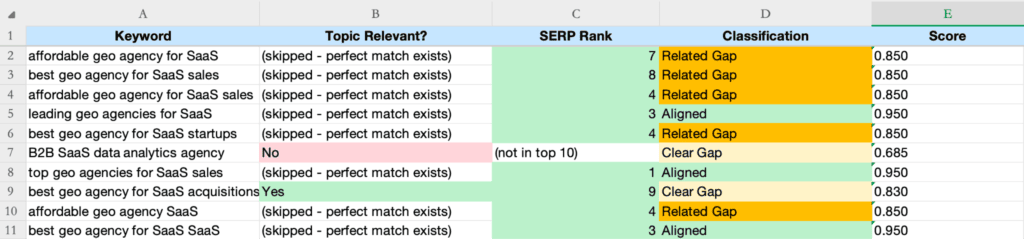
- For angles flagged as a Related Gap: go into the existing page and add a clearly scoped section addressing that exact angle.
- For angles flagged as Clear Gap or No Coverage: create new content, sized to what the gap actually needs, not to a target word count.
Check out our guide on writing content for LLMs for the specifics on structuring and phrasing at this level.
3. Make Your Presence Bigger Than Your Website
Original content and a real presence off your own site reinforce everything you’ve already built, giving Google’s AI more reasons, and more places, to recognize and cite you. Here are a few ways you can do that:
Create original content from your own data
Apart from the content you create to address SEO gaps, publish content built from your own data, experimentation, or firsthand experience. When something you’ve published becomes part of the conversation on a topic, you get cited because you’re the only source it could have come from.
Say you run a scheduling tool for agencies, and you publish a benchmark showing the average number of client revisions per project across your user base, broken down by agency size. Nobody else has that data. If someone later asks an AI system about typical revision counts in agency work, your piece is one of the only sources that could actually answer it, which makes it a natural citation.
How to create citable, original content:
- Turn your own product usage data (feature adoption, time-to-value, common workflows) into content: a “state of X” report, a benchmark (“average time to Y for teams like yours”), or a trends piece based on your user base.
- Survey your customer segment on something tied to how they use your product, not general industry sentiment.
- Instead of “how do you manage client projects,” ask “how many revision rounds does a typical client project go through before final approval,” – something specific to the exact friction your product addresses. Then publish the results with real numbers; that becomes a citable piece.
- Write founder or team POV pieces: what you tried, what surprised you, what you’d do differently.
- Create case studies built around specific numbers, “cut onboarding time from 12 days to 4,” not vague language like “significant improvement.”
Build brand mentions through digital PR
Once you have original, citable content, digital PR helps spread it to the places that can give you more credibility, mentions, and links.
Because traditional link building alone won’t give you the best chance of AI Overview citation. An analysis of 75,000 brands by Ahrefs found branded web mentions correlate with AI Overview visibility roughly three times more strongly than backlinks do. That tells us contextual mentions are a separate, important signal Google’s AI relies on.
How to build brand mentions with digital PR:
- Respond to journalist requests on platforms like Featured, matching your expertise to active queries from reporters looking for sources.
- Use Press Ranger to find and pitch journalists directly. It gives you a searchable database, AI-drafted pitches, and press release distribution.
- Pitch your founders or subject matter experts for interviews and quotes in industry publications that cover your space, offering industry trends and insights that give their readers something useful.
- Pitch the original research or survey data from the previous step to journalists as a story. Lead with the key findings and specific numbers, and offer a founder or team expert they can quote on what the results mean.
- If you don’t have the bandwidth, work with a PR agency or specialist who already has relationships with journalists in your industry and can get your founders quoted as experts.
Create YouTube content alongside your text content
Ahrefs found YouTube mentions correlate more strongly with AI Overview visibility than any other factor they tested. That’s not proof YouTube presence directly causes citations, but it’s a strong pattern, and it tracks with the fact that Alphabet owns both Google and YouTube in the first place. YouTube also shows up constantly across searches that trigger AI Overviews on its own, so pairing written content with video gives you another entry point into the same topic.
How to approach YouTube content creation:
- Turn brief, standalone insights from your existing text content into YouTube Shorts, quick, focused clips that answer one specific thing.
- Turn deeper pieces into long-form video: feature walkthroughs, tutorials for specific use cases, product demos, etc.
- Contribute to podcasts, webinars, or industry conversations that get uploaded to YouTube; this gets you video presence without having to produce it entirely yourself.
- Identify creators already ranking or getting cited for topics in your category, and look for ways to collaborate so your product naturally comes up as part of how they solve that problem.
Your AI Overview Visibility Has an Expiration Date
Google keeps updating its core search algorithm, and that feeds directly into your AI Overview visibility too. On top of that, it also ships updates specific to Gemini, the LLM powering AI Overviews. That affects what Google’s AI ends up surfacing for the same query from time to time. So the same way you’d check your rankings regularly for SEO, you now need to check your AI visibility regularly when doing GEO.
How to track your AI Overview visibility:
- Ask AI tools directly about your brand periodically, and check whether the description is accurate and consistent. This tells whether the entity work (from step 1) worked and is holding.
- Use Search Console’s Gen AI performance reports for AI-driven traffic (though it’s still missing click data).
- At scale, use a tool like Peec.ai to enter your target prompts and track how different LLMs describe you over time, which competitors show up alongside you, and which sources are influencing those answers. This gives a zoomed-out view that’s hard to get from manual checks alone, especially useful as you go deeper into GEO.
Final Thoughts on Ranking in AI Overviews
If there’s one thing we’ve learned with total certainty, it’s that a solid SEO foundation is non-negotiable for AI Overview visibility, but it’s not the only thing you need anymore. The generative engine optimization (GEO) strategies we shared above are what you need to apply on top of your existing SEO work.
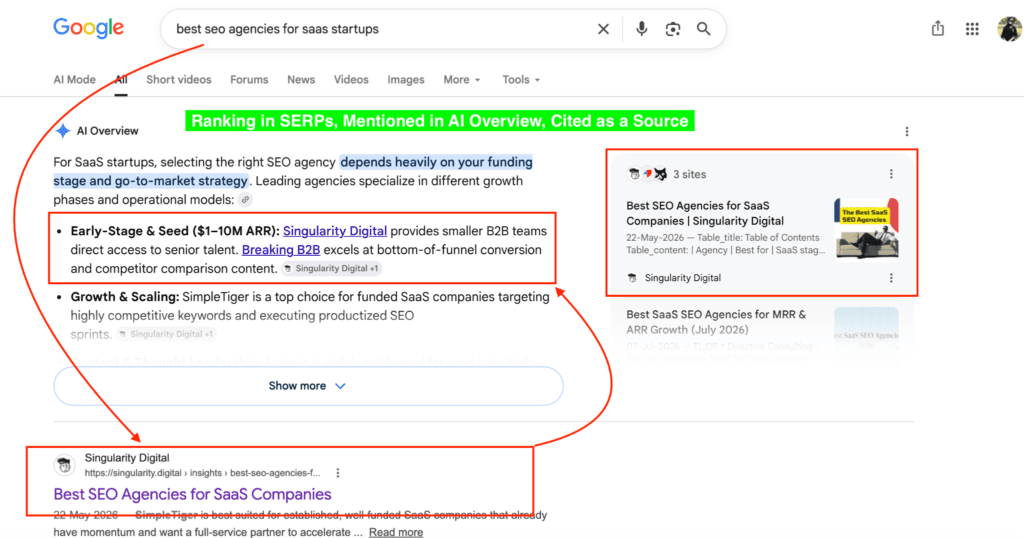
We worked through these steps ourselves, and they gave us a real lift on top of the SEO we already had in place. Take “best SEO agencies for SaaS startups,” a query we’d ranked for before but never showed up in the AI Overview on. Today, we rank in the SERP, get named directly in the AI Overview, and get cited as a source, all three, on the same query:
If you want help figuring out what this looks like for your own brand, we’re always happy to talk it through. Book a Call with us anytime!
GEO Checklist for How to Rank In AI Overviews: All You Need to Add to Your Existing SEO
Make Your Brand Legible to Google’s AI
☐ My brand messaging is consistent everywhere
- Audit all owned channels starting from your website for name variants, shifting category terms, and vague positioning
- Write your brand definition in one sentence, two sentences, and a paragraph
- Apply it across every channel you can edit
☐ My schema is in place
- Organization schema on your homepage with sameAs links to every owned/earned channel
- Article, FAQ, and Product/SoftwareApplication schema where relevant
- Implement in HTML, not JavaScript, and validate with Google’s Rich Results Test
☐ I know my ICP’s workflows, language, and buying path
- Capture real language from reviews, support tickets, and forums
- Pull patterns from closed-won deals: role, company size, industry
- Confirm what prospects compare you against before buying
Close the Gaps Between Your Content and What Google’s AI Wants
☐ I know which keywords in my space trigger AI Overviews
- Pull AIO-triggering keywords via Ahrefs, filtered by intent and 7+ word count
- Compare against what you’re currently targeting
☐ I’ve checked my rankings for those exact AIO-triggering queries
- Confirm top 10 rankings for those specific queries, not just your usual list
☐ I’ve extracted fan-out variations for my target queries
- Run target queries through our Fan-Out Query Extractor
- Identify which angles your existing content doesn’t cover
☐ I’ve closed content gaps with dense, specific content
- Run fan-out queries through Domain Coverage Analyzer
- Add scoped sections for related gaps, new content for clear gaps
- Size each piece to the gap, not to a word count
Make Your Presence Bigger Than Your Website
☐ I’ve published original content only I could have made
- Turn product usage data into a report or benchmark
- Survey your customer segment on something tied to their specific friction with the product
- Publish founder/team POV pieces and case studies with real figures
☐ I’m building brand mentions through digital PR
- Respond to journalist requests via Featured
- Pitch journalists and publishers via Press Ranger
- Pitch founders or experts for interviews and quotes in industry publications
- Pitch original research or survey data to journalists as a story
☐ I have a real presence on YouTube alongside my text content
- Turn key insights into Shorts, deeper pieces into walkthroughs and demos
- Contribute to podcasts or webinars that get uploaded to YouTube
- Identify creators in your category to collaborate with
Your AI Overview Visibility Has an Expiration Date
☐ I’m tracking AIO visibility on an ongoing basis
- Ask AI tools directly about your brand periodically
- Use Search Console’s Gen AI performance reports
- Use Peec.ai to track prompt-level visibility at scale