“Best of” articles aren’t throwaway listicles. When someone lands on yours, they’re usually evaluating software for a real business decision, comparing SaaS tools, weighing trade-offs, and trying to narrow the field to choose something that will scale, integrate, and justify its cost.
That makes these pages high-stakes, and in today’s AI-driven discovery environment, these articles are no longer read only on your site. Search engines, featured snippets, and large language models routinely extract “best of” software content and re-present it as summaries, comparisons, and recommendations inside SERPs, review modules, and AI answers.
When your software evaluation logic isn’t explicit within your article, those systems fill in the gaps. The result is often a flattened, generic summary that erases meaningful differences between tools, or worse, reframes your content in a way that misaligns buyers with your product, pricing, or ideal customer profile.
A strong SaaS-focused “best of” article prevents that. It makes criteria explicit, trade-offs visible, and judgment easy to interpret—for software buyers, search engines, and AI systems alike. Done well, these pages guide software purchasing decisions, qualify intent, and shape how your brand and recommendations appear across search and AI surfaces.
In this article, we’ll show how SaaS and software teams can write “best of” content with clear structure and defensible criteria, so it survives AI compression, earns buyer trust, and drives high-intent traffic toward real product decisions, not just clicks.
What a “Best Of” Article Actually Does
When someone searches for a “best of” list, they are in the process of making a decision. They’re trying to choose software that fits their team size, budget, workflow, and growth stage.
That’s why a strong “best of” article provides a decision framework for your buyers, not just a collection of options. By clearly stating criteria, trade-offs, and ideal use cases,it helps readers understand not only what software exists, but which option makes sense for their specific business context.
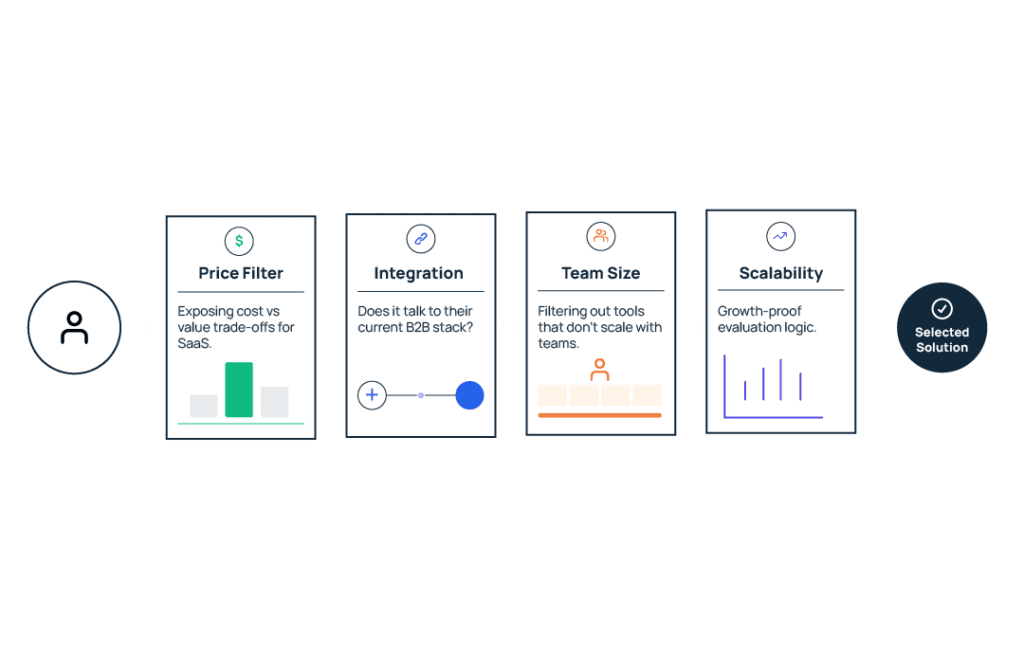
In 2026,AI systems increasingly sit between your SaaS content and the buyer, extracting conclusions and republishing them across SERPs, featured snippets, and AI summaries. When your evaluation logic is explicit, those systems can preserve your reasoning instead of flattening it into generic recommendations.
Why Best Of Articles Are Still Effective
There are three reasons “best of” articles remain one of the most effective formats for SaaS and software marketing teams.
First, they align with how software buyers actually make decisions. By clarifying what matters—pricing models, integrations, scalability limits, and trade-offs—a well-built “best of” article reduces uncertainty and shortens evaluation cycles for buyers who are actively comparing tools.
Second, they’re structured for modern discovery environments. Clear criteria, consistent formatting, and explicit judgment allow third-party AI systems to reuse your content without distorting intent, preserving nuance in snippets, summaries, and AI-generated comparisons.
Third, curated software lists signal expertise. When readers see their industry, team size, and operational constraints reflected in your evaluations, they recognize real understanding. That judgment carries forward into trials, demos, and sales conversations, often shaping expectations before a salesperson ever gets involved.
Best Of Article Structures: How to Win in Search and AI
High-performing “best of” articles follow clear structural rules. The sections below show how to design comparison content that’s easy to scan, hard to misinterpret, and reliable across search results, AI summaries, and real buyer decisions.
Define What “Best” Means
“Best” is never universal—it always relates to specific goals, constraints, or buyer profiles, so you need to start by defining what “best” actually means in context.
Are you prioritizing affordability, ease of use, feature depth, or scalability? Is your list tailored for early‑stage teams, enterprise buyers, or solo founders? Clearly establishing these parameters up front helps both humans and AI quickly understand who the list is optimized for and what kind of trade‑offs it accepts (e.g., fewer features for lower price, or deeper customization at higher cost).
Additionally, high‑performing “best of” articles briefly explain how the evaluation was done. While this doesn’t require an extensive methodology section, even a short description of your assessment approach—whether through hands‑on testing, documentation review, customer feedback analysis, or real‑world usage—raises credibility.
What this looks like in practice:
- State a clear target persona (e.g., “best for mid-sized marketing agencies,” “best for tech-savvy solopreneurs”)
- List 3–5 explicit criteria (e.g., pricing, integrations, AI capabilities, ease of use)
- Signal any constraints (e.g., “only tools with free trials,” “only platforms with native AI features”)
- Include a short “how we tested” block that mentions testing duration, sample size, or key benchmarks.
By doing this, you turn “best” from a vague marketing claim into a repeatable, auditable decision framework that holds up in search, AI summaries, and real buyer evaluations.
Intentionally Limit the List
A strong “best of” article reflects a real buyer decision, not the entire market, which means prioritizing clarity over coverage. For most use cases, that results in a focused list of 8–15 primary options, with secondary picks grouped separately.
To maintain that focus, you need clear exclusion rules. Define which categories, price ranges, company sizes, or product types fall outside your scope, then remove overlapping tools until each remaining option represents a meaningfully different choice a buyer might realistically make.
And when creating your list, always remember, your credibility stems not from creating either minimal or exhaustive lists, but from demonstrating thoughtful judgment about what merits inclusion, why it’s different, and how it fits the reader’s real-world constraints.
Use a Consistent, Extraction-Friendly Structure for Scannability, SEO, and AI Interpretation
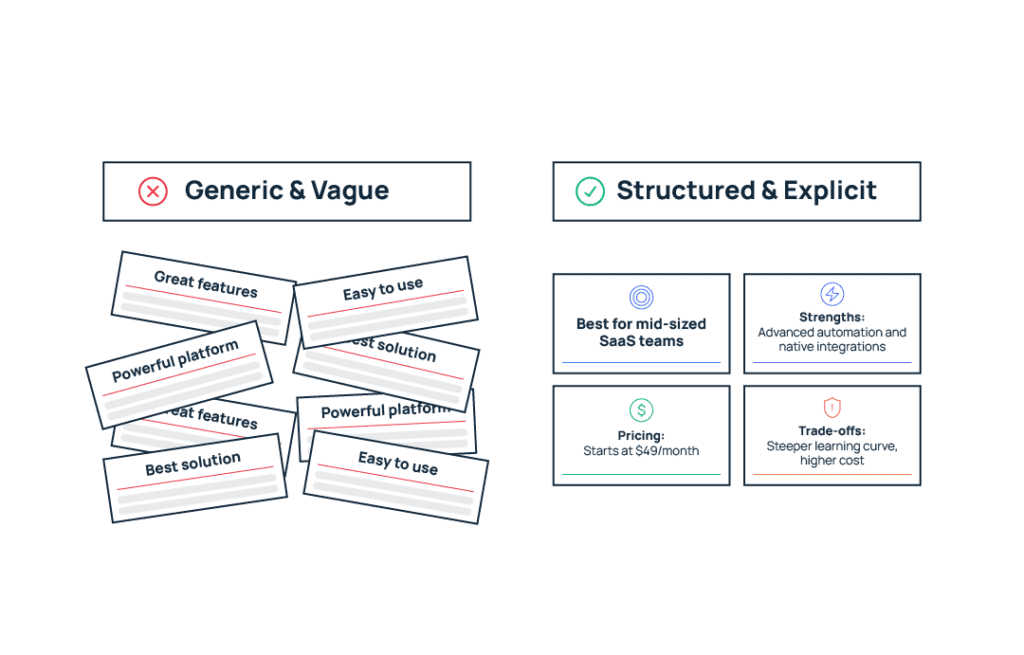
High-performing “best of” articles use the same structure for every item, creating a predictable pattern that guides both readers and algorithms. Consistent H2/H3 sections covering who the tool is for, key strengths, trade-offs, pricing, and use cases make comparisons intuitive and reduce ambiguity.
That consistency also allows each entry to stand on its own. When one of your recommendations is extracted into a snippet or AI summary, standardized data points (such as price band, deployment model, and core differentiator) ensure the choice still makes sense without surrounding context.
Each product block should begin with a clear positioning statement that answers two questions immediately: who this option is for and what it does best. From there, skimmable highlights—short paragraphs, bullets, and clearly signposted differentiators—make strengths and limitations easy to compare and extract.
Rather than ranking arbitrarily, structure each entry around fit. Simple signals like “Best for…” or “Not ideal for…” help readers and AI systems place each option correctly within the buyer’s decision set.
Add Decision-Support Elements (Without Turning It Into a Directory)
Decision-support elements should accelerate choices, not overwhelm readers.
Lightweight comparison tables that highlight 3–5 essential factors—such as pricing range, deployment model, core capabilities, and ideal team size—help readers quickly orient themselves without wading through long descriptions.
Internal links can guide deeper exploration without breaking focus. Guiding a reader to more information on how to solve their core problems with your category of product turns a single article into part of a larger decision-support system and builds trust in your expertise.
To ground abstract claims, use visuals and examples selectively. A single screenshot of the software, short annotated UI example, or demo clip that illustrates a key workflow helps readers—and AI systems—understand why a tool is differentiated, without bloating the page.
Short, concrete SaaS use-case examples serve a similar purpose. Brief scenarios showing how a specific team uses a tool make recommendations easier to internalize and easier for AI systems to extract as patterns.
Finally, reinforce decisions with simple rules. “When to choose this” and “when to look elsewhere” callouts, paired with occasional “Best for” or “Top Pick” labels, clarify fit and trade-offs without turning the article into a ranked directory.
Used together, these elements—comparison tables, targeted links, selective visuals, scenario-based examples, and clear decision rules—strengthen trust while keeping the article focused on its real job: helping buyers decide.
Design for AI, Search, and Rich Results
High-performing “best of” articles are optimized for SEO and GEO to be interpreted beyond the page itself. That starts with schema—using Article, Product, FAQ, and How-To markup to clearly signal to search engines and AI systems what each section represents.
This technical foundation works best when paired with explicit structure in the content itself. Clear, descriptive headings and visible evaluation criteria help readers scan while making your content eligible for featured snippets, People Also Ask results, and comparison modules that depend on clean intent signals.
Short, SaaS-specific FAQ blocks extend this clarity. When questions like “Is this CRM worth it for a 10-person SaaS team?” are answered directly and marked up with FAQ schema, AI systems can reuse your reasoning instead of replacing it with generic summaries.
The same principle applies to decision guidance. Step-by-step sections such as “How to choose the right CRM for a SaaS company,” when marked up with How-To schema, allow search engines and AI tools to surface your decision logic—not just your recommendations.
The goal is consistency across surfaces. By combining Article schema for credibility, Product schema for individual tools, and FAQ or How-To schema for decision points, you ensure third-party systems preserve your intent when extracting content. Done right, a single article becomes a multi-surface asset that performs in search, AI summaries, and rich results without losing its value for human readers.
Common “Best Of” Mistakes to Avoid
- Overloading the list with marginal options
Adding items that offer no meaningful difference in price, features, or use case replaces judgment with volume and signals uncertainty rather than expertise. - Using vague praise instead of specific reasoning
Generic claims (“great UX,” “powerful features”) fail to differentiate options and collapse into sameness when summarized or compared. - Writing for clicks instead of decisions
Content optimized for attention rather than evaluation becomes fragile when compressed into snippets, tables, or AI-generated recommendations.
Each of these mistakes erodes trust and increases the likelihood that both readers and AI systems misinterpret your conclusions.
Checklist: How to Write a “Best Of” Article That Works
- Is “best” clearly defined up front?
- Are inclusion and exclusion rules visible?
- Does the list reflect a real buyer decision?
- Are overlapping or marginal options removed?
- Is the structure consistent across every item?
- Is each recommendation anchored to a clear use case?
- Are tradeoffs made explicit, not implied?
- Can each item stand on its own if extracted?
- Would an AI or SERP summary preserve your reasoning?
- Does the article help someone decide, not just compare?
Bottom Line: “Best Of” Articles as Decision Infrastructure
“Best of” articles earn their value when they function as decision infrastructure for SaaS buyers—content assets that help teams determine whether a given software option truly fits their needs. When that logic is clear, buyers don’t just compare faster; they enter your funnel already aligned with what your product is built to do.
That clarity is also what makes these articles perform across search and AI discovery. Search engines and AI systems reward structured reasoning and defensible judgment, not hype. When your conclusions are explicit, third-party systems can compress and reuse your content without distorting intent—improving how your SaaS brand appears in summaries, snippets, and recommendations.
The quiet advantage is leverage. Well-built “best of” software content qualifies buyers, frames expectations, and shapes decisions before a sales conversation ever begins. For SaaS teams that treat these articles as strategic infrastructure—designed for buyers, algorithms, and real purchasing decisions—they remain one of the highest-ROI formats for SEO, AI visibility, and long-term buyer trust.
If you want your “best of” content to drive real decisions—not just traffic—we can help. Talk to us about building content that’s structured for search, AI discovery, and the way SaaS buyers actually choose.