If you’re preparing to interview buyers, you probably already know that your current understanding of them is not detailed enough. Maybe you know the broad problem they have, but not what makes them act, how they solve it today, what they compare you against, or what they actually want from a better solution.
Talking to customers does not automatically fill those gaps. An interview can just as easily reinforce what your company already believes, turn into a sales discovery call, or stay at the level of general descriptions that tell you very little about how a real decision happened.
This guide shows you how to:
- Choose the right people to interview,
- Structure the conversation,
- Ask and probe without leading,
- Capture the buyer’s language and context, and
- Compare what you hear across interviews.
By the end, you’ll have organized qualitative evidence you can use to build a stronger buyer persona.
Use your ICP to define what you need to learn
Don’t jump into scheduling interviews with anyone willing to talk to you. Your ICP defines the type of company you want to sell to, so use it to narrow your outreach to people within those companies and the buying roles relevant to the decision.
From that pool, choose the uncertainty you most need the interviews to resolve. For example:
- What makes the problem urgent enough to act on?
- How does the buyer solve it today, and where does that approach fall short?
- What do they need a better solution to do differently?
Whatever questions you choose to investigate, don’t assume you already know the answers. If you go in trying to confirm that buyers have the exact problem you think they have, care about the feature you want to promote, or prefer the solution you have already built, you are collecting validation rather than doing research. A useful interview has to leave room for the buyer to prove your assumptions wrong.
Tip: If you don’t have an ICP, start with our ICP guide before moving into buyer research.
Who should you interview to build your buyer personas?
Now that you know what you need to investigate, you need to find the people who can actually answer those questions. Consider three things when building your interview list:
1. People who give you a breadth of perspectives. As HubSpot recommends, don’t limit your research to happy customers. Depending on what you need to learn, useful interviewees might include:
- Current customers,
- Churned customers,
- Closed-lost opportunities, and
- ICP-fit prospects who considered the category but did not buy from you.
2. People involved in different parts of the buying process. In B2B, the person who uses the software may not be the person who champions, evaluates, or approves its purchase. Use Forrester’s B2B Buyer Persona Interview Guide as a starting point for identifying relevant purchasing roles and gathering comparable information from them.
3. Enough comparable interviewees. One conversation can give you useful evidence, but it cannot represent an entire buying role or persona. Build enough overlap into your interview list that you can compare what similar buyers say rather than treating one person’s experience as a pattern.
To find that mix, you may need to pull from your customer and opportunity records, ask Sales or Customer Success for relevant contacts, and recruit ICP-fit prospects through your network, LinkedIn, or industry communities.
No customers yet? Interview ICP-fit prospects
You do not need to wait until you have customers to conduct useful interviews. Patrick Herbert, CEO of Singularity Digital, notes that early-stage SaaS founders can recruit ICP-fit people through their existing network or LinkedIn and ask about their real experience with the problem.
ICP-fit prospects are valuable interviewees because they can tell you how they experience the problem, what they do today, what alternatives they consider, and how they make buying decisions. When you reach out, make the purpose clear: you want to understand their buying process, not pitch your product or turn the conversation into a sales call.
The limitation is that, without customers or with too few customers to compare, you have less evidence from people who actually chose your product. If you feel you need to do most of your persona interviewing from ICP-fit prospects instead of customers, we recommend you supplement these interviews with broader persona research.
Build an interview template that lets you follow the buyer’s lead
Once you have your list of candidates, it’s time to prepare your interviews. Create a semi-structured template to cover the same core areas across conversations without forcing every buyer through a rigid script.
Decide in advance what you need to learn, but leave room to follow an answer when it reveals something important.
Qualtrics’ guide to qualitative research interviews recommends open-ended questions and follow-up probing when you need depth rather than predetermined responses. For a buyer persona interview, your core areas might include:
- Problem context
- Trigger for taking action
- Current approach
- Search and evaluation process
- Alternatives considered
- Decision criteria and constraints
- People involved
- Preferred solution
- Definition of success
Adobe’s buyer persona guidance also points to customer interviews to investigate areas such as:
- Role
- KPIs,
- Pain points,
- Product use, and
- What customers consider when choosing a solution.
And keep the interview separate from sales discovery. Your goal in this conversation is not to qualify the person, handle their objections, explain why they misunderstood your product, or persuade them to buy. It is to understand what happened and, more importantly, why: what triggered the decision, why certain criteria mattered, and why the buyer preferred one approach or solution over another.
Structure the interview around understanding buyer decisions, not building a persona
Do not interview someone as though you are trying to fill boxes in a persona template. Instead, reconstruct a real decision or problem-solving experience. A useful sequence is:
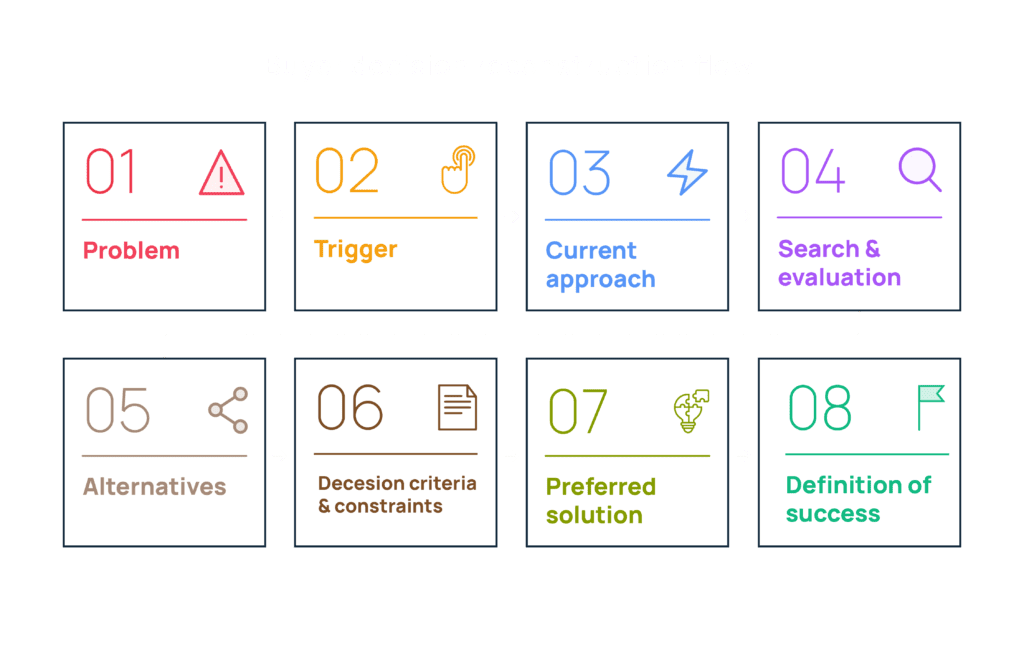
The buying-decision sequence your interview should reconstruct, from the original problem to the buyer’s definition of success.
That sequence helps you distinguish between two questions that companies often collapse into one:
Does this buyer have the problem?
and
How does this buyer actually want the problem solved?
Those are not the same thing. Singularity saw this with Distru, a SaaS company whose team initially believed inventory tracking was the main problem its product solved. But conversations from Sales and prospects kept surfacing another issue: regulatory reporting was more painful, urgent, and valuable to solve.
That discovery changed the marketing focus, including the paid-search strategy and state-specific landing pages around that reporting need.
“One of the most common assumptions is that buyers have the same problem you have and would want the same solution. But everyone solves things differently and wants different things. People don’t dig enough into that. They just want to validate that the problem exists, instead of asking how buyers currently solve it or what solution they would actually prefer,” concludes Patrick Herbert, CEO of Singularity Digital.
The case also highlights another issue Herbert raised: Sales or Customer Success may identify recurring buyer signals before Marketing does. Without a process to capture, compare, and revalidate them, those insights can remain anecdotal or siloed. Buyer interviews give Marketing a deliberate way to investigate them instead of waiting to discover them by accident.
If you want help turning buyer research into clearer positioning, messaging, and marketing decisions, contact Singularity Digital to discuss your SaaS marketing strategy.
Your interview technique: Ask open questions, then probe for detail
To uncover the details behind a buyer’s decisions without forcing their answers into predefined persona attributes, use open-ended questions. Start with the core areas in your interview template, let the buyer describe what happened, and probe where more detail is needed. Questions you can use include:
- What problem first made you start looking for a solution?
- Why did that problem become important when it did?
- How were you handling it before you started looking?
- What was working or not working about that approach?
- What alternatives did you consider?
- What mattered most when you evaluated the options?
- What nearly stopped you from moving forward?
- Who else was involved in the decision, and what mattered to them?
- What were you hoping the solution would change?
- At that point, what did success look like to you?
Treat these as a guide, not a checklist you have to work through in order. If the buyer gives you a useful but vague answer, stay with it. For example:
Buyer says: “Reporting was becoming a nightmare.”
You could immediately move to your next prepared question or you could learn what “nightmare” actually means. Try:
- What makes you say that?
- What do you mean by that?
- Can you give me an example?
- What happened next?
- Why did that matter?
The follow-up is often where the useful detail appears. Maybe “reporting was a nightmare” means the buyer spent six hours every Friday combining spreadsheets. Maybe their manager had started questioning the accuracy of the numbers. Maybe new regulation meant a process they tolerated for years suddenly became untenable. Those are three very different contexts behind the same initial statement.
Also listen for answers that challenge the direction you expected the conversation to take. If you thought cost was the trigger and the buyer keeps talking about compliance risk, don’t keep pulling them back to cost because that is the field you wanted to populate. Follow the evidence.
A light example of what not to do:
An exaggerated example of how quickly an interview can go off track when the questions themselves become the problem. It is obviously not a buyer interview, but the lesson carries over: keep questions clear, listen to the answer, and let the conversation help you decide where to probe next.
Capture the buyer’s language and evidence as you go
What the buyer tells you matters; so does how they say it. If someone repeatedly describes a process as “held together with spreadsheets,” “a black box,” or “something I have to chase people for every month,” replacing that language in your notes with inefficient workflow strips away context.
Record the interview with permission when practical, or take detailed notes so you do not have to rely on memory afterward.
Once you have a transcript or detailed notes, pay attention to both the buyer’s words and the context around them. A buyer may soften criticism, hesitate before explaining an objection, or describe the problem differently from the terminology your company uses internally. Those signals can change how you interpret the answer. Before you draw conclusions, keep two things separate in your notes:
Evidence = what the buyer actually said or described.
Interpretation = what you think that evidence means.
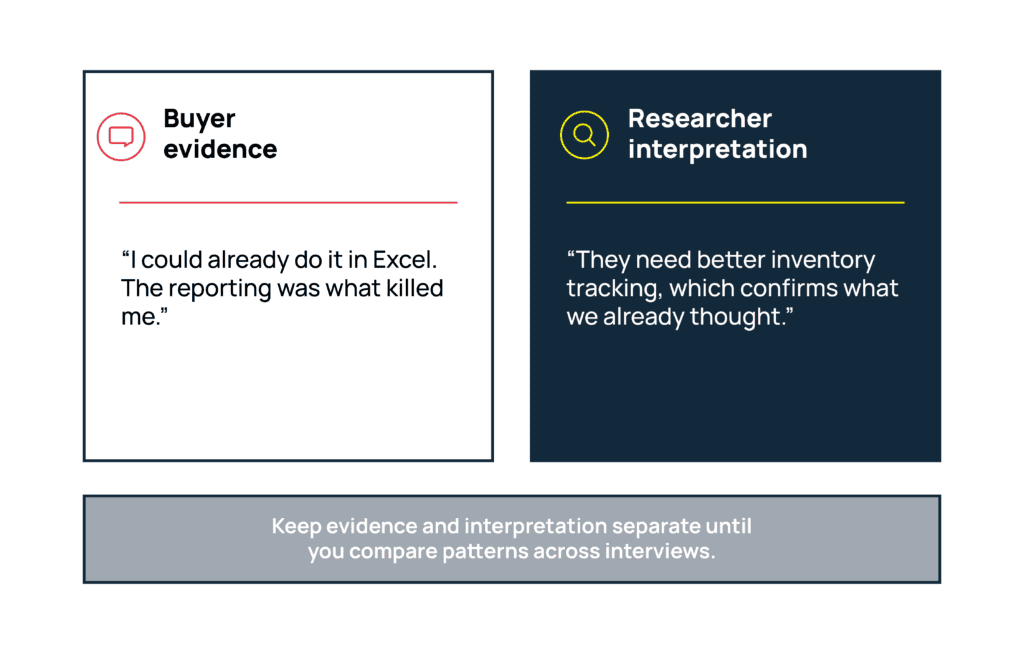
An example of how a researcher’s assumptions can distort what the buyer actually said.
That distinction becomes important when you compare conversations later. Otherwise, your own interpretation can quietly turn into “what customers said.”
You can collect this evidence wherever your team already works: a shared document in Notion or Drive, a spreadsheet, or even a Miro board. What matters is keeping it in one place and capturing the same broad categories for every conversation:
- Buying role
- Problem and trigger
- Current approach
- Alternatives considered
- Decision criteria
- Constraints or objections
- People involved
- Desired solution
- Useful buyer language
- Unresolved questions
At this stage, you are building an evidence bank your team can compare, not a polished persona.
Compare conversations to organize your evidence
One interview gives you context. It does not give you a persona. Once you have documented several conversations, compare them side by side, and look for:
- Motivations that recur
- Similar triggers
- Repeated decision conditions
- Common alternatives
- Language several buyers use independently
- Differences between buying roles
- Contradictions worth investigating
- Desired outcomes that keep appearing
Do not average differences away too early. If users consistently care about ease of use while budget owners repeatedly focus on implementation risk, that conflict may be meaningful. If buyers from one segment describe the problem completely differently from buyers in another, you may be looking at distinct contexts rather than noise.
And resist the memorable-quote problem. One striking answer is evidence worth investigating. It is not automatically a persona characteristic.
How many persona interviews should you conduct?
The comparison phase is where you are most likely to wonder if you’ve collected enough data and done enough interviewing.
There is no useful universal number. Qualtrics’ guidance on data saturation in qualitative research describes saturation as the point where additional data is largely reinforcing themes you have already identified rather than continuing to produce meaningful new information.
Applied here, that guidance means keep interviewing while relevant themes, contexts, or differences are still emerging. Once later conversations mostly repeat patterns across the buyer roles and situations you need to understand, you may be approaching enough evidence for this stage.
At this point, summarize the recurring patterns, meaningful differences, buyer language, and unresolved questions in the same document or spreadsheet you used to capture the interviews.
Then stop. The next step is not to squeeze more conclusions out of each individual conversation. It is to take that organized evidence and use it to build the persona.
Turn buyer evidence into a persona you can actually use
A useful buyer persona interview does more than confirm that a market has a problem. It shows you how buyers experience that problem, when it becomes important enough to act on, how they handle it today, what they expect from a better solution, and how they describe the whole situation in their own words.
Use that evidence to sharpen your positioning, bring the buyer’s own language into your messaging, and give Marketing and Sales a clearer understanding of what drives a purchase or hesitation.
Once you have organized that evidence, turn it into a buyer persona your team can actually use with our guide to How to Build a Persona. Then use How to Simulate Buyer Personas With AI to pressure-test how that persona responds to your marketing before you put it to work.